

TPFF: July 2021 Official Selections
Our jury has put forward the following films as Official Selections, Finalists & Semi-Finalists for this month’s edition of The People’s Film Festival which culminates at our annual gala - March 2022!
Our jury has put forward the following films as Official Selections, Finalists & Semi-Finalists for last month’s submission to The People’s Film Festival which culminates at our annual gala - March 2022!

PORTRAIT
directed by Keir Siewert
'Based on real accounts, a model takes matters into her own hands
to expose a serial predator in the photography world.'
Rhetta, an industrious model, sets up a shoot with a predatory photographer, notorious for his coercion tactics and aggressive actions. However, little does he realise that Rhetta has orchestrated this meeting as a sting to expose his inappropriate behaviour on an online video live stream.
Winner of the Genera grant, Portrait is a tense drama built on research from interviews with 21 models about their experiences overcoming the abuse of power in the photography world.
PORTRAIT is an Official Selection in the Micro-Budget Category.

LIFE SKILLS
directed by Gino Evans
Life Skills tells the story of Nathan, a former soldier who is struggling with life after serving in the armed forces. When Nathan’s world is collapsing and he is at his lowest point, he seeks respite by taking a unique path to try to overcome his problems.
LIFE SKILLS is an Official Selection in the Low Budget Category.

THANK YOU SO MUCH
directed by Tomasz Frymorgen
During the UK's Thursday evening clap for healthcare workers, an over-virtuous neighbour is challenged by the nurse next door. His only way to avoid public humiliation is to crush the heretic before him.
This short satirical film searches for the line between encouraging virtue and enforcing submission in pandemic Britain. It’s about class divides, witch hunts and the darkness beneath our most righteous performances.
THANK YOU SO MUCH is an Official Selection in the Sponsored Category.
finalists
Micro-Budget Category
SLIGHTLY RED HANDED directed by James Hastings
THE SOCIAL DOCTOR directed by Matteo Valentini

Low-Budget Category
SHALLOW directed by Paul Ashton
YOSHI FUNABASHI directed by Mattia Ramberti

Sponsored Category
COME FIND ME directed by Nela Wagman
DEAD MAN WALKING directed by Ryan Marcus

semi-finalists
BEAST OF BURDEN directed by Christopher Deakin
COVID TALES directed by Ryan Ackland
MILK directed by Celia Jaspers
PASSING BY directed by Pheline Hanke, Duc Quang Le, Lisa Jane Albrecht, & Johanna Geimer
SUCTION directed by Rachel Tillotson
THE SUBTERRANE directed by Seán Staab
THERE IS A SCRATCH ON THE INSIDE OF MY RIGHT KNEE directed by William Cho
TINA AND PETER directed by Dan Hodgson
2:15 directed by Matteo Valentini
WHAT SETS THE PEOPLE’S FILM FESTIVAL APART?
✔️ Win £1,000 in funding for your next short film
✔️ Free feedback w/ every submission
✔️ Categories based on budget vs genre


The Extinct
A self-deprecatory portrait of an endangered pickpocket and his financial struggles resulting frоm the third UK quarantine.
Written and Directed by Yury Vorobev
Politicians, big actors, high-rank footballers and other significant figures keep insisting to give voice to the voiceless. It is finally happening. Whoo-hoo! A self-deprecatory portrait of an endangered pickpocket and his financial struggles resulting frоm the third UK quarantine.
READ OUR INTERVIEW WITH Yury
Tell us a bit about yourself and your filmmaking background.
Born in St. Petersburg. Brewed in Moscow. Matured in London. Radiohead. Earlybird. Storyteller. Loving son. I should probably stop here to make "tell us a bit about yourself" more intriguing. Trust me you don't really want to know much more about my "intergalactic" filming adventure. Especially taking into account how many Ted Talks to catch up with are out there. So please be sensible with your time.
I started off my way to filmmaking by developing intros for various broadcast programmes at Channel 5 Russia. It was fun mostly because after hours we used to play a lot of Call Duty. Ah, these were the times!
As a firm believer in storytelling I made my way to the adland hoping to create more idea focused content. But the more I worked on TV commercials and branded films the more I craved them to be less adverts but more like films. Honestly, it wasn't going anywhere. I struggled. People who worked with me did too. But controversial enough, I'm very much glad that I did. Because that was a wake up call for me. I suddenly realised that filmmaking is the thing I mostly enjoy doing, no matter what. From writing stories to working with actors, location scouting, going the extra mile one the set and so on and so forth. I just love every bit of it. Even when everything goes nuts I love it.
Since 2012 I have settled in London. I studied filmmaking in Raindance School while constantly upgrading my script writing skills at different online courses. In 2020 I wrote and shot a debut short film "Stalin Unlimited".
How did lockdown affect your creativity and inspiration to make art?
Which one, the 1st, 2nd or 3rd?
The first lockdown was a perfect spark to look at things we all used to from a completely different perspective. As it turns out we take so many things for granted and all of sudden they just feel so unique. Everything ignited from the fact that my beloved take away cup of coffee was taken away from me and as a result had become the most carved thing over the pandemic. I have never thought that I'd be dreaming about such a basic thing. But I did. Mostly in the mornings. And then I got bored dreaming about the coffee. That was my starting point. Boom!
From coffee to tofey. I mean trophy.
What obstacles did you overcome while in the making of this film?
Turning my living room into some sort of shooting studio was an overambitious idea to say the least. A massive challenge as well. I had to live in that mess for over a month convincing my wife that it was worth doing it. Not to mention that I have an OCD to keep everything nice and tidy at home. It was tough. But on the plus side, my wife has not divorced me. Yet. And I have not gone into a mental institution. Yet.
Any hacks or tips for making a short film?
I'd say just better to make a bad one rather than not to make it at all. Filmmaking is such a never ending learning curve. Obviously making mistakes is a big part of it. So you'd better make them as much as you can in the beginning. Sounds a bit like I encourage people to make shitty films though. Weirdly enough it makes sense though.
Tell us about the journey of getting your film to audiences.
It wasn't too easy to be honest. I had to do loads of parts by myself. I was a writer/director, set designer, editor/colourist and even had to do some clean up myself. Almost a one man band. A big lesson for me is that I will never ever do everything myself again. If you want to come in one piece afterwards it's highly not recommended. Just focus on your part and let the others do the rest.
What are you working on now?
I'm writing a new short which I'm planning to film in August.
Any film recommendations that we should add to our watchlist?
I recently opened to myself the films of Christian Petzold. 'Barbara' in particular has quite resonated with me. It's a beautiful drama film that reflects on choices, dilemmas and sacrifice.
Follow Yury on Instagram
Interested in getting your work selected as Short of the Week?

British Graffiti
An art history graduate couldn't get a job after graduating and now works in a supermarket. Years of being terrorised by his boss make him reach his boiling point.
Written, directed, and produced by Mark van Heusden.
An art history graduate couldn't get a job after graduating and now works in a supermarket. Years of being terrorised by his boss make him reach his boiling point.
READ OUR INTERVIEW WITH MARK
Tell us a bit about yourself and your filmmaking background.
I grew up in The Netherlands and made no budget short films with friends while doing my undergrad. I soon realised that I didn't really have any technical knowledge and started interning as an editor and camera assistant on corporate videos to become a more skilled filmmaker. I then moved to the UK and wanted to make a new film and I was able to do that by doing an MA in filmmaking. British Graffiti is my first film after having interned for 6 months and it helped me a lot in terms of planning and knowing how much time it costs to do certain camera set ups. I since made another short film David French Is A Piece of Shit and I Want Him Dead and a couple of music videos and mainly work as an editor to pay the bills.
What's your inspiration behind British Graffiti?
When I was doing my MA, lots of other students in my year had this fear of what would happen after graduating. Would we able to find work in the film industry?
I found that very nervewrecking too, and so decided to make this the central theme of my movie. What if you can't find your dream job and are forced to work somewhere you don't want to work? In this particular case I set the film in a supermarket because I worked in a supermarket for eight years whilst I was in school. I enjoyed the mundane task of restocking shelfs as I could kind of switch off, but it wasn't always a fun place to work because I encountered quite a few miserable people there. This film was a great way of getting both of these frustrations out of my system!
What obstacles did you overcome while in the making of this film?
Filming in a supermarket was very tough. An amazing opportunity, but we shot overnight between 22:00 PM until 04:00 AM for a week whilst they were restocking shelves. The first obstacle was exhaustion, because we had been up during the day to go through the shotlist and rehearse the scenes and then we needed to shoot through the night. So we were extremely tired every day. Secondly we had to be on our feet constantly because even though there were no customers, there were still employees stocking the shelves. We had to make sure not to be in their way and had to move around a lot to ensure we could get our scenes done and not have them in shot or ruin the sound.
Any hacks or tips for making a short film?
Be as prepared as you can! Things will not go exactly as you planned, so the best thing you can do is plan everything meticulously with everyone involved. This way not only you know what you want, but also your cast and crew have an idea of where you're heading. If obstacles arrive, you have a goal in mind and you can work around them. I hate it when people say "we'll cross that bridge when we get there" because in filmmaking, that bridge is usually on fire so you'll have to be prepared.
Also, take care of your crew. In order to make your film everyone needs to be at their best, and in order to do that it's best to keep them happy and comfortable! Check if everyone is ok and the best trick to a happy and motivated crew is good catering! (No pizza or kebab but nutritious meals!)
Tell us about the journey of getting your film to audiences.
This one is tough because I had a little trouble with this film. I produced it myself and shot in a supermarket showing all their branding and uniforms and they weren't too happy with that. My own fault, so I had to learn DaVinci and change the colour of the uniforms and a VFX artist removed the branding. So getting it to audiences happened a little later than I wanted, but it did have a small festival run. Since then it's been on Vimeo as to be very honest, I find it difficult to promote my work! I'm very comfortable on set and in the cutting room, but once a film is done I find it tricky to reach an audience.
What are you working on now?
I have written two short films that I would like to make. A Part of Me is the prologue/proof of concept for a feature, but since it would be quite ambitious and expensive I might make a cheaper short set in one location titled Love Is a Drug and I Overdosed. My films have always been quite large in scale and very (maybe too) ambitious so I quite look forward to doing a small movie before I gear up for something bigger again.
Any film recommendations that we should add to our watchlist?
So many! Not many people in the UK are familiar with Dutch cinema so I'd like to recommend a few. Soldier of Orange (1977) is a classic by Paul Verhoeven who would later make it big in Hollywood. Character (1997) won the Oscar for best Foreign Language Film and is very good. And a personal favourite is Aanmodderfakker (2014) which is a comedy that reminds me a lot of Edgar Wright's films. One of my all time favourite's is an underrated gem: Delicatessen (1992) by Jean-Pierre Jeunet who did Amelie. And recently these films have blown me away: Höstsonaten (1978), To Be or Not To Be (1942), After The Wedding (2006), Fail Safe (1964).
FOLLOW MARK ON INSTAGRAM
Interested in getting your work selected as Short of the Week?

Rambling
Don your boots to ramble a rural expanse that's rich with doggers, mentally scarred artists, and You Are Here signs that are out to get you.

Created and written by WILL NOBLE and JOE REANEY
The Great British Countryside™ covers an area equivalent to a trillion football pitches. Probably. We don our boots to ramble a rural expanse that's rich with doggers, mentally scarred artists, and You Are Here signs that are out to get you.
READ OUR INTERVIEW WITH WILL NOBLE
Tell us a bit about yourself and your filmmaking background.
Myself and Joe met on a scriptwriting course at Bournemouth Uni and bonded over a love of Alan Partridge, Curb and Look Around You. Joe's previously made a couple of award-winning short films. Our first foray into animation was with BenPics - with a short called 'Spaghetti' - a cautionary tale about cooking too much pasta. The script itself was actually a sketch written for our comedy group, Birds.
So Rambling is part of a web series called The Green and Pleasant Guide. Can you tell us about your inspiration being this web series and in particular for the Rambling episode?
The Green and Pleasant Guide is basically an homage to/send up of those shows you get on the BBC on a Sunday afternoon, where people are banging on about how great the countryside is. We wanted to put a surreal/dark spin on that, through the lens of Londoners who know nothing about the countryside. So for instance, the Rambling episode features a 'You Are Here' sign that chases a poor rambler around until he winds up running into the thresher of a combine harvester. The presenter is that perma-smile type, who could keep grinning through a bit to camera in an abattoir.
What is your process for creating animation and any hacks or tips you can share?
Find an animator whose style you really love. In our case it was Ben. Plus, the voice talent (Celeste Dring, Luke Rollason, Amy Gledhill) were all people we'd admired from afar, and were fortunate enough to get on board.
Our process is: Joe and I write the scripts, then send them to Ben, who often chips in with one or two suggestions for visual gags. We'll change the script accordingly, before recording the voiceovers. At this point, Ben will make the final animations to fit the voices and everything else that's going on in the script.
How have to tried to get attention to your when releasing it direct online?
We've essentially set up a YouTube channel and a Twitter account, and put some bad jokes on the latter to try and get people to visit the former.
Any film recommendations that we should add to our watchlist?
I mean, the best films about the countryside are probably Nuts in May, Sightseers and Withnail and I. In each one, things go horrifically awry - just like in the Green and Pleasant Guide.
Subscribe to The Green & Pleasant Guide on YouTube
Interested in getting your work selected as Short of the Week?

Teeth
A year after covid ravaged New York city, Ikeem "Teeth" Jones reflects on his legacy as the best subway dancer.

A film by Alex Fischman Cárdenas & Gabriel Crawford Connelly
A year after covid ravaged New York city, Ikeem "Teeth" Jones reflects on his legacy as the best subway dancer.
READ OUR INTERVIEW WITH THE FILMMAKER
Tell us a bit about yourself and your filmmaking background.
I began making movies when I was 12. All my friends got really into skating and since I was frightened by the prospect of falling, I filmed. These movies were shot and edited on a 2007 Sony Erickson phone and they were incredibly bad! Regardless, I received so much encouragement that I continued my hobby of making movies. I upgraded to a camcorder and began working with semi-professional actors, and then, with a crew. Eventually, I made what I'd consider to be my first short film, La Vieja Quinta at 17. Since then, I moved to the US to study film and continued making work like Alienación. When the pandemic struck, it shut down my thesis film, and with nothing to film in NYC I was incredibly bored.
How did you find your subject for Teeth?
This is where my friend and DP Gabriel Connelly comes in! We had worked on Alienación together, and he said "oh we should do something about a subway dancer"... That thought sent me spinning across the internet in search for NYC's best subway dancer, and so, I found Ikeem. Ikeem, AKA TEETH, was kind enough to meet me. Our first interview was in July of 2020, and I spent almost a year going back and digging deeper through his story. We became close and even played call of duty together.
Any hacks or tips for making a short documentary?
When making a documentary or narrative film I think you have to become really close to your cast and crew. Gaining and maintaining their confidence is key. I really pride myself in trying to create a fun and enjoyable experience on set. I think the only hack I could give is YouTube! I learned so much by following filmmaking accounts and basically taught myself most of the stuff I would re-learn in college.
Congrats on “Teeth” getting selected for a Vimeo Staff Pick! Any tips for filmmakers on how they can up their chances in following in your footsteps?
We were so honored to receive a Vimeo Staff Pick for Teeth recently. The little badge is a huge honor and it helped in spreading the film to more eyeballs.
This is my first time getting a staff pick, so I can only really speak of what I think worked this time. I think its first about creating work that feels fresh and then sending it out to blogs. Pages like Kino, Short of the Week, Booooooooom, Film Shortage, Directors Library, etc.. I want to believe Vimeo curators roam those pages and having your work there makes it easier for them to find it.
Any film recommendations that we should add to our watchlist?
Shorts: I want to give a plug to Ewurakua Dawson-Amoah's to the girl that looks like me also shot by my friend Gabriel Connelly.
Features: I recently saw the Russian film Beanpole and its beautiful depiction of death and suffering was a mind-boggling trip.
Follow Director Alex Fischman
Follow Cinematographer/Editor Gabriel Connelly
Follow Producer Adrian Sobrado
Follow Composer Gavin Brivik
Interested in getting your work selected as Short of the Week?

Perfectly Flawed
Set underneath a bridge, on the outskirts of Amsterdam during the hot summer of the pandemic, Jak O’Hare’s short film captures the genuine conversation between two strangers about life, uncertainty, dreams, vulnerability, and also trust and faith.

Directed by Jak O’Hare
The intimacy of strangers.
Set underneath a bridge, on the outskirts of Amsterdam during the hot summer of the pandemic, Jak O’Hare’s short film captures the genuine conversation between two strangers about life, uncertainty, dreams, vulnerability, and also trust and faith.
The film fills the gap, somewhere between fiction and documentary.
READ OUR INTERVIEW WITH THE FILMMAKER
Tell us a bit about yourself and your filmmaking background.
I started shooting music video’s in the early 2000’s, mainly for the rising Grime scene in London. We were carving out what now is so polished. It was a great time to work with artists like Skepta, Tinchy Stryder and Ghetts. I then moved into branded content and commercial work, where I got to travel and work with such a variety of talent and crew. This film is very much the beginning of a new chapter in my journey of filmmaking.
What was your inspiration behind Perfectly Flawed?
I suppose it was life. Moving to Europe, which feels far more romantic than the UK at times. Then the pandemic hit and I couldn’t help but think, what about the generation starting out on their path. How do they feel, what do they want? I wonder if were loosing a generation, a detached sense of community. The world is defiantly more confusing to navigate now, with globalisation and the information overload. So I wanted to focus on an emotion that has and will never change - Love.
Any hacks or tips for making a short film?
The age old, just do it. It’s far easier to procrastinate, than make whats in your head. Make the films you want to watch was the best advice I’ve heard.
Tell us about the journey of getting your film to audiences.
I found this really difficult personally. Im so used to making films for brands or artists that take care of the promotion. But I must say, I’ve discovered a whole new world of short film makers and platforms. Without these platforms and show cases we would not be liberated to create.
Does your film have any landmarks that you can discuss (awards, special screenings, etc.)?
Its been entered into festivals towards the end of the year, so fingers crossed. I was pleased that Berlin based fashion magazine, KaltBlut picked it up. To be honest, what honours me the most is people personal feelings and thoughts to the film.
Any film recommendations that we should add to our watchlist?
I really enjoyed watching ‘Baby Teeth’ recently. I love zooming into people’s lives.
Follow Jak O’Hare on Instagram
Interested in getting your work selected as Short of the Week?

TPFF: June 2021 Official Selections, Finalists & Semi-Finalists
Our jury has put forward the following films as Finalists & Semi-Finalists for this month’s edition of The People’s Film Festival which culminates at our annual gala - March 2022!
Our jury has put forward the following films as Official Selections, Finalists & Semi-Finalists for last month’s submission to The People’s Film Festival which culminates at our annual gala - March 2022!
Official Selections

ON THE COUCH WITH MY DEPRESSION
directed by Angharad Gladding
Full of excited anticipation, a poet plans to go to a book party. Then along comes depression. A film about yearning simply to be able to clean your teeth and leave the house.
Based on the poem "I was going to go to Dorothea Lasky’s book party in Brooklyn, but instead I stayed on the couch with my depression, not crying" by Paula Harris
ON THE COUCH WITH MY DEPRESSION is an Official Selection in the Sponsored category.

JAHANNAM
directed by Hamza Pool
A victim of Israel’s use of administrative detention, a Palestinian detainee goes on a hunger strike after being separated from his daughter and incarcerated without trial or charge.
Inspired by recent cases, "Jahannam" tackles the issue of administrative detention and Israel's use of this practice to imprison thousands of Palestinians for lengthy periods of time. The film also explores the use of hunger strikes by detainees as a form of protest, and how the Israeli prison system punishes such resistance.
JAHANNAM is an Official Selection in the Sponsored category.

MYRTLE
directed by Patricia McCormack
Myrtle, a trailer park Mom from Indiana, cooks dinner for her son. But something's not quite right. This kitchen is anonymous, industrial, and Myrtle's working to a deadline. As her composure unravels, we realize that 21 grams is all that separates life from death.
MYRTLE is an Official Selection in the Sponsored category.
finalists
Micro-Budget Category
LIFE’S A SHOW directed by Harvey Puttock
THE TROLL directed by Yennis Cheung

Low-Budget Category
I WANT TO LOVE YOU IN ANALOGUE directed by April Lampre
THE END OF AN ERA directed by Alexander Vanegas Sus

Sponsored Category
BACK TO US directed by Gabriele Rossi
T.A.N. directed by Adrian Younge

semi-finalists
BELIEVE directed by Peter Stead
MAYA directed by Jacquile Kambo
TO START OF NOTHING directed by Nico Pimparé
TWO GHOSTS WATCHING EACH OTHER directed by Malindi Kindrachuk & George Moore Chadwick
UNDO directed by Katie Harriman
WHAT SETS THE PEOPLE’S FILM FESTIVAL APART?
✔️ Win £1,000 in funding for your next short film
✔️ Free feedback w/ every submission
✔️ Categories based on budget vs genre

Alex
Alex tells us of a woman reliving and working through a trauma. Inspired by EMDR therapy, the film looks at abandonment during childhood as something that is likely to accompany us into adulthood. Through an experimental, movement-led approach, Alex takes us on a journey into the human psyche.

Written & Directed by Luca Spreafico
Exploring the more narrative soul of fashion film while staying true to the genre’s strong focus on aesthetics, Alex tells us of a woman reliving and working through a trauma. Inspired by EMDR therapy, the film looks at abandonment during childhood as something that is likely to accompany us into adulthood. Through an experimental, movement-led approach, Alex takes us on a journey into the human psyche.
READ OUR INTERVIEW WITH THE FILMMAKER
Tell us a bit about yourself and your filmmaking background.
I have always been fascinated by visual arts - since I was a kid. I still remember my first trip to Paris and how much of an impression the Musee D’Orsay left on me with all the great impressionist painters. Then my attention gradually shifted towards photography and video. It started as a passion then slowly it has become the job that I love. I began by making videos and taking photos, which helped understand the creative process and the work involved and led me towards a more directing role.
What was your inspiration behind Alex?
I have always been interested in exploring the subconscious. For example, anything to do with EMDR techniques fascinates me. As this is my first narrative project and there was no client involved, it made sense to experiment, do something for myself and not think too much about whether it would fit within a certain genre. Hence why I brought dance into it: I’ve always seen dancing as a way to free oneself from doubts and fears. With Alex I wanted it to be the tool the lead character employs to work through her trauma.
Any hacks or tips for making a short film?
Keep things simple and clear, but do focus on the details both on a narrative level as well as visually. And most importantly, surround yourself with a great team. This is what makes the difference.
Tell us about the journey of getting your film to audiences.
This is something that is always tricky as a filmmaker. I worked with festival strategist and publicist Niccolò Montanari to come up with a distribution strategy for Alex. As we weren’t in a rush, we decided to focus first on the film festival circuit, specifically on the fashion film festival world but also on those short film festivals that cater for content with a strong focus on aesthetics. We were selected by more than 25 international festivals, with 10 nominations and 5 wins, which has also helped us secure online coverage as the film has just been released.
Does your film have any landmarks that you can discuss (awards, special screenings, etc.)?
I feel that winning at A Shaded View on Fashion Film with Best Actress is definitely something I’m proud of. That’s the first ever fashion film festival and its founder Diane Pernet is a very respected personality within the industry.
Any film recommendations that we should add to our watchlist?
Among my favourites, I would definitely recommend The Tree of life, Moonlight, Cold War, 8 1/2.
Follow Luca Spreafico on Instagram
Interested in getting your work selected as Short of the Week?
Lesson 7
What begins as a seemingly innocent and melancholic trip to a near deserted hospital ward in the late night hours, becomes a twisting journey of anguish and manipulation.

Directed by Neil Linpow | Written by Hunter Andrews
Having downloaded a self help program devised and narrated by the enigmatic MAX, we follow ASH, as he prepares to tackle Lesson 7: Confronting death. What begins as a seemingly innocent and melancholic trip to a near deserted hospital ward in the late night hours, becomes a twisting journey of anguish and manipulation.
READ OUR INTERVIEW WITH THE FILMMAKER
Tell us a bit about yourself and your filmmaking background.
I’m a bit like frankensteins monster to be fair, lol. I started off as an actor, and had a few decent parts in some things, but it all started to plateau and I got bored of the roles that were being sent my way. I was never going to have my name above the movie poster next to Brad Pitt, and I was okay with that, but there’s also only so many times you can play ‘the coach, or ‘the policeman,’ or whatever, before you’ve had enough. Whilst I kind of felt like I’d never had my ‘shot’ so to speak, I also didn’t want to live job to job anymore just to pay the bills.
I had been writing bits and pieces on and off, and a few director friends would often ask me to help them with their commercial pitches and treatments. Before long that led me in-house to a small production company. I really enjoyed working with the directors and found that my love of films and misspent youth consuming cinema aligned pretty well with understanding how to best position talent for commercial opportunities. From there I started Exec Producing on those campaigns and moved on to work for a bigger production company. I have been really fortunate to have been able to work with some incredible talent including Michel Gondry (Eternal Sunshine of a Spotless Mind), Michael Gracey (The Greatest Showman), Colm McCarthy (Peaky Blinders), Sam Miller (I may destroy you) and Bobby Farrelly (Dumb & Dumber) amongst others. I also get to work with some really exciting up coming talent every day too.
It inspired me to continue to explore my own creativity and write stories that interest me. Then in turn, collaborate with some of the amazing talent I have met over the years to try and get these stories made. Part of it was an opportunity to play some of the parts I never had the opportunity to play, and part was because I found that having a creative outlet for my own ideas made me more focused and better equipped to guide the careers of the directors I look after in my day to day.
So your day job is as an Executive Producer? Can you explain what it is that you do and how it's different from a traditional producer?
I work primarily in advertising so it’s bit different to traditional film. But, my role is about the creative development and overseeing of projects from the initial pitching process through to final delivery. I build relationships with advertising creatives and agency producers, and look for opportunities that would best fit the roster of directors my production company has. From there, I work with our directors to further develop those ideas through a pitch and into production.
A traditional producer generally runs the logistical aspects of the shoot organisation and management. They are responsible for the money. Budgeting, crewing up, and running the day to day production. I work very closely with the producer on commercial jobs so that we are able to push the creative as far as the money will allow. Working in tandem with a producer, and understanding how to break down a script and budget allows us to pitch realistically together, and has been really helpful when I’ve had to physically line produce my own films too.
What was your inspiration behind Lesson 7?
Writer Hunter Andrews and I had been kicking around a feature idea about a ten-step self-help program that preyed on vulnerable people for a while. We thought an interesting approach initially would be to make a proof of concept that also worked as a short film in its own right.
These days we’re all so reliant on creating shortcuts and life hacks. So much of what we do and what we trust is digital and anonymous. Our phones have become our most trusted confidants. We let it into our psyche and desires. We trust the apps we download, the audiobooks, podcasts and life guides we listen to. It’s the place we look to find the answers to both our passing whims and our deeper more existential life questions. We wondered what it might look like if someone was able to abuse that trust. Just how malleable could a vulnerable person’s identity be, and how far could they allow themselves to be pushed in the pursuit of freedom from the constraints of modern society?
How did you balance acting, producing and directing at the same time?
I think fundamentally it’s about surrounding yourself with amazing people that you trust, and that care about your film as much as you do. That, and meticulous planning, so that you are all united in what it is you are trying to make. That way you’re able to maximise your time on the day concentrating on the execution of those creative choices.
That’s not to say I’ve managed to nail all that though. Lol.
To be honest, so far both the films I’ve finished were one day shoots and each came with their own unique set of problems. I found that the producing side of it all is actually the most stressful, and having someone that can take the shoot day stress off your shoulders is invaluable. You really don’t want to be worrying about whether the lunch is going to turn up on time, or if there’s enough toilet paper in the portaloo when you’ve only got 8 hours in a derelict hospital location with no heating or running water, and 6 pages of script to shoot.
As far as the acting goes, I’ve always been able to look at myself on screen objectively and see the character, as opposed to myself. That helps, because it means I can watch playback and concentrate on whether we’ve got what we need for the story, as opposed to being worried about whether I am pulling a stupid face in a scene. I usually am.
That said, doing it for much more than a one day shoot where you are also directing and producing on no budget is not appealing. It’s tough going. For my latest short film I’m finishing up, I decided to stay behind the camera. I love working with actors, and I really wanted to shoot with some that weren’t me. And to be fair, I don’t think I could have pulled off playing a 20 something year old female football player anyway. Haha.
Any hacks or tips for making a short film?
Keep making stuff. As often as you can. I think the biggest road block for most filmmakers is procrastination. It’s never been easier to go out and make something yourself, and if you’re smart about it, there’s no reason why you can’t make something that stands out, despite budget limitations.
Unless you are lucky enough to secure some kind of funding, the likelihood is that your short (like Lesson 7) will be entirely dependant on the favours and goodwill that you can pull together through your network of friends and collaborators. So have a look at the resources that you already have, and try to work with those when you are writing your script. Have access to a great location? Set your film there. Friends with a great actor? Write a kick ass part for them. I think when you write with no limitations, the budget can quickly spiral, and that’s when short films end up just living on the page indefinitely.
Keep your short, short, and ideally achievable in a one day shoot. It’s easier to get people to lend you a day of their time than it is 2 or 3.
Build relationships and payback your favours, be it in kind on other people’s projects, or on loyalty when you have paid work to offer out. All simple stuff, but all things that I have found incredibly helpful in getting my own little films made.
Tell us about the journey of getting your film to audiences.
I made my first short film in 2019 and did the whole traditional festival circuit thing. I was really lucky that it was selected for a couple of BAFTA qualifying festivals, but it was also passed over by a lot of them too. Most of these festivals also want your film to be exclusive, and the notification of selection dates are often 6 months down the road, so you are really limited when you are planning how and where you can release your film.
In truth, I had one amazing connection at Cambridge film festival where the producer behind the acclaimed ‘County Lines’ liked my film and we’ve since made another short (currently in post) together. That was great, but, I ultimately found that the online release of the film was far more impactful than its festival run. It opened it up to a much wider audience and meant that the film could be picked up by a number of short film platforms.
So, I decided this time that I wasn’t going to do the festivals, barring one or two that I particularly liked. Instead, I went straight to the same places online that had liked my previous film and hoped that they liked this one too.
It’s been great to see the positive response, and to be able to control the release of the film. I am so grateful that the film is finding an audience so quickly.
Does your film have any landmarks that you can discuss (awards, special screenings, etc.)?
The aim is still to explore the wider story, so we are talking with a couple of production companies about developing the it further. I see it as a feature, or as an anthology series, where each lesson follows a different character. It’s a slow burn process though. We’ve won awards at the Infinity film festival (Best Sound & Best Director) and there are two other festivals we are waiting on, with a hope that we can screen with them. Like I said though, we’re not really exploring festivals this time around.
Where and how did you release your film online, since you found it more impactful than the traditional festival circuit?
I put the last short film, ‘Time,’ on Vimeo, and sent it out to a number of short film platforms including Shots, Little Black Book, Beyond the Short, Film Shortage, David Reviews and Discover Film. It gave me a diverse spread of audience, from the more traditional short film curators, to those in the advertising community too.
Two part question: How far along are you in the development process of turning Lesson 7 into a feature or anthology series? And do you think the strategy of making a short film as proof of concept will help you in the pitching process?
It’s early days to be honest. Hunter has been so busy this past year with feature projects, and in my spare time I have also been writing my first feature film (another single location thriller) with Warner Bros that is scheduled to shoot this Autumn with the brilliant Matthias Hoene directing.
We have spoken to a couple of production companies that are interested in developing it, but we’re still figuring out the best route to go. Whether it’s episodic and covers a wider breadth of Max’s ’pupils,’ or if we keep it intimate and focus on one persons journey over a feature length.
Either way, I think that the short film builds intrigue and hopefully gives people a sense of what that wider story could be, hinting at the lessons that led us to this point and posing the question of whats still left to come. If people finish the short and want to know more, then I think it’s done its job.
Any film recommendations that we should add to our watchlist?
I love lo-fi thrillers. I recommend that anyone who’s never seen ‘Blue Ruin’ goes and watches it. Not only for the film itself, but for inspiring and aspirational way they went about making it. Two mates that believed in each other. It keeps the belief going that it’s possible.
I also love films that are contained to one or two locations, so I’d say ‘Moon,’ which does that incredibly well, and ‘Right at Your Door’ which I think kind of went under the radar, but is a really great example of tense storytelling on a limited budget.
Follow Neil Linpow on Instagram
Interested in getting your work selected as Short of the Week?

SQUIB
This incredible stop motion animation takes you on the claustrophobic journey through lockdown and a hopeful look towards the future.
Written & Directed by Baz Sells
How will you feel "When All of This is Over?"
This incredible stop motion animation takes you on the claustrophobic journey through lockdown and a hopeful look towards the future. This poetry film, visualises Anthony Anaxagorou's poem 'Squib'. Commissioned by Bradford Literature Festival (UK), the poem was written in response to the post-lockdown provocation 'When All of This is Over'.
READ OUR INTERVIEW WITH THE FILMMAKER
Tell us a bit about yourself and your filmmaking background.
Hi, I’m Baz - director at One6th Animation Studio. I began creating stop-motion short films at film school, with our producer, Ben. As live-action filmmakers back then, stop-motion appealed to us thanks to the likes of Suzie Templeton and Tim Burton but also because it seemed like a good way to create imaginative visuals, on a small student budget.
Twelve years later, here we are. We’ve taken slightly different paths since film school - I’ve had various roles within commercials and film and Ben has been busy developing his business portfolio. In 2018 we established One6th Animation Studio where we create short films, commercials and commissions such as Squib.
So the film was commissioned by Bradford Literature Festival. What can you share with us about that process?
Recently, the BLF commissioned a series of poems which were written in response to lockdown and the provocation “When All of This is Over”.
We were approached by the BLF about collaborating with Anthony Anaxagorou. Anthony is a poet with great cadence, so I thought about building the film around a typewriter, which operates with a certain rhythmic quality. Also, being an old technology, it seemed to capture the restrictions and nostalgia we’ve all experienced during lockdown. Initially, the idea of creating a paper puppet for Anthony was a side note in our treatment - mainly because it would be (and was) extremely challenging to build and animate within the tight deadline.
One of the great things about a poem like Squib is that it really gets you thinking. Most people will interpret it differently, so we tried to let the poem speak for itself. From an animation point of view, we focused more broadly on creating Anthony’s environment and building a narrative to capture the emotion of the poem and the claustrophobic journey through lockdown.
We were fortunate that the BLF and Anthony really got behind our ideas and gave us the freedom to run with them. In the end, we delivered the film just 4 weeks after we started animating which is credit to our brilliant crew. I should also mention that the film only features the second Stanza of Anthony’s original poem, so there’s more Squib out there for poetry fans to look forward to.
How has lockdown affected your process as a filmmaker?
As a studio, the start of lockdown was a time for reflection. Given the financial impact, we had to drop certain projects and focus on those we are most passionate about. Refining our work load really improved our enjoyment of the creative process and in hindsight, has been the biggest revelation for us over the past year.
Any hacks or tips for making a stop motion animation?
If you haven’t tried stop-motion, I’d recommend searching for free apps on your smartphone and having a go! There really is something special about bringing inanimate objects to life. If you want to develop further, research the 12 principles of animation and practise movement exercises. I’d also encourage anyone interested to seek out creators in the stop-motion community and join in with social media groups and forums - they are full of supportive people who share work and exchange advice.
What's your favourite part of the filmmaking process?
For me, it’s all about collaboration and seeing ideas come to fruition - whether that’s seeing the puppet on set for the first time, or an animator finishing a great piece of action. Those are my favourite moments because you see how much work goes into them.
On Squib, one of our animators was working a night shift and a few hours into the shot the shoulder joint inside the puppet snapped. The animator then spent the next couple of hours opening up the puppet, replacing the joint and then positioned the puppet exactly in place to continue animating for hours more. That level of persistence and problem solving is so important.
Tell us about the journey of getting your film to audiences.
The film was first released online by Bradford Film Festival and then later on our website and social media - so far the response has been great. We have plans to submit to film festivals in the coming year and really appreciate Kino being the first to share it with their audience!
Any film recommendations that we should add to our watchlist?
‘Sound of Metal’ would be a great choice for those returning to cinemas right now!
Follow One6th Animation Studio
Interested in getting your work selected as Short of the Week?

SEND IN THE CLOWNS
A clown struggling to make ends meet is faced with an opportunity he cannot afford to miss.

Written & Directed by Ben Ashton
A clown struggling to make ends meet is faced with an opportunity he cannot afford to miss.
SEND IN THE CLOWNS won our coveted Audience Award earlier this year at The People’s Film Festival making it the “spoiler” to compete against the 9 nominees for our £1000 Film Fund. In a twist of fate, this short film beat our the competition and we’re currently in development with Ben on his latest short film project.
READ OUR INTERVIEW WITH THE FILMMAKER
Tell us a bit about yourself and your filmmaking background.
I trained as an actor at the Bristol Old Vic Theatre School that boasts a wealth of fine screen actors: Daniel Day-Lewis, Olivia Colman, Jeremy Irons, Josh O’Connor, Naomi Harris to name but a few – which was always inspiring to know those faces past through those doors. I’ve performed professionally mainly in theatre from Shakespeare to contemporary plays. I have also performed in TV/Film: Doctors, Silk, Kansas and the upcoming feature “Queen of the Redwood Mountains” from 14167 films.
When I was 19 I was a supporting artist as a Hufflepuff Prefect in Harry Potter and the Goblet of Fire. I had around four weeks of filming on that, which was an incredible experience to witness and be on set in a film with a such massive budget and to observe how it all worked. I would often wonder onto set to watch the director and the actors during takes to try and soak it all in and observe their way of working.
Alongside my acting career I have always been interested in directing and have directed many plays and musicals in the amateur sector. I love being a part of the whole of the creative process. As a director you are part of the decision making in how the set will be, the design elements of the production, the soundscape and everything that goes into putting on a production and that always excited and appealed to that part of my creative brain.
What was your inspiration behind Send In The Clowns?
I never had any aspirations to write a film. The way “Send in the Clowns” came about still mystifies me. Around six years ago, I dreamt the whole story from beginning to end. It was so clear in my mind. I woke up and I wrote it down straight away which was completed in about 15 minutes. Part of me would have liked it to have been a painstaking experience of taking hours, days, months to come up with a concept and create a story, to have that creative writing grounding but the story was so clear and I felt really passionate about the story and the layers within it, I wrote it all down and couldn’t stop thinking about it. It then took 6 years to work out how the heck I would get it from the page into an actual tangible thing, filmed and edited and completed.
Any hacks or tips for making a short film?
I don’t pretend to have any hacks or knowledge about the best ways to create a film. I am a complete novice and had the help from many friends and fantastic up-and-coming filmmakers, Simon Stolland from Aukes Media and James Hastings from Hastings Infinity. Any tips I can impart are:
- Treat everyone in the process with respect – we’re all in this together to help create the film.
-It’s important to have a strong idea of what you would like to achieve but I really like a collaborative process, where everyone chips in and you listen to everyone’s expertise to help create the best moments.
-Make the film that speaks to you. Don’t try to appeal to certain audiences or tick certain boxes – make the film you want to make and if you’re happy with it that’s all that matters. If other people then like it also, that’s a bonus. At least you would have created and not compromised on the film you made!
Tell us about the journey of getting your film to audiences.
As I said, I was and still am a complete novice filmmaker. I had the idea and story written down for 6 years before I could actually work out how to make it. I had great advice and help from Simon Stolland of Aukes Media, who I was waiting for to be available to get it made but Simon’s career is going from strength to strength and has such a busy schedule, it was difficult to get our schedules to collide. As I was scrolling through social media, a local filmmaker’s showreel popped up on my feed and I was impressed with the cinematography and stories I got in contact. This ended up being such a blessing and I cannot thank James Hastings from Hastings Infinity Films enough for his work on the film, his passion, his dedication, attention to detail, time and every help with “Send in the Clowns”. I strongly believe James will be a very successful filmmaker – he lives and breathes film and is always creating work. James also helped point me in the direction of FilmFreeway to look at film festivals and enter the film.
How have you found the film festival circuit?
I wasn’t expecting anything from the festivals. I was just really chuffed that I had gone from this idea that came to me in a dream to then have filmed and created “Send in the Clowns” and have something that I was really happy with and proud of. I entered the film into a few festivals just to see if anybody else would like it. I was completely shocked and surprised that “Send in the Clowns’ won the audience award at Kino’s The People’s Film Festival.
Since you won our £1000 Film Fund at TPFF, tell us about your upcoming project.
Since the idea of “Send in the Clowns” came to me I was really hoping and urging for another idea for another film to come. Nothing was coming. However, a few ideas and stories have now developed and the film that I am going to be creating with the help of the film fund is something that I am really excited about. It’s called “Embers” focusing on a young boy and that’s all I’m saying! It is a bit darker and more intense than “Send in the Clowns” but encapsulates similar themes and undertones.
Any film recommendations that we should add to our watchlist?
I loved Sound of Metal and I’m really looking forward to seeing The Father with Sir Anthony Hopkins – he is an utter legend! I saw the original play of The Father in the West End, starring Kenneth Cranham, and I was totally blown away and heartbroken. It’s part of a trilogy of plays and I wonder if they will turn the others into films also.
Interested in getting your work selected as Short of the Week?

TPFF: May 2021 Official Selections, Finalists & Semi-Finalists
Our jury has put forward the following films as Official Selections, Finalists & Semi-Finalists for this month’s edition of The People’s Film Festival which culminates at our annual gala - March 2022!
Our jury has put forward the following films as Official Selections, Finalists & Semi-Finalists for last month’s submission to The People’s Film Festival which culminates at our annual gala - March 2022!
Official Selections

Clouds
directed by David Yorke
A young boy struggling with depression navigates through his daily routine, while being followed by a grey cloud.
CLOUDS is an Official Selection in the Micro-Budget Category

A Tree Fell Today
directed by Oliver Crawford
Elise revisits the traumatic memories of her lover Jessica committing suicide due to the catastrophic death of their child, struggling to escape the eternal circle of anguish and misery she tries to move forward but she is stuck in an endless loop.
A TREE FELL TODAY is an Official Selection in the Low Budget Category

Pelicans
directed by Ellie Heydon
Pelicans are a symbol of the process of letting go. They are birds who gather together in order to overcome struggle with the knowledge that they are most likely to succeed as a combined unit. Our story follows 5 grieving teenagers trying to comprehend and navigate their personal loss. The film is an aesthetically driven piece set against the vast expanse of the British coastline. It finds the friends in a slightly comedic limbo between denial and acceptance. The film is structured around the changing tide, moving in waves and healing our group of misfits until finally they are able to head from the bizarre purgatory of their seaside sadness back into the real world.
PELICANS is an Official Selection in the Low Budget Category
finalists
Micro-Budget Category
BEST FOOT FORWARD directed by Lewis Carter
IN ISOLATION directed by Edmund C. Short

Low-Budget Category
I WANT TO LOVE YOU IN ANALOGUE directed by April Lampre
THE END OF AN ERA directed by Alexander Vanegas Sus

Sponsored Category
HUNGER directed by Mark Dollard
STING LIKE A BEE directed by Leone

semi-finalists
BACK TO US directed by Gabriele Rossi
HANK directed by Michael Pedley
LAST ORDERS directed by Katie Harriman
LIFELINE directed by Lewis Carter
ON THE COUCH WITH MY DEPRESSION directed by Angharad Gladding
PERPETUAL directed by Alexander Vanegas Sus
THE TROLL directed by Yennis Cheung
WHAT SETS THE PEOPLE’S FILM FESTIVAL APART?
✔️ Win £1,000 in funding for your next short film
✔️ Free feedback w/ every submission
✔️ Categories based on budget vs genre

SHAPES AND COLORS
A cinematic poem bringing a different perspective and positivity in the fight against racial injustice.

Written & Directed by Guilhem Coulibaly
A cinematic poem bringing a different perspective and positivity in the fight against racial injustice.
READ OUR INTERVIEW WITH THE FILMMAKER
Tell us a bit about yourself and your filmmaking background.
Hi, I'm Guilhem and I'm a French director and editor based in London. As I like to say my passion for filmmaking was always there growing up but fully bloomed by chance in my mid-20s. As a kid, filming and editing family holidays was always fun to me, then I had a glimpse at actual filmmaking when my high school opened a film club and gave us (students) the opportunity to make our own short surrounded by professionals. As I went to university studying something completely different, I never seriously considered a career in filmmaking; but it became clear that's what I wanted to do a few years later when I started shooting music videos for my brother who's a musician.
I now work as a broadcast video editor as well as directing projects in my own time, with a strong desire to do more of the latter in the future.
My portfolio includes music videos, documentaries, promotional content and short films. Aesthetics enthusiast, I try to capture the beauty "the eyes can't see" in the people and their environment.
What was the inspiration behind Shapes & Colors?
The 2020 Black Lives Matter movement triggered in me a need to contribute to the cause in my own way, so I went to the protests to capture some footage in London with my friend/producer/photographer Shakir. At the time, I didn't know exactly what I was going to do with it but it was clear I wanted to create something that would be touching and inspiring and that would bring a bit of positivity despite the circumstances.
I've been wanting to include some sort of dance performance in a project for a little while and I thought it would fit perfectly in this instance. Stephanie (the dance artist) did amazing and I want to thank her for helping me getting the message across with such gracefulness.
Additionally, I believe change can only last if it includes our children. They have the future in their hands but we're responsible for how we teach them the world, not only through words but also through actions; and so, it was only right to portray a loving father & son relationship.
What was it like to bring this film to life and what obstacles did you overcome along the way?
Bringing this film to life was quite easy in the sense that it doesn't really belong to a certain genre; it was almost like any idea could've been thrown in there as long as I could find a way to connect them together; I definitely feel like I achieved that and I'm proud of the result.
Although the covid restrictions slowed down the process, it also gave more time to come up with new ideas. The film would've looked different if it wasn't for these restrictions but I think it actually played out in our favor, we only had to be patient..
Any hacks or tips for making a short film?
I'm still fairly new to the game but what I've learned so far is to go ahead and do. There are many ways to tell stories so you don't necessarily need to raise a lot of money to create something; start small, and by repeating the process you'll get better at it and start making connections.
Several people congratulated us for not giving up and completing this film given the sanitary restrictions but I think there's always a way when you're passionate about something.
What's your favourite part of the filmmaking process?
I definitely enjoy every step of the process but I think my favorite part is the first time watching the final version.
That is when I'm finally able to take a step back and look at it with fresh eyes and it gives me a pleasant feeling.
Tell us about the journey of getting your film to audiences.
I may have to reply to this later as it's yet to be released but just know that there has been a lot of emails!
Any film recommendations that we should add to our watchlist?
I'll recommend two brilliant short films: RE-ENTRY by Ben Brand & SERIOUS TINGZ by Abdou Cisse
Follow Guilhem On Instagram: @imguilhemc
Interested in getting your work selected as Short of the Week?

RUMORI
Watch the short film that swept The People’s Film Festival 2021, taking home 4 awards including: Best Director, Best Cinematography, and Best Drama.

Directed by Sämen
Watch the short film that swept The People’s Film Festival 2021, taking home 4 awards including: Best Director, Best Cinematography, and Best Drama.
Visually exploring the emotional complexity of a breakup, Rumori has at its core how the lack of understanding and communication between two people can destroy a relationship. Introspective, subtle and beautifully melancholic, the short film stands as a summary of the endless conversations and sleepless nights experienced as two people gradually drift apart and disappear from each other's minds.
Set in a house in the Italian countryside, we find the characters in the film, played by Andrea Arcangeli and Matilda De Angelis, stuck in a loop of internal arguments. They share the same space, yet they are unable to see and perceive one another. They live for each other, yet they are blind to each other's needs. Feeling trapped and alone within this space, the house becomes a metaphor for their stagnant and decaying relationship.
As a true reflection of our world, Rumori argues that to stand still is to disappear. The only way out of a toxic dynamic is to embrace change, transform and move forward.
READ OUR INTERVIEW WITH THE FILMMAKER
Tell us a bit about yourself and your filmmaking background.
As childhood best friends, we loved watching horror films. But growing up in Milan, Italy, we found that people valued beauty and style over grim and gore. Suffice it to say, our parents were less than enthusiastic about this newfound obsession and demanded we give it up. So, like the good boys that we were, we obeyed our doting parents, stopped watching them…and started making them instead.
After years of splattering ketchup over some very forgiving friends and family, we determined that it was time to abandon the confines of our upbringing and pursue our love of filmmaking with abandon. We subsequently started to travel the world shooting ads.
What was the inspiration behind Rumori?
We have lived, in our recent life, two important relationships, the end of which happened almost at the same time, and this meant a long period of personal transformation. Rumori is the outcome of countless discussions and exchange of ideas through sleepless nights, summer holidays and work trips. It is also the recap of our most introspective, peculiar, melancholy moments; they’ve been so beautiful we’ve decided to define them. This film is also the result of a debate based on common experiences which may, eventually, mean something.
What was it like to bring this film to life and what obstacles did you overcome along the way?
It was simply beautiful, we finally felt like real filmmakers and not performers in the advertising world. The only obstacles were just ourselves, since we had no one to blame for creativity, storyline and such, we constantly questioned if we made the right choices but the result is simply the representation of what we are, sincere in making mistakes, as the cinema needs to be.
Any hacks or tips for making a short film?
First focus on the idea and then add the context, we often put more attention to the visual power of cinema over the communication. If you got a gimmick, that’s the starting point where you can build everything else.
What's your favourite part of the filmmaking process?
Shooting! as directors we spend most of our time at home, writing treatments, loosing pitches and starting all over again, then once in while we are lucky to spend some time on set, and if you did a well done pre-production, you just need to do the magic and enjoy the unexpected.
Tell us about the journey of getting your film to audiences.
Sadly our short barely made it to real audience, we mean the people sat on a cinema armchair, it was a sad year due to the virus but we are really glad film festivals like yours kept going on and gave the audience the quality they deserve.
Any film recommendations that we should add to our watchlist?
“Sound of Metal” by Darius Marder, indie style that made it to the Oscars. “Blind Spot” by Tuva Novotny, it’s about a mother’s struggle to understand her teenage daughter’s crisis. “NEVRLAND” by Gregor Schmidinger, shows the process of sexual awakening and self-discovery of a young boy.
Follow Sämen on Instagram @samendirector
Interested in getting your work selected as Short of the Week?

STITCH
This spoken word piece examines the impulse felt during lockdown to revitalise traditional 'feminine' activities like baking, knitting and embroidery - posing the question of whether they have a place in modern feminist rituals, and whether our obsession with outward appearances is chipping away at our true selves.
Directed by Rosie Baldwin
This spoken word piece examines the impulse felt during lockdown to experience personal growth; revitalising traditional crafts such as baking, knitting and embroidery as a way of creating an aesthetically pleasing, instagrammable world around ourselves.
As the protagonist cycles through each day, the repetition of her daily tasks and her failure at the new craft-based tasks affect her mental balance. As the false world of visually pleasing idealism begins to fade and fall away, we see that the time-honoured, traditionally 'feminine' activities from the past intended to improve her wellbeing have had a detrimental effect, posing the question of whether they have a place in modern feminist rituals, and whether our obsession with outward appearances is chipping away at our true selves.
READ OUR INTERVIEW WITH THE FILMMAKER
TELL US A BIT ABOUT YOURSELF AND YOUR FILMMAKING BACKGROUND:
I actually normally work in documentary, and have made short docs for the BBC and VICE, as well as various funding bodies and charities. I have been really lucky with the reception to these films; they've won multiple awards and screened in cinemas nationwide and at BAFTA-qualifying festivals like Sheffield DocFest and Aesthetica. I tend to focus on character-led stories that provide a wider reflection on society as a whole. I have made four films featuring people living with various disabilities who refuse to be defined by that, and I think of all my work I'm the most proud of those. I'm definitely attracted to stories of people finding ways to live and thrive in our often disabling society.
Since you have a background mainly in documentary, what was your inspiration to switch things up with "Stitch"?
Stitch was a very collaborative project and came about through the BFI Network x BAFTA Crew programme. A small group of us on the scheme (Zara Symes - writer and performer, Chloë Kilby - Editor, Jovana Gospavic - Production Design, Vincenzo Marranghino - DOP, and Adrien Leung - Composer) got together (virtually) right at the peak of the first lockdown, when we were all just stuck inside with all our productions having been halted and feeling like we were stuck in limbo, and came up with the concept over a couple of Zoom calls. We basically began with what we had access to in terms of props and kit, and then worked the story out from there based on what we knew we could actually do within the lockdown restrictions. It was an unusual way of working but we enjoyed the challenge. Obviously lockdown and being stuck inside on this monotonous cycle was at the forefront of our minds so that was where our ideas naturally went.
Any hacks or tips for making a short film during lockdown?
So yeah, tips for making films during lockdown would be to basically just start with working out what you have at hand and get creative with ways to tell a story with that! It's actually quite surprising how much you can do within those limits.
What's your favourite part of the filmmaking process?
As much as I love being out shooting scenes, for me it's seeing sequences really come together in the edit. I've been lucky to work with some brilliant editors, who not only bring the story together but see new ways of telling it and breathe a whole new life into the film. It's a really collaborative process and I just love seeing it all come together.
You work very collaboratively! As the director, how firm are you with your vision vs how open are you to changing your vision?
I do tend to start with quite a strong vision for a film but I am very open to allowing that to develop into a new shape or form once I start working with a team. I think it's so important to listen to ideas from your producer or DOP or editor or any of the team really. I always want to work with people who come with their own ideas and interpretations of a project. I won't always necessarily agree 100%, but that's what's so great about working collaboratively - it forces you to think about other avenues or ways of telling the story that come from someone else's experience or viewpoint, and even if you aren't persuaded by them completely, maybe they'll help to elevate the idea into something better. I think if you don't then you're in real danger of making the same kind of work over and over, and not exploring different ways to show something.
Do you think your background in documentary filmmaking makes your process more collaborative even when working in another form?
Definitely. Working in documentary means you really have to be open to your story or vision changing throughout the process. Sometimes you start filming and the story just goes in a totally different direction that turns out to be a better or more honest film. And in those cases it's really detrimental to the film to stubbornly stick to the original plan. So yeah, that's certainly affected the way I work in other forms because it means I'm always ready for something unexpected to happen and always open to the possibility that that something might be a positive thing to incorporate into the film, and ready to quickly adapt plans around that.
Tell us about the journey of getting your film to audiences.
This was an unusual festival circuit for us because it's the first time having a film screen predominantly in virtual festivals. We had one physical screening in the Cornwall Film Festival, but other than that it was all online. We looked at previous programming of the festivals we wanted to enter to see what kind of films they like to screen and whether ours would fit their interests, and that worked quite well for us. Obviously the film is very strong on the lockdown/quarantine theme, so we knew we had a window where that was relevant so we really tried to make the most of that!
Stitch won the Directors Choice Short award at the Cornwall Film Festival which was amazing, and it was shortlisted for a Shiny award. We were also really happy to be screened at BIFA-Qualifying The Shortest Nights film festival. Considering the film was made on a non-existent budget just using what we had at the time in the middle of a pandemic, that felt like such an achievement.
ANY FILM RECOMMENDATIONS THAT WE CAN WATCH TO KEEP US BUSY WHILE SOCIAL DISTANCING:
If you haven't already seen it, I can't recommend The Mole Agent enough. It's a really lovely, warm and well-made feature documentary and free to watch on BBC Storyville at the moment. It's also nominated for an Academy Award, so if my word isn't enough maybe that can persuade you!
Follow Rosie on Instagram @RosieFilmsThings
Interested in getting your work selected as Short of the Week?

QUIET CARRIAGE
A comedy about a passive man with an overactive imagination.
Directed by BEN S. HYLAND
A comedy about a passive man with an overactive imagination.
Starring Amit Shah and Emma Sidi.
QUIET CARRIAGE was the Audience Award Winner at The People’s Film Festival 2020, and also brought home the award for Best Performance in a Comedy for Amit Shah.
READ OUR INTERVIEW WITH THE FILMMAKER
TELL US A BIT ABOUT YOURSELF AND YOUR FILMMAKING BACKGROUND:
I’m a COMEDY writer/director. It took me quite a while mucking around with friends to work that out. In fact I initially spent time making hard hitting issue-led drama but found the allure of comedy too difficult to resist.
My most recent short, TALK RADIO stars the hilarious Julia Deakin, Pearce Quigley and Tim Key and is on the festival circuit having screened at Encounters, Edmonton, Aesthetica, Show Me Shorts, Norwich and London Short Film Festival to name a few.
During lockdown I made an online sitcom called ANGRY QUIZ GUY that stars Nick Helm, Rachel Stubbings and Amit Shah. That was a lot of fun.
QUIET CARRIAGE starring Amit Shah and Emma Sidi has played at BAFTA and OSCAR qualifying festivals such as LOCO, Aesthetica, LA Shorts, Norwich, Encounters, London Short Film Festival and of course The People’s Film Festival. It has been the most successful thing I’ve made to date.
Other little tidbits worth a mention include being a 2019 finalist in the ENTER THE PITCH competition. Being a 2019 recipient at the CHARITY FILM OF THE YEAR AWARDS with my film ROLE MODELS. Winning the 2017 LaCie #PushPlay European filmmaking competition with my film ’88’. Also winning the 2017 Colchester Film Festival 60hr film challenge with my film JUNIOR. In the same year I was shortlisted (top 20) for the JAMESON’S FIRST SHOT from 2722 entries.
I’m also a member of DIRECTORS UK and owner of a fat hamster.
You started off making quite serious short films, but lately you've switched to comedy. Why the change?
I think I made serious films because subconsciously I wanted to be taken seriously and I misguidedly fought against my urge to pursue comedy. Short films that won BAFTAs and OSCARS weren’t particularly funny and it was just something I fell into the habit of writing. Of course that's all nonsense and as soon as I removed the pressure of what success is and what my actual interests are the switch to comedy was both the easiest and best decision I ever made.
Tell us about the journey of getting your film to audiences.
Quiet Carriage was initially funded by a body called Talkies Community Cinema. They gave a small grant which was really the kick in the bum we needed and it also gave us a deadline to work towards. It’s sometimes nice to have a deadline imposed by someone else. There is an obligation to deliver.
Any hacks or tips for making a short film?
Initially just make anything you can. Making something that is imperfect is better than making nothing at all. As you progress you’ll naturally develop relationships with people that you’ll go on to collaborate with on future projects. The first step is just making something… anything.
WHAT'S YOUR FAVOURITE PART OF THE FILMMAKING PROCESS?:
Tough question. There isn’t any particular part that I dislike. I suppose the most exciting part initially is developing an idea. Something that keeps you coming back to your laptop or fills your whiteboard with coloured manic nonsense. Having an idea that keeps you awake at night is an unwelcome thrill.
You seem to have really cracked the film festival code. What is your secret?
You throw enough shit at the wall and some will stick. Yes we’ve had a huge success on the circuit with Quiet Carriage, but it was a huge surprise. We didn’t think we’d be hitting 70+ festivals, but I guess the storyline just resonated with a lot of programmers. It helps that the film sits at an easily programmable 5 minutes in length. It’s difficult to plan to make a film that does well on the circuit. I’d say it’s impossible. We just focussed on the craft of making something short, sharp and funny then crossed every part of our bodies. Seemed to work.
ANY FILM RECOMMENDATIONS THAT WE CAN WATCH TO KEEP US BUSY WHILE SOCIAL DISTANCING:
Since this is a short film festival and I’ll recommend shorts that I saw alongside Quiet Carriage that are currently available to watch online. There is a super short animation called Dog Pianist which is just perfect. Under one minute long and simply wonderful. There is also a fantastic comedy called Norteños which I found to be a real treat. Dark, pitch perfect and very very funny.
Follow Ben on Twitter @Ben_S_Hyland
Interested in getting your work selected as Short of the Week?
SPEED OF TIME
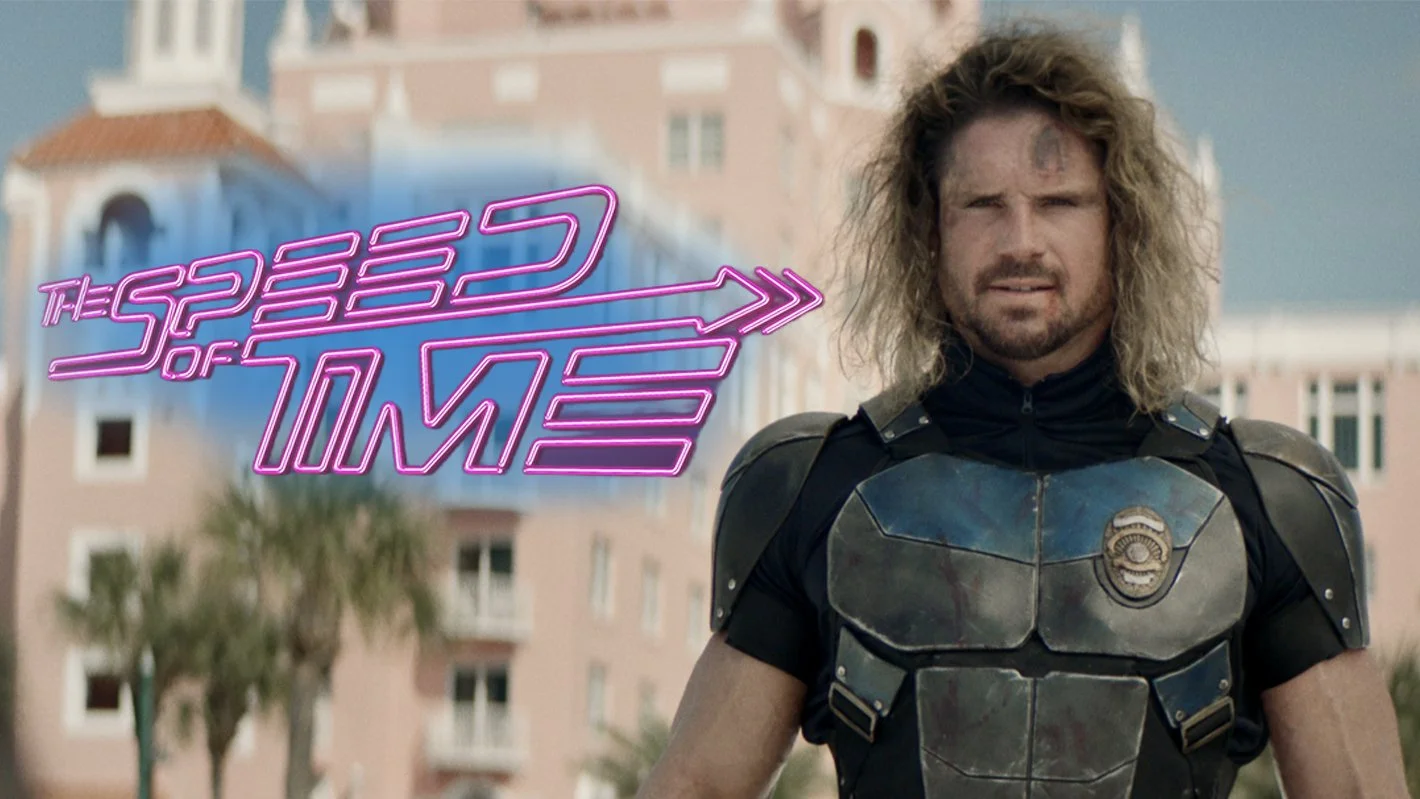
Johnny Killfire must go back in time and team up with his former self to stop the TimeBorgs from getting their hands on an app that breaks the space-time continuum by delivering pizzas into the past... before they were even ordered.

Directed by William J. Stribling
Johnny Killfire must go back in time and team up with his former self to stop the TimeBorgs from getting their hands on an app that breaks the space-time continuum by delivering pizzas into the past... before they were even ordered.
READ OUR INTERVIEW WITH WILLIAM
Tell us a bit about yourself and your filmmaking background.
Hi, my name is William and I’m an Al-aholic. As in Weird Al. As in Yankovic. When I was a kid, I really gravitated towards comedy. Monty Python, Weird Al, the movie Airplane!, Homestar Runner, anything Robin Williams touched. The 90s was a fun decade to grow up in. A lot of comedies being released in theaters every week. If Martin Lawrence was in a movie, I was guaranteed to see it several times. But I was also a child of the Blockbuster generation, so when I wasn't seeing a movie in the theater, I was devouring anything and everything at home on VHS and eventually DVD. I saw so many films way too young, like Citizen Kane and Cuckoo's Nest. I saw Iñárritu's 21 Grams in theaters when I was 12. A few times. I’m originally from St. Petersburg, Florida, and I was always the kid with the video camera wherever I went, making little movies just for fun, just to make myself and my friends laugh. I went to a performing arts high school but realized quickly that I didn’t want to pursue performing in college and beyond. So I looked into film schools, applied to a bunch, and ended up at NYU for undergrad. And I’m glad I did, because it’s where I met one of my closest collaborators, Alex Gallitano, who has shot just about every movie I’ve made. After college I went to Chapman to get my masters in screenwriting, which is where I met my writing partner Russ Nickel. A few months after graduating we were on set making our feature film Bear with Us. That film and the relationships we made in the process have been responsible for a lot of the work we’ve done since. I’m still proud of that one.
What was the inspiration behind SPEED OF TIME?
The challenge we posed to ourselves was pretty simple: can we cram an entire action flick into 10 minutes? The answer was resounding no. The film ended up being almost 13 minutes long. But oh well! Russ and I had been working with John Hennigan (who plays Johnny Killfire) for a few years on a handful of other projects. We were chomping at the bit, just anxious to get out there and shoot something that married John’s unique style of stunts/fighting with our comedic chops. And the rest is history! Back to the Future is obviously a clear inspiration, along with all the other big silly action films of the 80s and 90s. We tried to channel that without actually making too many specific references. I think the Predator handshake is the only thing we just straight-up stole. The rest is us tapping into that vibe.
What was it like to bring this film to life and what obstacles did you overcome along the way?
Though we all live in Los Angeles, we actually shot the film in my hometown in Florida, with a lot of help from the good people at the St. Petersburg/Clearwater Film Commission. Most of the prep was done remotely, and when we arrived in Florida we found out that our primary shooting location had backed out at the last minute. Which sent us into panic mode, because the plan was to use that one location to play as about a dozen locations in the film. The thinking behind that was we’d be able to make better use of a shooting day and avoid company moves at all costs. But there wasn’t a replacement available, so we scrambled to scout as many places as we could and I’m honestly happier with what we ended up with. There’s a lot more variety to the locations that wouldn’t have been possible with the original plan. Sure, we shaved years off our lives in those two manic days leading up to the shoot, but I’d say it was worth it.
What is your favourite part of the filmmaking process?
Easy! Being on set. In the entire process, we spend so little time on set, proportional to the writing, pre-production, and post-production processes. So I try to really enjoy myself when we’re shooting.
So you’ve made both shorts and features. How important has short film been in springboarding you into feature filmmaking?
I’ve never really used a short film as a springboard into a feature. Not intentionally anyway. It’s always just been a way to tell a different kind of story, or to make a film in a way that wouldn’t necessarily work as a feature. The Speed of Time, for example, works as a calling card, but the basic conceit of the short doesn’t work as a feature. So as we’ve been developing the feature version of The Speed of Time, we’ve been finding funny ways to maintain the spirit, knowing that the basic gag doesn’t work in a 90 minute film the way it does in a 10 12 minute film. Shorts are such a different medium, and the process of making one is so different from features. As easy as it is to put your short film online or take it around to festivals, shorts in America just don’t have a great distribution model the way features do. So I don’t find myself actively working on short films, but when an opportunity arises, I’m always game to use it as an excuse to try something I haven’t done before. The DUST release of The Speed of Time was a godsend. 2020 was going to be a fun year of taking the film all over the world to film festivals, but when they all went virtual, those plans evaporated. Being able to launch the movie to DUST’s giant, passionate audience has been an absolute blast.
What advice would you give to short filmmakers trying to make the jump to features?
Just make a feature! Do it! I dare you! I see so many people spending so much money on shorts. And I get it. But also, I don’t really get it. You can make a feature film that can be shot for whatever you were going to spend on your short. I just made a feature film in 5 nights in Las Vegas for faaaaaaaaar less than we spent on The Speed of Time. It can be done! And in my experience, a feature is simply a more valuable investment with a better chance of getting distribution.
Any film recommendations that we can watch to keep us busy while social distancing?
I’ve spent the entire pandemic binge-watching RuPaul’s Drag Race. If you haven’t gotten into it yet, what are you waiting for??? Two of my favorite films from last year were The Sound of Metal and Uncle Frank. Highly recommend.
Apply to get your short selected as our Weekly Pick

WE
A tour of the development and unravelling of a relationship. A beautiful and hypnotic visual representation and journey of the make up and break up of a relationship.

Written & Directed by David Yorke
A tour of the development and unravelling of a relationship. A beautiful and hypnotic visual representation and journey of the make up and break up of a relationship.
READ OUR INTERVIEW WITH THE FILMMAKER
WELCOME BACK! WHAT HAVE YOU BEEN UP TO IN THE PAST YEAR SINCE WE FEATURED YOUR FILM "CLOUDS"?:
Thanks for having me, I think like many of us I have just been trying to survive and keep myself busy the best way I can. A lot of films have been watched, many computer games have been played and a lot of my scripts have been re-written.
CONGRATS ON MAKING BAFTA CREW! HOW HAS IT HELPED PROPEL YOUR FILMMAKING FORWARD?
Thank you so much, it was a real pick me up that’s for sure, I had applied multiple times in the past and to finally get accepted really means a lot to me.
So far it’s been great, I’m meeting so many people and seeing their great work, which is inspiring. The network sessions and guest talks have been keeping me sane also, I just hope we can all meet in person.
It’s early stages at the moment because most things are on hold but many of us are already talking about collaborating on projects so it’s just really great being around so much creative energy.
BEAUTIFUL WORK ON "WE". WHAT'S THE INSPIRATION BEHIND YOUR FILM?:
Thank you so much, the film came about in a very unconventional way. Me and my dop David Cawley were at the time creatively frustrated and were hungry to make something.
I came up with a concept where we could be experimental but also create something visually interesting. With the constraints of budget and time, I knew we could only really have a skeleton crew and a few cast members, so I started developing ideas.
But it wasn’t until I was on the tube one day where I heard the song ‘Losing Light by Explosions in the Sky’ that the idea evolved, the track just had this rhythm that I really connected to, not to mention the track is just really emotive. I thought about how interesting it would be to show a relationship deteriorating over a long period of time but without dialogue to a similar beat as the track. Then the idea just grew from there.
YOU'VE PACKED AN ENTIRE RELATIONSHIP, TOLD FROM THREE DIFFERENT VANTAGE POINTS, IN UNDER 5 MINUTES. HOW DID YOU DO THAT? WAS THERE A LOT LEFT ON THE CUTTING ROOM FLOOR OR DID YOU SHOOT THESE INTIMATE MOMENTS TACTICALLY?
Well the great thing about making this film was I had scenes that were needed but location wise we could be very flexible. I had certain locations in mind but most of the time we would drive around, jump out the car and shoot these short moments. We got many alternate takes and my first cut of the film was about 2 minutes longer, so I do have a lot of unused footage. But when I showed people the longer cut it was obvious it was just too much and that in this case less was more.
WHAT WAS IT LIKE TO BRING THIS FILM TO LIFE AND WHAT OBSTACLES DID YOU OVERCOME ALONG THE WAY?:
I find every film I make a challenge and when you’re working with literally no budget it becomes very difficult. Some scenes were more straight forward and the actors could improvise and then there were the more delicate scenes especially the ones shot in the dark space. We only had a few hours to film in that location but the actors did a really amazing job and because of that we got some really powerful and emotive shots.
Every film has it’s problems, securing locations and working against the clock but I found this experience to be very collaborative and it’s a film I’m still very proud of.
ANY FILM RECOMMENDATIONS THAT WE CAN WATCH TO KEEP US BUSY WHILE SOCIAL DISTANCING:
I do a list of my favourites films of the year, so here’s 40 from last and this year that I recommend
Parasite
Queen and Slim
Uncut Gems
JoJo Rabbit
Saint Maud
Sound of Metal
1917
Mogul Mowgli
Baby Teeth
Relic
Soul
On the Rocks
Portrait of a Lady on Fire
WolfWalkers
Vivarium
His House
The Invisible Man
Onward
Make Up
Never Rarely Sometimes Always
Rocks
The Platform
Perfect 10
Tenet
Spontaneous
Happiest Season
The Lighthouse
Uncle Frank
The Rental
Save Yourselves!
Alone
Big Time Adolescence
Palm Springs
The Dark and the Wicked
Possessor Uncut
Greenland
Freaky
The Mortuary Collection
Straight Up
Host
Interested in getting your work selected as Short of the Week?

THE PLUNGE
After a night of passion Emily tells Jay that she’d like to use a strap-on. Scared of losing a girl he has a connection with, Jay reluctantly agrees.

Directed by Simon Ryninks | Written by Omar Khan | Produced by Tibo Travers
After a night of passion Emily tells Jay that she’d like to use a strap-on. Scared of losing a girl he has a connection with, Jay reluctantly agrees.
The Plunge won Best Comedy Short, Best Sponsored Short & Best Ensemble Cast (Comedy) at The People’s Film Festival 2020.
READ OUR INTERVIEW WITH THE FILMMAKERS
TELL US A BIT ABOUT SWEETDOH FILMS:
Tibo Travers (Producer): Sweetdoh Films is a creative media company that focuses on the production of fiction, documentary and commercial films, and in the organisation of screenings, professional tutorials and workshops. We've had projects funded by the BFI, Film London and Ffilm Cymru Wales, and made films that aired on Canal+, Vice TV and RTÉ, and were distributed by NiTV, Premium Films and Shorts International.
As a company we aim to:
- Change the environmental impact of the arts industry for the better, by implementing positive measures throughout all our projects and actively reducing our carbon footprint.
- Focus on training and education within the creative industries, by mentoring students and training interns.
- Associate our projects with disability and mental health organisations, offering training and employment opportunities to vulnerable or disabled individuals.
WE UNDERSTAND THAT THE INSPIRATION BEHIND THE PLUNGE CAME FROM A REAL LIFE INCIDENT. HOW MUCH CAN YOU TELL US?:
Omar Khan (Writer/Actor): The idea behind THE PLUNGE was inspired by my own misfired sexual encounter, when the idea of pegging (sex act in which a woman uses strap-on dildo on their partner) was suggested to me. I politely declined, but then wondered what would have happened had I agreed. One horrific “what if” thought after another lead to THE PLUNGE as a screenplay.
WHAT WAS IT LIKE TO BRING THIS FILM TO LIFE AND WHAT OBSTACLES DID YOU OVERCOME ALONG THE WAY?:
Tibo Travers (Producer): The experience of making The Plunge was really enjoyable, because we made it as a team of friends, and all in all there was little stress involved. The fact that we could make it with our own money, and therefore on our own terms, means that we had a minimum amount of pressure - and I'm persuaded this is the most favourable conditions for any creative work.
Like any independent production, the main challenge was to cater for our needs with this limited budget. This means we could only shoot for 2 days, and had to pull a lot of resources (and spend a lot of time) trying to create small miracles! But like any good filmmaking team, we made it work by being proactive, imaginative, and above all by having a positive approach to problem solving.
WHAT'S YOUR FAVOURITE PART OF THE FILMMAKING PROCESS?:
Tibo Travers (Producer): My favourite part of filmmaking is being on set and witnessing this creative synergy that is filmmaking. Seeing written words being transformed into performance and moving images will always feel a bit like magic to me, and I don't think I'll ever grow tired of being a part of it.
CONGRATS ON DEVELOPING YOUR FEATURE FILM "OUT THERE" WITH THE BFI. HOW IMPORTANT HAS SHORT FILM BEEN IN SPRING-BOARDING YOU INTO FEATURE FILMMAKING?:
Simon Ryninks (Director): Really important! I've been making short films for ten years and that's allowed me to explore, take risks and learn from my mistakes in a way that I couldn't have done if I'd miraculously gone straight into making features. If I had it would've been terrible. Shorts have helped me find my voice, my confidence and my filmmaking community. All of which I'm hugely grateful for.
WHAT ADVICE WOULD YOU GIVE TO SHORT FILMMAKERS TRYING TO MAKE THE JUMP TO FEATURES?
Simon Ryninks (Director): I'm still making that jump, but I've learned that patience is a virtue. It takes a long time to get a feature off the ground - I've been working on Out There for nearly 3 years now and am really still the start of the process. Make sure you embark on telling a story that you really want to tell, and that means something to you, otherwise it may not be worth the wait.
ANY FILM RECOMMENDATIONS THAT WE CAN WATCH TO KEEP US BUSY WHILE SOCIAL DISTANCING:
Simon Ryninks (Director): Recent films I've really enjoyed are Ete'85, Another Round and Never Rarely Sometimes Always. Thank goodness for streaming!
Tibo Travers (Producer): Cuba and the cameraman, Fahrenheit 11/9, Dick Johnson is dead, Les Misérables
Interested in getting your work selected as Short of the Week?

ALL THE TRIMMINGS
Paul is a desperate father who knows he can't provide presents for his kids again this Christmas. But maybe he can at least provide Christmas dinner... and is willing go to extreme lengths to make this happen.
Written, Directed & Produced by Thomas Edwards
Paul is a desperate father who knows he can't provide presents for his kids again this Christmas. But maybe he can at least provide Christmas dinner... and is willing go to extreme lengths to make this happen.
All the Trimmings is a true story inspired by director Tommy Edwards own upbringing, growing up with very little and having to find value in the small things.
In the current climate we live, where the disparity within the distribution of wealth is growing ever bigger and the expectation of consumerism is changing what we value, Tommy feels that this story has become ever more relevant, providing a vital voice to the stories of those living on the breadline and hopefully helping re-enforce the values of family and community.
READ OUR INTERVIEW WITH THE FILMMAKER
TELL US A BIT ABOUT YOURSELF AND YOUR FILMMAKING BACKGROUND:
I am a Londoner, born and bred, with a keen interest in observing the margins of society and looking at the smaller stories that reveal big ideas.
Since graduating in 2010, I have worked with 1000's of young people from all over, devising and delivering creative programmes. Working with young people has always been massively important to me, giving them the opportunities to be creative and express themselves, developing resilience and empowering them to have a voice. This work has ran parallel with my own personal film-making pursuits, picking up side hustle jobs here and there, from writing and directing show reel scenes for actors, to location scouting to street casting, always trying to keep my toe in industry water. But some of the best training is actually making films with the young people. The varied ideas and range of young people has meant I have always had to be flexible, teaching myself how to do certain things so I can then pass that on effectively, often learning with them. When a group of young people with Autism wanted to make their own take on Dr Who, I had to deliver.
Right now, I am two self-funded short films deep, both produced and directed by myself and hoping to move into a position where I can be funded for my next project. Or at least have a producer to help. You can only dream.
CAN YOU TELL US ABOUT THE INSPIRATION BEHIND YOUR FILM?:
Christmas was the only time being poor was particularly hard. It was the only time any of the men in my family would cry.
It was the reminder that we had nothing…. So when one year, when we had no gas running, a pink plastic Christmas tree that I stole from Poundstrecher, the promise of an ‘I owe you’ to be left under the tree, and a Christmas hamper with the ‘All the Trimmings’ my Nan thought was appropriate to buy: my Dad refused to be beaten.
He took it upon himself to find a house to cook dinner and make sure we had something. The next day we were still poor but it demonstrated to me the value of family and as I reflect now, my Dad’s desire to the do best he could, despite the adversity, to be a good dad
This story is an evolution of a true-life event and provides a microcosm to a grander problem. Poverty and the growing gap between rich and poor. In a world where we are exposed to grandeur and pummelled with the expectations of consumerism, the pressure to provide has been become wholly different and with that our values of what is important, leaving a whole section of society left on the outside looking in, isolated and struggling to find hope.
POWERFUL STORY! ANY SECRET TIPS OR HACKS FOR MAKING AN AWESOME SHORT FILM?
Make a good treatment and visual stack. It helps articulate your ideas and sell your project to potential collaborators and good crew is the best possible currency you can have to make a short film. It can often help get great talent for affordable rates as well because they are invested in the world you are building.
Be willing to ask people for favours. People are often happy to help. When l went door knocking for the balcony shot in All the Trimmings, literally the first door I knocked on said yes
Shoot over the weekend. Kits houses will often give you reduced rates and will count a friday to monday as a two day rental.
TELL US ABOUT YOUR JOURNEY GETTING YOUR FILM TO AUDIENCES:
I went for the traditional festival route first. Added the project to the various different platforms such as FilmFreeway, Festhome and Shorts Depot. I researched the top end festivals, checking which ones were the BAFTA qualifiers and I started entering some of them. I wish I could say there was a great strategy to it but it was often decisions based on economics. Which entries were the best value for money ... or the cheapest. Once the inevitable rejections started coming, a hard thing at first to get used to, I spread my net further and began to reach out to more mid range festivals. I would research this a bit further. My criteria would often be previous selections/winners and how long the festival had been running. I would often be drawn into good website designs and events that demonstrated production value in their marketing material. There are a lot of festivals, many that have very little value and are borderline exploitative so it was important to do this due diligence and make sure it would get an audience. Spreading my net further bore success and I was grateful to have the film be part of a range of different festivals all around the world.
Post festival run, the online distribution was the next challenge. I had always wanted the film to service the needs of a charity that works with child poverty and be used by them as a resource and to support their cause. I approached the Childhood Trust and they were more than willing to take it on and share it on their platform. It now sits on their Youtube channel and I am proud that it has a valuable home and speaks to an important issue that is something I am very passionate about. It was released over Christmas and it is great to see it has over 11,000 views.
THAT VIEW COUNT IS GREAT! WHAT OTHER LANDMARKS HAVE YOU EXPERIENCE WITH “ALL THE TRIMMINGS”?
Despite many a BAFTA qualifying festival rejection, and there were many, I was very grateful to the 3 BAFTA qualifying festivals that did select it. It was something really special to go see the film at Curzon Shaftesbury avenue as part of the London Short Film Festival in 2020. To also be part of Aesthetica was massive for me too. I have been such a big fan of their ethos and programming so to have All the Trimmings screened as part of their 2020 festival was great.
Other notable selections was the American Premiere deadCentre Film Festival and the other BAFTA qualifying festival, Belfast Film Festival
All the Trimmings also had a couple wins. Best Drama at the Sunday Shorts 2020 awards. I can't speak highly enough of Sunday Shorts. An excellent smaller festival, brilliantly run with a real attention and love for film. I would recommend everyone to submit to them. The other award was Best Actor for the amazing Jimmy Gallagher at BELIFF Festival, another really great festival that had some great communication.
ANY FILM RECOMMENDATIONS THAT WE CAN WATCH TO KEEP US BUSY WHILE SOCIAL DISTANCING?:
Short film wise, I am a big fan of what Charlotte Regan is doing and excited as she goes into long form. Fry-up and Standby are excellent short films, simple ideas that are really elevated by sharp storytelling.
Feature wise, I have really been getting into Celine Sciamma's work. Tomboy is an extraordinary film, a captivating take on growing up and sexual identity. And from 2020, I can't recommend enough Sarah Gavron's 'Rocks'. Just stunning. For me, the most authentic portrait of growing up in inner city London. A must watch for anyone.
Interested in getting your work selected as Short of the Week?