
TACKLING
Written & Directed by Gillian Harker
Produced by Becky Rooney
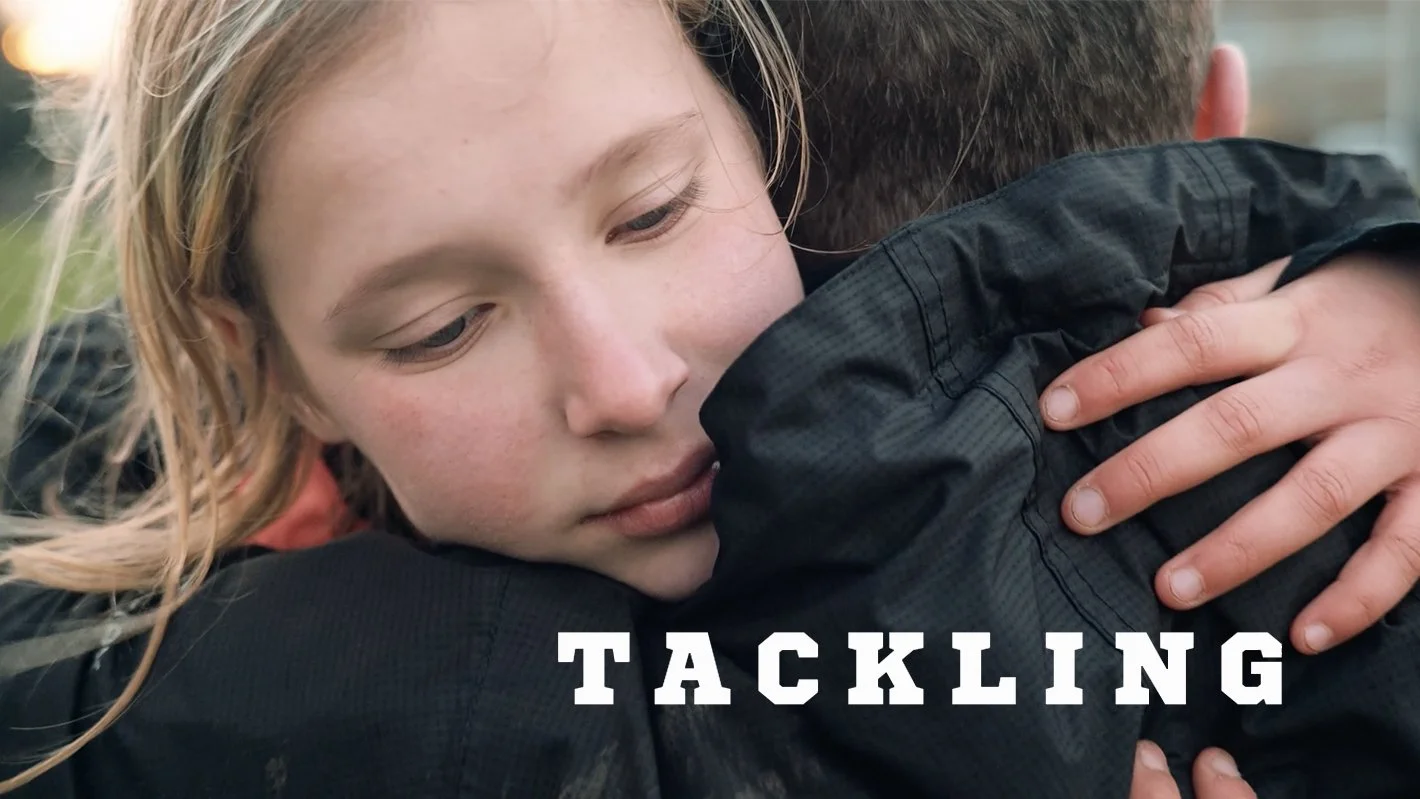
A young girl and her dad bond over a game of Rugby League.
ABOUT THE FILMMAKER
Gillian is an award-winning writer and director, recognised by Shiny Network as one of the ‘best new directing talents worldwide’. She is a member of Directors UK and specialises in bold, character-driven storytelling.
Her latest short film, Strip the Peacock Bare- starring Abigail Hardingham, Jess Douglas-Welch, Andre Flynn and Simon Phillips- is currently in post-production. Her previous short film, Tackling, premiered at the BAFTA-qualifying Aesthetica Film Festival in 2022. As a writer, she reached the quarter-finals of the Outstanding Screenplays TV Pilot Competition (2024) with her debut pilot script, 'Blooming Elle.'
Gillian’s debut short, Cross, starring Ryan Hayes, won multiple awards, including Best Male Actor at the BIFA-qualifying Little Wing Film Festival 2019 and the Audience Award at the 20th Keswick Film Festival 2020.
Her Straight 8 films Jinx and Day 60 were selected for the 2020 and 2021 competitions by a judging panel that included Academy Award-winners Asif Kapadia and Robbie Ryan. Her 2021 film Feast screened at several UK festivals, including BIFA-qualifying Little Wing and Kino: The People’s Festival, and was nominated for Best English Short Film at the British Short Film Awards 2021.
READ OUR INTERVIEW WITH GILLIAN
Tell us about the inspiration behind Tackling. Where did the idea come from?
The idea for Tackling came while I was trying to secure funding for a longer short film (RHINO) about grassroots girls’ rugby league. Although people responded positively to the project and liked the script, there were concerns about whether I had enough directing experience to work with children and shoot sports sequences effectively. So my producer and I decided to make this zero-budget short film as a way to explore what it would be like to work with children on screen and to film basic action sequences.
How did you develop that idea into the short that's now made its way out into the world?
As I already had a completed script for RHINO, I knew I didn’t want to make anything thematically similar. However, keeping the protagonist the same age felt important: a young pre-teen girl. The whole process, from deciding to make the short film to writing the script, casting and shooting, took about two weeks.
Can you chat about your experience working with kids on screen?
We shot over the course of a single day, but working with children meant there were a number of regulations we had to adhere to, including limits on the amount of time they could spend on set, so we had to factor that carefully into the schedule. All of the children in the film already played rugby league, and the coach we cast was a real rugby coach, which helped bring authenticity to the project. It was a really fun shoot, and the kids were fantastic- incredibly enthusiastic particulary as it was bitterly cold and windy February morning. For many of them, it was their first time on camera so editing out the occasional glance into lens proved tricky at times.
I really enjoyed the experience of working with children on screen. I’m a private tutor as well as a filmmaker, so I work with children a lot, although directing them for film is a very different kettle of fish. Our lead actor, Seren, was wonderful, and she and Robert Dukes developed such a natural rapport with one another on screen.
Collectively here at Team Kino, we’re in the final stages of programming for our festival this summer. As usual, more shorts have been submitted than in previous years, so the job becomes more challenging. How has your perspective on the current state of short film changed since you evolve as a programmer?
Hmmm, I do feel that my perspective is constantly changing, and my personal tastes are recalibrating somewhat as I evolve as a programmer. The more short films you watch, the more attuned you become to what feels fresh and unique, although I’m always drawn to things that feel emotionally honest.
I think I’ve also become more aware of how difficult it is to make something that genuinely lingers with an audience after a programme ends. How can your film stand out? How can your message have an impact? I see lots of really good films, but it’s much rarer to come across ones that truly stay with you.
At the same time, programming has made me more open-minded. Films I may not have connected with personally a few years ago, I can now appreciate for their craft, originality or the way they might resonate with a particular audience. I’ve also gained a much deeper respect for how much work goes into making a short film at any scale. Even when something isn’t entirely successful, you can usually feel the passion and effort behind it.
I love learning about the journeys filmmakers have taken, and I particularly value transparency. It’s easy to share the success stories (and deservedly so ) but I really appreciate it when filmmakers are honest about the realities of the process too. Hearing someone say, “We applied to a hundred festivals and only got into twenty percent of them,” can actually be incredibly encouraging, especially when the film appears, from the outside, to have experienced nothing but success.
Can you chat about your own festival experience with Tackling. How was it received, and how did that compare to your other work?
As I mentioned, making Tackling was really about providing a testing ground for myself in the hope of eventually raising the capital to make RHINO, the longer, more complex short film about grassroots girls’ rugby league and female participation in team sports.
We didn’t plan on submitting Tackling to many festivals because, as you know, the costs can become very expensive. We were very selective and submitted to around ten festivals, most of which had some connection to rugby league, for example, festivals held in rugby league towns or regions.
I did, however, have my heart set on getting into the Aesthetica Short Film Festival, which is held in York each year. Yorkshire is such a strong rugby league area, so it felt like the perfect fit for the film. I was absolutely over the moon when we were accepted into BAFTA-qualifying Aesthetica. I had a great time!
I think the film was received well, although I personally wasn’t entirely happy with it, so we ended up having it re-edited afterwards. We’d originally edited it ourselves to save money and, while we did an okay job, we’re not editors! Sometimes seeing your work on the big screen highlights things you missed in the edit, or maybe it’s the pressure of watching it with an audience, but I definitely scrutinise my work even more in that environment. I learnt alot from that process.
I think the film is much stronger for having been re-edited, and we also replaced the music, for which the rights had expired, with a new score by the wonderful composing duo Two Twenty Two.
When we last featured your work - Jinx - we chatted briefly about your upcoming project Strip the Peacock Bare. How’s progress?
It’s coming along! We’re almost at picture lock, and we’ve got a brilliant group of people working on it. I always get a little nervous talking about projects before they’re finished as I don’t like to jinx things but I’m genuinely excited to get this one out into the world.
The cast are truly incredible, and I feel very lucky to have found them, with the help of the brilliant casting director Kerry Grainger. I’ve taken some big swings with this film and really pushed myself as a writer, director and producer.
I’m trying not to focus too much on the end result and instead just enjoy the process, which I really am. It’s been such a rewarding experience so far, and I’ve learned a hell of a lot along the way.
