

Kill List
While carrying out his latest contract, a hitman’s demons are exposed when he comes face to face with the man who killed his brother.
Written & Directed by JAMES MILLAR
Produced by Chris Datson & Ashley Millar
Get ready for an action-packed ride with 'Kill List'! Follow a ruthless bounty hunter as he sets out to take down his latest target. This short film is a proof of concept for a larger story that will keep you hooked.
ABOUT THE FILM
Kill List Won Best Cinematography at the Midland Movies Awards. It also played at the Northampton Film Festival and the Lift Off Global Network Sessions.
ABOUT THE FILMmaker
Growing up in a movie-loving household, James Millar knew he was destined to make films. Since his first short film in college, he's made over 20 shorts and music videos, snagging a variety of awards, including one judged by Watchmen author Alan Moore.
With experience as a CG artist for major brands like O2 and Marks and Spencer, James is now head of video production at Jaguar Land Rover. But his ultimate dream is to write and direct a feature film.
READ OUR INTERVIEW WITH James
Welcome back to our Short of the Week series. What have you been up to since we featured SWINE?
Since the release of SWINE in 2021, my creative journey has been an exhilarating ride. Following the labour of love that SWINE entailed, I experienced a period of fatigue and burnout, especially while balancing a full-time role at Jaguar Land Rover and the responsibilities of family life alongside my passion projects.
However, I am thrilled to share that things are now back on track. SWINE's journey took us to some fantastic festivals where we had the pleasure of connecting with incredible individuals from the film community. The film's success was further bolstered by the recognition it received through various awards, which served as an inspiration and validation of our hard work.
As the dust settled, I dedicated my time to writing and nurturing exciting new projects. The experience with SWINE has fuelled my passion and motivated me to embark on an array of future endeavors.
With a renewed sense of enthusiasm and a vision for what lies ahead, I am eager to delve into these upcoming projects.
Tell us about the genesis of Kill List and how the project came about.
For years, I've been brewing an idea for a project called Shoe Town, named after my hometown of Northampton. This place holds a special significance as it was once a global hub for shoe manufacturing, and that legacy lives on through our football team, the Cobblers, and the enduring nickname 'Shoe Town' among the locals.
Shoe Town delves into the gritty underbelly of the town, drawing inspiration from personal experiences and the tales of others. It revolves around larger-than-life characters whose paths intertwine in unexpected ways, building up to a climactic finale.
Kill List emerged as an audacious experiment. We wanted to test the limits of our small filmmaking team, pushing the boundaries of what we could achieve without any external funding. We decided to shoot exactly what we envisioned, curious to see if compromises would hinder our artistic vision. To our delight, the outcome far exceeded our initial expectations.
It was an exhilarating journey, breathing life into our passion project, and discovering the untapped potential within our talented crew. Kill List stands as a testament to our collective dedication and creativity, proving that even with limited resources, we could craft a compelling and impactful film.


Kill List seems like it's part of a much larger story. Is this a proof of concept for a feature or just one in a series of Shoe Town short stories?
Kill List serves as an exciting glimpse into a larger narrative universe we've been developing. In our discussions, we envisioned a twofold approach: continuing to produce Shoe Town story shorts as standalone proof-of-concept projects, while ultimately aiming to bring forth a feature film set within the same universe.
Kill List, being the inaugural entry in this series of shorts, was a bold proof-of-concept experiment. It allowed us to test the waters, exploring the potential of this dark and immersive world we've created. As we move forward, we're thrilled to expand on the compelling characters and intricate storylines, paving the way for a future feature that will truly bring the Shoe Town universe to life.
Can you tell us about the world of Shoe Town?
Certainly! Welcome to the captivating realm of Shoe Town, a hyper-real, darkly comic reimagination of my hometown, Northampton. Prepare to be immersed in a world steeped in visceral crime, rampant corruption, and a multitude of sins that intertwine with its very fabric. In this twisted reflection of reality, the characters that inhabit Shoe Town serve as amplified caricatures, embodying the town's pervasive darkness in larger-than-life ways.
Within these streets, you'll encounter a colourful cast of characters whose lives intertwine amidst the chaos. Each individual represents a unique facet of the town's seedy underbelly, revealing the extremes of human nature in a way that blurs the boundaries of plausibility and amplifies the grotesque.
Shoe Town is a place where every corner hides secrets, every interaction brims with tension, and every moment pulses with a dark energy that keeps you on the edge of your seat. It's a world that challenges perceptions, provokes laughter through discomfort, and pushes the boundaries of storytelling.
Check out this awesome behind the scenes video
What were some of the main obstacles you experienced when making of Kill List and how did you overcome them?
Throughout the making of Kill List, we encountered several formidable obstacles that tested our creativity and problem-solving skills. The first challenge arose with continuity as we commenced shooting during a local fair's arrival last May. To capitalize on the golden hour lighting, we aimed to capture as much footage as possible before nightfall.
Initially, this approach worked seamlessly. However, as the week progressed, we faced sudden closures of the fair due to low attendance. In some instances, we found ourselves in the middle of a take only to have all the rides abruptly shut down. This disruption threatened our desired consistency.
To mitigate this issue, we ingeniously implemented Astera Titan tubes to light our talent. By simulating the hues emitted by the rides, we could seamlessly match the lighting and maintain visual continuity when the fair abruptly closed.
Given that Kill List was a proof-of-concept project, we embarked with a loose idea of what we wanted to capture. Our vision truly took shape as we pieced together the footage during post-production. Unfortunately, this coincided with the fair's final week, resulting in its departure and leaving us in a bind, in need of additional footage.
To overcome this setback, we actively tracked the fair's movements through social media. As it relocated to different locations, we strategically shot in each new setting. For instance, the scenes featuring the talent walking around were captured in the initial location, while the drone shots were taken in a completely new location where the fair had relocated. We repeated this process for a total of three different fairgrounds to obtain all the necessary footage.
Despite these challenges, our resourcefulness and adaptability enabled us to triumph over unexpected hurdles. We emerged with a cohesive and visually stunning short film, Kill List, that captures the essence of our original vision.
Awesome location! How did you go about securing that or did you pull it off guerilla style?
Thank you! The truth is, securing the location was mostly a guerrilla-style endeavour. One evening, while visiting the fair with friends and family, I was struck by the incredible atmosphere and realized it would be the perfect setting for a shoot. Inspired by this revelation, I quickly formulated a rough plan that aligned with the Shoe Town concept, and we took the plunge!
During the shoot, we did encounter fair workers who expressed curiosity about our project. Fortunately, their inquiries were never derogatory; instead, they showed genuine interest and excitement about us shooting something in their workplace.
Embracing the guerrilla-style approach allowed us to capture the essence of the fair authentically and without constraints. It added an element of spontaneity and adventure to the process, enhancing the overall experience and resulting in some truly remarkable footage.
Tell us about the journey of getting your film to audiences.
The journey of bringing our film to audiences has been nothing short of exhilarating. Like every project we've undertaken in the past, our approach has always been to harness the power of social media and expand our reach. It can sometimes feel like an uphill battle, but through incredible platforms like yours and the support of remarkable film festivals, we've been able to ensure that the right people discover and appreciate our work.
With this film, we took a unique approach that added a new layer of excitement. We collaborated with a local musician, the sensational FFSYTHO, and incorporated her electrifying track, "Bop Through your manor," as the opening music of the film. Being a literal local legend and boasting a devoted fan base, it made perfect sense to infuse her high-energy track into our cinematic creation. The result was a seamless fusion of music and visuals, elevating the overall cinematic quality of the film to new heights.
This collaboration was just the beginning of our exciting journey together. We have plans to reciprocate the creative energy by working with FFSYTHO on one of her upcoming projects. It's a testament to the power of collaboration and mutual support within the artistic community.
We are grateful for the platforms and partnerships that have allowed us to connect with audiences who appreciate our work. It is through these meaningful connections that our film finds its way into the hearts and minds of those who truly resonate with it.
What do you think is the biggest challenge short filmmakers face trying to break into the industry?
Undeniably, one of the biggest challenges facing short filmmakers breaking into the industry lies in making a significant impact within an already vast and competitive market. With the rise of short-form videos on platforms like TikTok and Instagram Reels, capturing audiences' attention has become increasingly challenging. People's attention spans have shortened, and the patience to watch content exceeding a minute online has diminished compared to the past.
Countless successful individuals in the industry have emphasized the importance of not solely relying on short films as a means to break through. Instead, they suggest using short films as a platform to showcase one's capabilities and seize opportunities to secure talented actors, crew members, and funding. The prevailing advice has been to leverage these short films as stepping stones toward embarking on ambitious feature film projects.
Navigating this landscape requires strategic thinking, adaptability, and the willingness to embrace change. As short filmmakers, we must find innovative ways to captivate audiences, while simultaneously utilizing our short films as powerful tools to demonstrate our vision, talents, and potential. By leveraging these opportunities effectively, we can build the necessary foundation to make a lasting impact within the industry.
Any film recommendations that we should add to our watchlist?
Something I watched recently was a short film called Lay Me by the Shore by David Findlay which was a Vimeo staff pick and It just got me! I loved it, also another short film I loved recently was Look at Me by Sally Potter starring Chris Rock and Javier Bardem and again it was just great! Also, the latest season of ‘Love Death and Robots’ on Netflix is inspiring! Feature film wise the new Spiderverse movie was epic! And I randomly watched ‘Wheelman’ on Netflix starring Frank Grillo from 2017 and I thought it was a cool concept kind of like DRIVE if he never left the car. Also, Guy Ritchie's new film on Amazon called Covenant was really cool.
Interested in getting your work selected as Short of the Week?

SMASH & GRAB
Four women race a ticking clock across a bustling city, readying themselves for the ultimate Smash and Grab showdown.
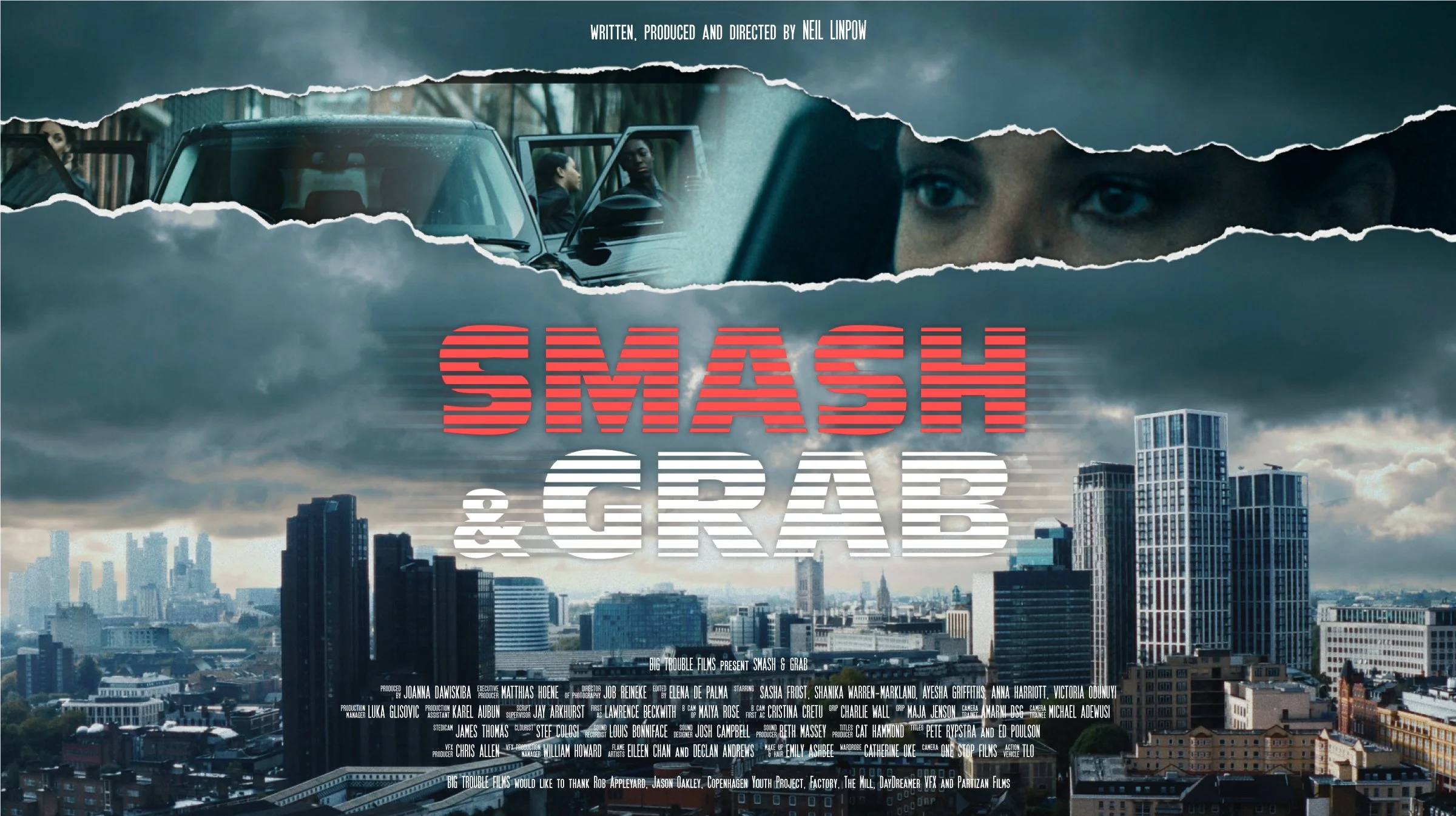
Written Produced & Directed by NEIL LINPOW
Four women race a ticking clock across a bustling city, readying themselves for the ultimate Smash and Grab showdown.
READ OUR INTERVIEW WITH NEIL
Welcome back to our Short of the Week series. What have you been up to since we featured your film Lesson 7?
It’s been a pretty amazing year to be fair, and it’s in no small part thanks to the support I received from platforms like Kino.
After screening ‘Lesson 7’ on Kino and at a number of Bafta and Oscar qualifying film festivals, I was approached with the opportunity to write a feature film project through Warner Bros and Tea Shop films. It was an interesting process, and I feel like I learned a lot along the way. We shot the film in Feb-March this year and it’s currently finishing up in post. It’s a contained thriller set in one location with only a handful of actors, so it feels in the same tone of voice as my previous shorts too.
What inspired you to make Smash and Grab?
Working in commercial production I’ve found that the despite it being a keen discussion point, there is still very little pro-active engagement to develop new and diverse talent. It’s not enough to just support existing filmmakers, we have to be looking to create projects and routes into film for people that don’t have an initial in. For the people that don’t even realise it’s a possibility.
This film was born out of a frustration that there is too much lip service, and not enough action.
I am a volunteer mentor for a UK organisation called ‘Creative Mentor Network.’ It looks to support people from lower socio-economic backgrounds, and find them routes into the business. But, as much as I love working with my mentee, I still felt like I could be doing more to create my own opportunities to get him and others practical work experience.
I created this project and then reached out to my local community centres. We had 10 young people on set that had never been on a film shoot before, but wanted to get into the industry. All of them were partnered up with an experienced crew member that was lending us their time.
The film was self financed, and all of the young people were paid full rates. I’ve also invited them onto paid commercial shoots afterwards too. One of them recently won a mentor scholarship with John Boyega’s Converse campaign to find the next crop of young diverse filmmakers. So, if nothing else, it’s felt worth it for that.
What obstacles did you overcome while in the making of this film?
To be honest, I think most notably we encountered the familiar ones that almost all short film makers can relate to. Time and money.
When you have no money, you can’t be pushy with peoples time. Especially when you have incredibly talented people offering to get involved in your project. I knew that the film would be immeasurably better by having these amazing collaborators pushing it to be the best film it could be, but it also meant that the post production timeline of the film was very slow.
I had this (optimistic) idea to get the film turned around within a couple of months of shooting, but in the end it took almost a year. A mix of lockdowns, family bereavements and other Covid complications meant that the film bubbled along slowly in the background as my feature film also developed.
That said, I am immensely grateful for everything everybody did to get this film together, and I am very proud of what we achieved.
Tell us about the journey of getting your film to audiences.
Unlike with ‘Time’ and ‘Lesson 7’ I didn’t make this film to go into festivals, so I didn’t really have a plan on what to do with it. I just wanted to create a community project, so I assumed that it would just live online, and perhaps that’s exactly what it will do. I have been approached by a couple of sports brands that liked the film and wondered if there was interest in them using it as a branded piece with a little reworking of the ending, so I will see how that plays out. But I am very happy to have the film on Kino where the short film audience can check it out.
In your experience, what's been the biggest or most surprising difference about making a feature vs a short. Is it just the difference between a sprint and a marathon, or how much does the craft change?
That’s such an interesting question. Broadly speaking, it’s obviously much slower. Decisions that you can usually make on your own in short form now take weeks or months for someone to feed back on. You are always at the mercy of someone else, which can be a frustrating place to be. If I wanted to make a short film next month, and asked you if you wanted to be involved, it’s a tangible thing that you can board or not. Often with a feature, it’s not really a real thing until the money is in place and you are in pre production. And the money is not really in place until you have cast secured. So you are mostly talking about this thing that you can never be sure will happen. It takes a minute to accept that.
In terms of the craft, I’d say that the development process is certainly very different. Interrogating and fine tuning the dramatic beats so that you have your story working before you start writing your script is arguably the hardest part of the creative journey. For me, I can’t start writing until I have my entire story blocked. I think in short form, you have slightly more scope to explore moments and allow the story beats to develop on the page.
I think probably the most exciting and frustrating process is the casting. So much of it is dictated by financing, and perceived ‘commercial value.’ It can potentially force you down a road that you perhaps didn’t want to go, and even when you do align with the financiers, it comes down to availability and schedule. Casting a feature during Covid wasn’t easy.
That said, we were very lucky that we got a cast that we would have absolutley cut our hands off to get. It definitely felt at times though that it could have been pushed another way, so I feel blessed to have gotten the talent we wanted.
What do you think is the biggest challenge short filmmakers face trying to break into the industry?
That’s a tricky one, and I wish I had the answer, but I think depending on where you are in your career, the answer is different. For filmmakers like me, the hardest part is financing. If I hadn’t financed my own short films, they wouldn’t have been made. There are no platforms that would finance me, so I never have the backing of any accredited film bodies that could then help me push my films afterwards, or develop future projects with. I had to go a bit ‘one man band’ in my approach.
Equally though, as I touched on above, I think another major problem for a lot of young filmmakers is access. There’s not enough grass roots outreach to find diverse new voices and a reluctance to invest in initiatives to change that. It took me until I was in my 30’s to have the connections and a tiny bit of money to put into my films, and I fear that we will lose so many potential talents because this is indicative of the industry as a whole. Perhaps there needs to be more ways to try and monetise short films so that there is a commercial value in making them for financiers.
Any film recommendations that we should add to our watchlist?
Hmm… I’ve been watching some good TV recently. Severance was great, and perhaps the best thing I’ve seen was Midnight Mass. It was a brilliantly subversive take on a classic myth, through a different lens and I loved that it was allowed to be slow-burn at times. 15 minute long scenes of two people just discussing existential ideas alone in a room, all the while still being at it’s core in the horror genre.
Film wise, I’d go back further. Check out ‘Wind River’ by the brilliant Taylor Sheridan if you are looking for something new and perhaps little seen. Great performances across the board and a nice cameo from one of my favourite actors, Jon Bernthal.
Interested in getting your work selected as Short of the Week?

Swine
A local rapper and lovable smart-ass gets thrust into a world of mayhem after he wins the coveted SWINE Records competition. But instead of a lavish office filled with champagne and beautiful women, Danny discovers something much more sinister.
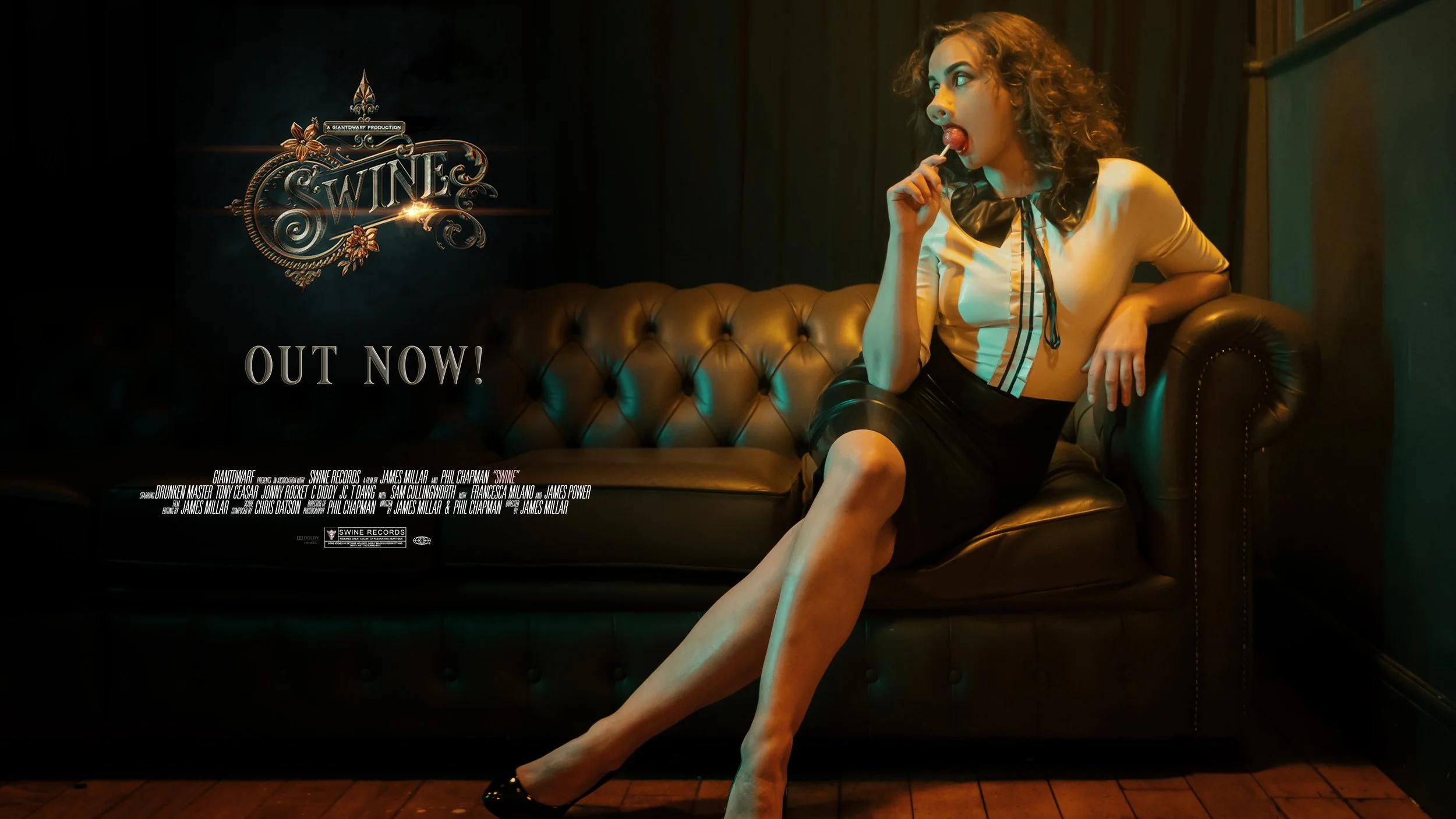
Written & Directed by James Millar
SWINE follows the journey of local rapper and lovable smart-ass Danny, AKA 'The Drunken Master'. On what seemed like a typical Friday night down the pub, Danny gets thrust into a world of mayhem after he wins the coveted SWINE Records competition. Despite a stark warning from fellow musician, Johnny Rocket, Danny decides to go and sign on the dotted line! Upon arriving at Swine Records he realizes he has made a huge mistake. Instead of a lavish office filled with champagne and beautiful women, Danny discovers something much more sinister. What follows is a high octane, pig throttling, raucous extravaganza into the unknown as 'The Big Dirty', led by 'Johnny Rocket', attempt the most insane rescue mission ever! Danny knew the competition would change his life... but not like this!
READ OUR INTERVIEW WITH JAMES
Tell us a bit about yourself and your filmmaking background.
Raised in a movie loving household there was only 1 thing I ever wanted to do in life, make movies!
I started making short films in college while studying interactive design and digital media. They we're mainly experimental shorts and terrible music videos but once I started there was no going back!
I've since made over 20 award winning short films and music videos as well as having 3 music videos appear on MTV.
What inspiration and influences made you want to create Swine?
After being let down and taken advantage of by some senior people in the music industry I was feeling very deflated by the whole prospect of music videos and production and decided I wanted to create something that showed the music industry for what it was.
This sparked a bit of an avengers moment and I decided to pull together some great local musicians and a very talented producer and create something special to show what we were capable of with no label interference.
Creatively I was inspired by films like Predator and Aliens - this idea of a group of people taking on something bigger and more powerful than them and then ultimately defeating it really resonated with me.
Stylistically I was massively influenced by the works of Edgar Wright, Guy Ritchie and James Gun - amazing directors who have managed to blend action and comedy so well!
What obstacles did you overcome while in the making of this film?
We had so many obstacles thrown at us when making SWINE, to start with we needed money to hire equipment and for props - more money than we had available anyway - and to raise the money we did a crowd funding campaign and even hosted a fund raising gig, both of which went really well and managed to raise just over £2k which was great.
Unfortunately though, that money only stretched so far and meant we had to go above and beyond to secure props and locations for as cheap as possible, if not free.
One example of this was the pig masks, we wanted to pig people to look as real as possible and the only masks we found that could achieve that were going to cost around £900 each and we needed at least 5 which quickly ruled them out, so instead myself and Phil Chapman went about making our own silicone pig masks from a 3d printed mould.
This actually ended up being a huge blessing as it meant our pig people were unique to our production and ended up being considerably cheaper as well!
The next set of issues for us were location based. Our first secured location, a place called Boothlane College in Northampton, unfortunately let us down after seeing some of our previous work and deciding that whatever we were making wouldn't be suitable which was a real shame as the majority of us had studied there at some point in our lives. We then found another location, an empty set of office blocks that was perfect for our shoot, but with less than two weeks before the shoot the building was condemned due to the discovery of asbestos.
So with two weeks till the shoot and everyone already booked in and everything organised we went on a crazy mission to find a new location in time and luckily for us a place in Kettering called the Knib an old victoriana school building stepped up and also let us use it for free!
There were many other setbacks and issues not to mention covid, which completely stopped our production half way through, but we were able to overcome them all and get SWINE out there eventually!
You have a pretty FX heavy film. How were you able to pull that off and how did that affect your budget?
Myself and Phil Chapman who own and run Giantdwarf have both worked in vfx for many years in different agencies and for different companies. We currently both work for Jaguar Land Rover in design working in the visualisation team.
We managed to create all of the vfx in the film between the two of us with myself focusing on pyrotechnics, explosions, edit and grade and Phil focusing on the big cg spots such as the van smashing through the wall and prison cells.
We also used a lot of practical effects alongside the cg to help uplift the realism for example we developed a system using an upturned leaf blower to create the clouds of money on each of the pig pop explosions.
Tell us about the journey of getting your film to audiences.
Promotion and social media have unfortunately for us always been a struggle especially when we were so focused on the post production of the film itself.
We created a lot of trailers for the film as well as a Press pack that we sent out to as many different film blogs as possible.
A major factor for SWINE was also the final edit length. Originally the film was 24 minutes long, which we were actually pretty happy with until we were turned down by some festivals and online film sites like Film Shortage due to the film being too long.
Then something really special happened and an editor called Colin Goudie who was the lead editor on Star Wars: Rouge One and Monsters messaged me saying he had come across the press pack and really enjoyed the film and he had some feedback if we were interested which of course we were!
A 2 hour zoom call later and Colin had helped me to get SWINE down to the 16min cut time it is now and to top it off Film Shortage said they loved the new cut and decided to accept the film!
What are you working on now?
Currently I'm extremely busy at JLR working on a collaboration project with Baracuta clothing which will be dropping in the next few weeks. It's a 1 min fashion film and promo spot that I'm very proud of.
I'm also writing my first feature script for a project were hoping to get started on next year called Shoetown.
Any film recommendations that we should add to our watchlist?
Being from Northampton and a huge fan of local hero Alan Moore who wrote Watchmen and many other gems there's only really 1 film I can recommend right now and that's a fantastic locally produced feature film called 'The Show' which was also edited by Colin Goudie.
FOLLOW GIANTDWARF ON INSTAGRAM
Interested in getting your work selected as Short of the Week?
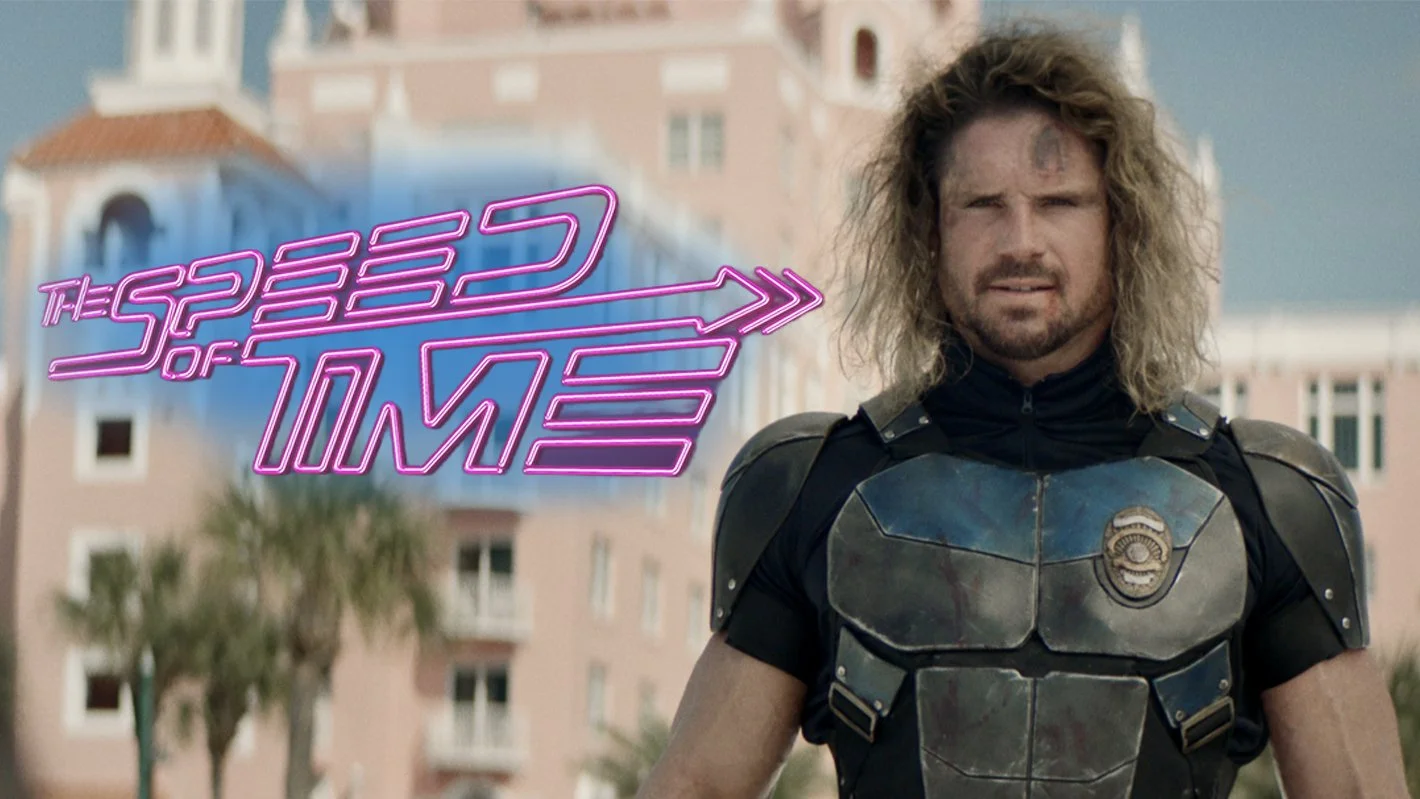
SPEED OF TIME
Johnny Killfire must go back in time and team up with his former self to stop the TimeBorgs from getting their hands on an app that breaks the space-time continuum by delivering pizzas into the past... before they were even ordered.

Directed by William J. Stribling
Johnny Killfire must go back in time and team up with his former self to stop the TimeBorgs from getting their hands on an app that breaks the space-time continuum by delivering pizzas into the past... before they were even ordered.
READ OUR INTERVIEW WITH WILLIAM
Tell us a bit about yourself and your filmmaking background.
Hi, my name is William and I’m an Al-aholic. As in Weird Al. As in Yankovic. When I was a kid, I really gravitated towards comedy. Monty Python, Weird Al, the movie Airplane!, Homestar Runner, anything Robin Williams touched. The 90s was a fun decade to grow up in. A lot of comedies being released in theaters every week. If Martin Lawrence was in a movie, I was guaranteed to see it several times. But I was also a child of the Blockbuster generation, so when I wasn't seeing a movie in the theater, I was devouring anything and everything at home on VHS and eventually DVD. I saw so many films way too young, like Citizen Kane and Cuckoo's Nest. I saw Iñárritu's 21 Grams in theaters when I was 12. A few times. I’m originally from St. Petersburg, Florida, and I was always the kid with the video camera wherever I went, making little movies just for fun, just to make myself and my friends laugh. I went to a performing arts high school but realized quickly that I didn’t want to pursue performing in college and beyond. So I looked into film schools, applied to a bunch, and ended up at NYU for undergrad. And I’m glad I did, because it’s where I met one of my closest collaborators, Alex Gallitano, who has shot just about every movie I’ve made. After college I went to Chapman to get my masters in screenwriting, which is where I met my writing partner Russ Nickel. A few months after graduating we were on set making our feature film Bear with Us. That film and the relationships we made in the process have been responsible for a lot of the work we’ve done since. I’m still proud of that one.
What was the inspiration behind SPEED OF TIME?
The challenge we posed to ourselves was pretty simple: can we cram an entire action flick into 10 minutes? The answer was resounding no. The film ended up being almost 13 minutes long. But oh well! Russ and I had been working with John Hennigan (who plays Johnny Killfire) for a few years on a handful of other projects. We were chomping at the bit, just anxious to get out there and shoot something that married John’s unique style of stunts/fighting with our comedic chops. And the rest is history! Back to the Future is obviously a clear inspiration, along with all the other big silly action films of the 80s and 90s. We tried to channel that without actually making too many specific references. I think the Predator handshake is the only thing we just straight-up stole. The rest is us tapping into that vibe.
What was it like to bring this film to life and what obstacles did you overcome along the way?
Though we all live in Los Angeles, we actually shot the film in my hometown in Florida, with a lot of help from the good people at the St. Petersburg/Clearwater Film Commission. Most of the prep was done remotely, and when we arrived in Florida we found out that our primary shooting location had backed out at the last minute. Which sent us into panic mode, because the plan was to use that one location to play as about a dozen locations in the film. The thinking behind that was we’d be able to make better use of a shooting day and avoid company moves at all costs. But there wasn’t a replacement available, so we scrambled to scout as many places as we could and I’m honestly happier with what we ended up with. There’s a lot more variety to the locations that wouldn’t have been possible with the original plan. Sure, we shaved years off our lives in those two manic days leading up to the shoot, but I’d say it was worth it.
What is your favourite part of the filmmaking process?
Easy! Being on set. In the entire process, we spend so little time on set, proportional to the writing, pre-production, and post-production processes. So I try to really enjoy myself when we’re shooting.
So you’ve made both shorts and features. How important has short film been in springboarding you into feature filmmaking?
I’ve never really used a short film as a springboard into a feature. Not intentionally anyway. It’s always just been a way to tell a different kind of story, or to make a film in a way that wouldn’t necessarily work as a feature. The Speed of Time, for example, works as a calling card, but the basic conceit of the short doesn’t work as a feature. So as we’ve been developing the feature version of The Speed of Time, we’ve been finding funny ways to maintain the spirit, knowing that the basic gag doesn’t work in a 90 minute film the way it does in a 10 12 minute film. Shorts are such a different medium, and the process of making one is so different from features. As easy as it is to put your short film online or take it around to festivals, shorts in America just don’t have a great distribution model the way features do. So I don’t find myself actively working on short films, but when an opportunity arises, I’m always game to use it as an excuse to try something I haven’t done before. The DUST release of The Speed of Time was a godsend. 2020 was going to be a fun year of taking the film all over the world to film festivals, but when they all went virtual, those plans evaporated. Being able to launch the movie to DUST’s giant, passionate audience has been an absolute blast.
What advice would you give to short filmmakers trying to make the jump to features?
Just make a feature! Do it! I dare you! I see so many people spending so much money on shorts. And I get it. But also, I don’t really get it. You can make a feature film that can be shot for whatever you were going to spend on your short. I just made a feature film in 5 nights in Las Vegas for faaaaaaaaar less than we spent on The Speed of Time. It can be done! And in my experience, a feature is simply a more valuable investment with a better chance of getting distribution.
Any film recommendations that we can watch to keep us busy while social distancing?
I’ve spent the entire pandemic binge-watching RuPaul’s Drag Race. If you haven’t gotten into it yet, what are you waiting for??? Two of my favorite films from last year were The Sound of Metal and Uncle Frank. Highly recommend.