

I Understand
After an argument, Ben and Eve meet a friend in a pub to each tell their side of the story. But what really happened that night?
WRITTEN & Directed by MARK VAN HEUSDEN
PRODUCED BY Victoria Fäh
After a heated argument Ben and Eve let off some steam by meeting a friend in a pub and each telling their side of the story. As they both tell their version of events and what they wished they had done instead, we find out what really happened that night.
ABOUT THE FILM
I Understand is the third short film from festival alumni Mark van Heusden. Thus far all three of his shorts have been screened by Kino, with I Understand being an official selection at our 2024 edition of the BIFA qualifying Kino London Short Film Festival. Other highlights for I Understand include screening at the Kingston International Film Festival and it’s online premiere with Film Shortage.
ABOUT THE FILMMAKER
Mark is a London based editor and occasionally writer and director. His films as director include British Graffiti (Norfolk Film Festival best student film winner, Birmingham Film Festival best short film & best editing nominee) and David French Is a Piece of Shit and I want Him Dead (Hollyshorts Film Festival official selection, Kino London Short Film Festival best short, best screenplay, best actor nominee and winner of best score). His latest effort as an editor Us & In Between just finished it’s highly successful festival run and premiered on Director’s Notes.
Mark also works as a visual effects editor on feature films and tv shows (House of the Dragon, The Witcher, The Lord of the Rings: The Rings of Power, Doctor Who)
READ OUR INTERVIEW WITH MARK
Welcome back to our Short of the Week series. What have you been up to since we featured your last short David French Is A Piece of Shit And I Want Him Dead?
After David French Is a Piece of Shit and I Want Him Dead, I took a long mental health break because I burned myself out a bit. This film is a direct result of that because I wrote it to make sense of all the thoughts going through my head. Before I went into production on I Understand I directed a few music videos (for bands Wyldest and GUYY respectively) working with Max Conran who is a great DOP and even greater friend. And I was fortunate enough to edit Katia Shannon’s short film Us & In Between which is probably my favourite thing I worked on so far.
Tell us about the genesis of I Understand. Where did the idea come from and how did you develop that idea into the short that's now made its way out into the world?
As I said I wrote this when I wasn’t feeling very well. I went through a break up which was quite messy and I kept thinking about what was said by both of us and what I wished I had said or done instead. I wanted to explore that strange occurrence where you lie to yourself and don’t say what you mean because you’re afraid to hurt the other person. Initially I wrote it as a breakup movie but I ended up changing it to a brother/sister story because I got over the break up and didn’t want to open those wounds again. I felt I moved on. Also my grandmother was dying at the time and she had a difficult relationship with my mother. Despite this my mum was by her side day and night before she died. And that made me realise that with family, even if you don’t get along, you have this connection that you can’t ignore. So I wanted to explore the difficulties of a family quarrel because I know many people will have experienced something similar.
What were some of the main obstacles you experienced when making I Understand and how did you overcome them?
We shot a house party with 20 extras in a 2 bedroom apartment. I was adamant we use a dolly in there too. It was very tight. But it all went smooth because the crew was prepared and we had set up a chill area outside so not everyone had to be in the apartment all the time.
Tell us about the journey of getting your film to audiences and some of the festival circuit highlights.
Honestly this has been a difficult part of the journey for me. You hope a film gets into loads of festivals and that it connects to people that way, but I Understand had only two festival selections out of many submissions. However of people who did see it at these festivals I got some nice responses of people who had troubled relationships with their siblings or their parents, and said that this is exactly what it feels like. Ever the self critic, I have some gripes with the film too, but instead of seeing it as a failure I see it as part of my journey as a filmmaker to see the mistakes I’ve made and focus on improving my craft.
What advice or hacks would you give to other short filmmakers?
Don’t do everything by yourself. I’m very introverted and do as much as I can by by myself. I edited this, mainly because I love editing and to save money, but I was too close to the material and afraid to kill any darlings. I think having an editor on board would have been better for the film in hindsight.
Any film recommendations that we should add to our watchlist?
Some things I saw recently that I really liked.
Carnal Knowledge
Lone Star
Ponyo
The Return of the Living Dead
Flow
Ordinary People
What are you working on next?
I’m attached to edit a short by the end of this year and I’m hoping to edit more shorts in the next year and to connect with directors that way. Otherwise I wrote a feature film I’m very passionate about, a thriller about a young girl who finds out her father is an incarcerated serial killer. A director friend of mine read it, loves it and we’re hoping to get this made as his directorial debut feature.
Interested in getting your work selected as Short of the Week?

Amina
As a way of mastering her skills, Amina takes on every new relationship as a chance to perfect her cooking.
WRITTEN, PRODUCED & Directed by Christie Fewry
A girl tries her best to master love through her artistic expression of cooking. She learns as quickly as she keeps making mistakes. For her, making the perfect dish and finding love is an act of service to herself that she is relentless on achieving. This micro-short film is based on West African, Sierra Leone/British women who love to cook.
ABOUT THE FILM
Aminia had it’s UK Premiere at the Manchester Film Festival and it’s London Premiere at the New Renaissance Film Festival where it also received an Honourable Mention for Best Short Short. It won the Black Power Award at the Reale Film Festival and it was nominated for the Best Micro Short Award at the Wolverhampton Film Festival. Other festival highlights include Women Of The Lens Film Festival, Spark Micro-Short Film Festival, FILMSshort Online Film Festival, Atlanta Micro Short Film 2024, and the Austin Micro Film Festival.
ABOUT THE FILMMAKER
Christie Fewry is a natural storyteller, actor and filmmaker, who recently graduated from Rose Bruford College in BA Acting. She produced her debut award-winning short film, Amina, which had its UK premiere at the BAFTA and BIFA qualifying Manchester Film Festival, then received an Honourable Mention at the New Renaissance Film Festival. Amina earned a total of nine festival selections worldwide. Christie made her stage debut in the world premiere of The Great Privation: How To Flip Ten Cents Into a Dollar at Theatre503. Beyond acting and filmmaking, Christie delves into her spiritual experiences through her writing, with her poems published in Breadfruit magazine’s Black British Writers Feature Project.
READ OUR INTERVIEW WITH CHRISTIE
Welcome to our Short of the Week series. Tell us a bit about yourself and your filmmaking background.
I’m Christie Fewry, a London-based actor and emerging filmmaker of Sierra Leonean heritage. I made my debut as a writer-director with Amina, a micro-short that explores love, identity and heritage through the act of cooking. My background is in performance, I graduated from Rose Bruford College with a First Class in BA Acting but storytelling has always been at the heart of my creative journey.
As a filmmaker, I'm fascinated with the stories of the women around me, and I’m always drawn to intimate, character-driven stories centring African and Black-British women and girls. Amina was made with heart and community, and it’s been incredibly affirming to see it resonate on the festival circuit, especially making its UK Premiere at Manchester Film Festival. I screened my second short film, Made of A Million, in 2025 and am now developing my third short. I’m excited to continue building stories that feel both grounded and bold.
Tell us about the genesis of Amina. Where did the idea come from and how did you develop that idea into the short that's now made its way out into the world?
Growing up, I observed women in my family commit to one specific stereotypical gender role, which was to spend a lot of time in the kitchen, and this bothered me. Rebelliously, I observed their behaviour from a place of judgment. However, as I investigated the reasoning behind why they cooked so much, I found it was their love language. A way of presenting and expressing their artistry as a gift to the family and with every dish they strived for excellence. This inspired me to write Amina and explore the parallels of a young woman cooking the perfect dish and finding love. Her relentlessness causes her to move on quickly from mistakes in order to create what she knows she deserves, whether it is through cooking or a new relationship.


What were some of the main obstacles you experienced when making Amina and how did you overcome them?
One of the biggest obstacles I faced making Amina was working with limited resources while being far from home. It was a self-funded, micro-budget project costing 900 GBP, and I was making it in Los Angeles without an established network. Every decision from locations to the size of the crew had to be incredibly intentional. On top of that, finding the right collaborators in an unfamiliar city felt daunting.
That changed when I attended a screening and saw a short film that really moved me. I reached out to the DP, Isaak Kimmel, and to my surprise and gratitude, he connected with Amina and came on board. That moment reminded me of the power of sharing your vision and not being afraid to ask, even as a new filmmaker. In the end, what felt like limitations became a source of strength. They pushed me to focus on the emotional core of the story and lean into creativity, collaboration, and belief in the work and in myself.
Tell us about the journey of getting your film to audiences and some of the festival circuit highlights and/or online release.
Getting Amina to audiences has been such a rewarding journey. The film screened at Manchester Film Festival as a UK Premiere, was nominated for Best Micro Short at Wolverhampton Film Festival, and received an Honourable Mention for Best Short Short at the New Renaissance Film Festival, each moment felt like a meaningful nod to the story and the work behind it. One of the most special highlights was screening at the National Youth Theatre, where the film was watched by a room full of young, aspiring creatives, the kind of audience I deeply hope Amina connects with. Now that the festival circuit has wrapped, I’m excited for it to live online through Kino Short of The Week and continue reaching new viewers.
What advice or hacks would you give to other short filmmakers?
My biggest piece of advice is, start with what you have. Amina began as a poem, and I had a very clear moving image in my head that I couldn’t ignore. I didn’t wait for the “perfect” conditions, I used what I had, trusted the story, and let that lead the way. Also, don’t be afraid to submit to festivals, even the ones that feel “too big.” I almost didn’t apply to Manchester Film Festival because I thought it was out of my league, but it ended up being one of the most affirming experiences of the journey. Take the risk. Let your film travel further than your doubt allows.
Any film recommendations that we should add to our watchlist?
The Photograph (2020), Soul (2020), Molly's Game (2017), Slumdog Millionaire (2008), and The Woman King (2022).
What are you working on next?
Next, I'm working on a new short called Pageant Sweet, that's sits in the sports drama genre. The Premise is a competitive and desperate young woman wants to win a beauty pageant, to pay back a loan shark but her biggest competitor is winning. Using her beauty, she turns to the pageant sponsors for help. When that fails, she goes to extreme lengths to win.
Interested in getting your work selected as Short of the Week?

Contemporary
Explore the transformative power of art through the stories of three groundbreaking UK-based artists—Denai Moore, a vegan Jamaican chef revolutionizing cuisine; Mr Cenz, a graffiti artist reshaping urban landscapes; and Bimini, a drag performer pushing the boundaries of identity and performance.
Directed by zaeem asad
Produced BY emma raz
Contemporary explores the transformative power of art through the stories of three groundbreaking UK-based artists—Denai Moore, a vegan Jamaican chef revolutionizing cuisine; Mr Cenz, a graffiti artist reshaping urban landscapes; and Bimini, a drag performer pushing the boundaries of identity and performance. This visually rich documentary celebrates their unique journeys, challenges conventions, and reveals how they are shaping modern culture by turning everyday moments into extraordinary expressions of creativity.
ABOUT THE FILMMAKER
Zaeem Asad is a London-based filmmaker known for his compelling commercials and documentaries. Having directed over 60 commercials, mainly in food and beverages, he brings a sharp eye for storytelling. His passion lies in crafting authentic narratives, capturing the lives of real people who challenge societal norms, and exploring culture and creativity through film.
READ OUR INTERVIEW WITH ZAEEM
Welcome to our Short of the Week series. Tell us a bit about yourself and your filmmaking background.
I’m Zaeem Asad, a London-based filmmaker. My career began in music and local TV before transitioning to commercials, with notable clients like Nestle and PepsiCo. I’m also known for directing Pakistan's first locally made food commercial. My passion for storytelling through visual mediums, particularly around cultural themes, led me to direct Katalina, a documentary about communal living in northeast London. In addition to filmmaking, I’ve always had a deep connection to art, which has been central to my creative journey.
Tell us about the genesis of Contemporary and your motivation for making this film.
Contemporary was born out of a shared passion for art between myself and producer Emma Raz. We both have personal connections to the arts—Emma through painting and I through music—that shaped our desire to explore how art influences contemporary society. The motivation for making this documentary was to showcase how art exists in everyday life, through unique perspectives like Denai Moore's innovative culinary approach, Mr. Cenz’s street art, and Bimini’s performances. We wanted to highlight the transformative power of art and its ability to shape identity and culture.
What were some of the main obstacles you experienced when making Contemporary and how did you overcome them?
One of the main challenges was coordinating with artists who have such diverse and dynamic practices. Each of them operates in unique spaces, from kitchens to the streets to stages, which made scheduling and capturing the essence of their work difficult. To overcome this, we relied on flexibility, adjusting our shooting schedules to work around their creative processes. Another challenge was balancing the vision of each artist with the overarching narrative of the film, but through collaboration and constant communication, we were able to maintain a cohesive story.
Tell us about the journey of getting your film to audiences and some of the festival circuit highlights.
The journey of getting Contemporary to audiences has been incredibly rewarding. We began by submitting to various festivals, and it was humbling to see how well the film resonated with audiences. A highlight was being selected for [specific festivals], where it sparked deep conversations about art's role in shaping modern culture. The festival circuit allowed us to connect with diverse audiences and filmmakers, further amplifying the message of the film.
What advice or hacks would you give to other short filmmakers?
Start with what you’re passionate about, and stay true to your vision. The journey of filmmaking is full of compromises, but never lose sight of why you wanted to tell that story in the first place. Additionally, collaboration is key. Surround yourself with a team that shares your enthusiasm and perspective. Lastly, embrace the process—every obstacle is an opportunity to learn and grow.
Any film recommendations that we should add to our watchlist?
I recommend watching Inside Llewyn Davis, as it offers incredible perspectives on the challenging life of an artist as well as the wider culture surrounding art. These films, like Contemporary, challenge conventions and offer deep reflections on the world we live in.
What are you working on next?
Currently, I’m developing a new project that explores the concept of heritage. It’s still in the early stages, but I’m excited to dive deeper into how art and identity intersect in different cultural contexts. Stay tuned for more updates!
Interested in getting your work selected as Short of the Week?

Satisfaction
Georgian England. A society lady raises her pistol to duel with her aristocratic mentor over a grave insult.
Directed by BAILEY TOM BAILEY
Written BY Christopher Buckley
Produced BY Marek Lichtenberg & Nathan Craig
Georgian England. A society lady raises her pistol to duel with her aristocratic mentor over a grave insult.
ABOUT THE FILM
Satisfaction was an Official Selection at our very own BIFA qualifying Kino London Short Film Festival in 2024 where it was nominated for Best Score. Other festival highlights include the Oscar Qualifying Flickers’ Rhode Island IFF, the BAFTA qualifying Bolton IFF, the four other BIFA qualifying festivals including Exit 6 (Nominated for Best Editing), Crystal Palace IFF, Brighton Rocks FF, and Sunderland SFF.
ABOUT THE FILMMAKER
Bailey Tom Bailey has made many shorts and music videos that have played international BIFA, BAFTA & OSCAR qualifying festivals and online platforms including Short of the Week, Slamdance, Fright Fest, Berlinale, LSFF, Rhode Island, Bolton, Nowness, Omeleto, 1.4 awards, Shiny awards, and have won several awards along the way. He also works as an editor and sometimes VFX artist for clients including Nike, Adidas, Somesuch, AMV, BBH, Dazed. He has a background in painting, is an alumnus of Arts University College Bournemouth, Berlinale Talent Campus and has studied Meisner acting and improv comedy. Bailey is developing several features and a series based on Satisfaction.
Christopher Buckley is an actor and writer. He has written two shorts, including Satisfaction and a play ‘Third Grade’ performed at the online ‘8x8’ theatre festival in May 2020. Chris was a lead part in the original cast of Stranger Things: The First Shadow. He has performed onstage across the UK and Europe, winning the Theatrepreis Hamburg Rolfe Mares award for ‘Best Actor’ in 2017 for ‘Orphans’. He has also recorded various radio and audio dramas for BBC4 and Audible. Through his writing, he hopes to champion and elevate neglected stories and characters, both onscreen and onstage.
READ OUR INTERVIEW WITH bailey
Tell us about the genesis of Satisfaction and your motivation for making this film.
I (Bailey) and Christopher connected through Centerframe's Get It Made competition. Christopher had written a script about petticoat duels (duels between women), which were uncommon but happened throughout history. In his research, he found a famous Georgian cartoon of two women duelling with pistols, and the script grew from there. We were fascinated by how Georgian social structures were dehumanising these old friends, making them rivals. Over the course of the script, they rediscover their humanity, their mercy. Chris developed a brilliant Georgian slang that had me looking up various words, but gave the project a unique voice and tone. In later drafts, I encouraged Chris to draw out the duel and heighten the suspense, an approach that continued into production, where I took cues from how Sergio Leone built his shootouts.
What were some of the main obstacles you experienced when making Satisfaction and how did you overcome them?
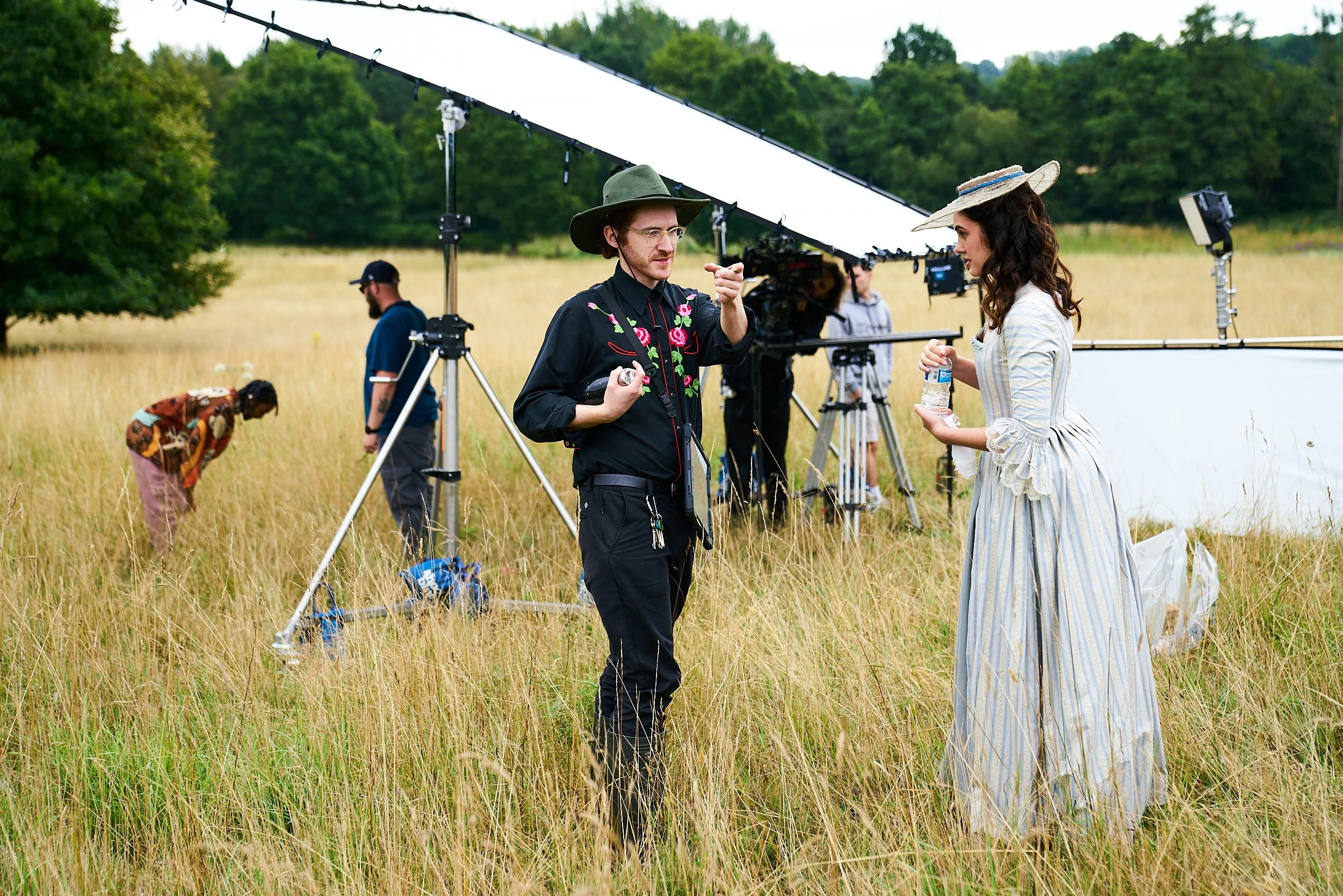
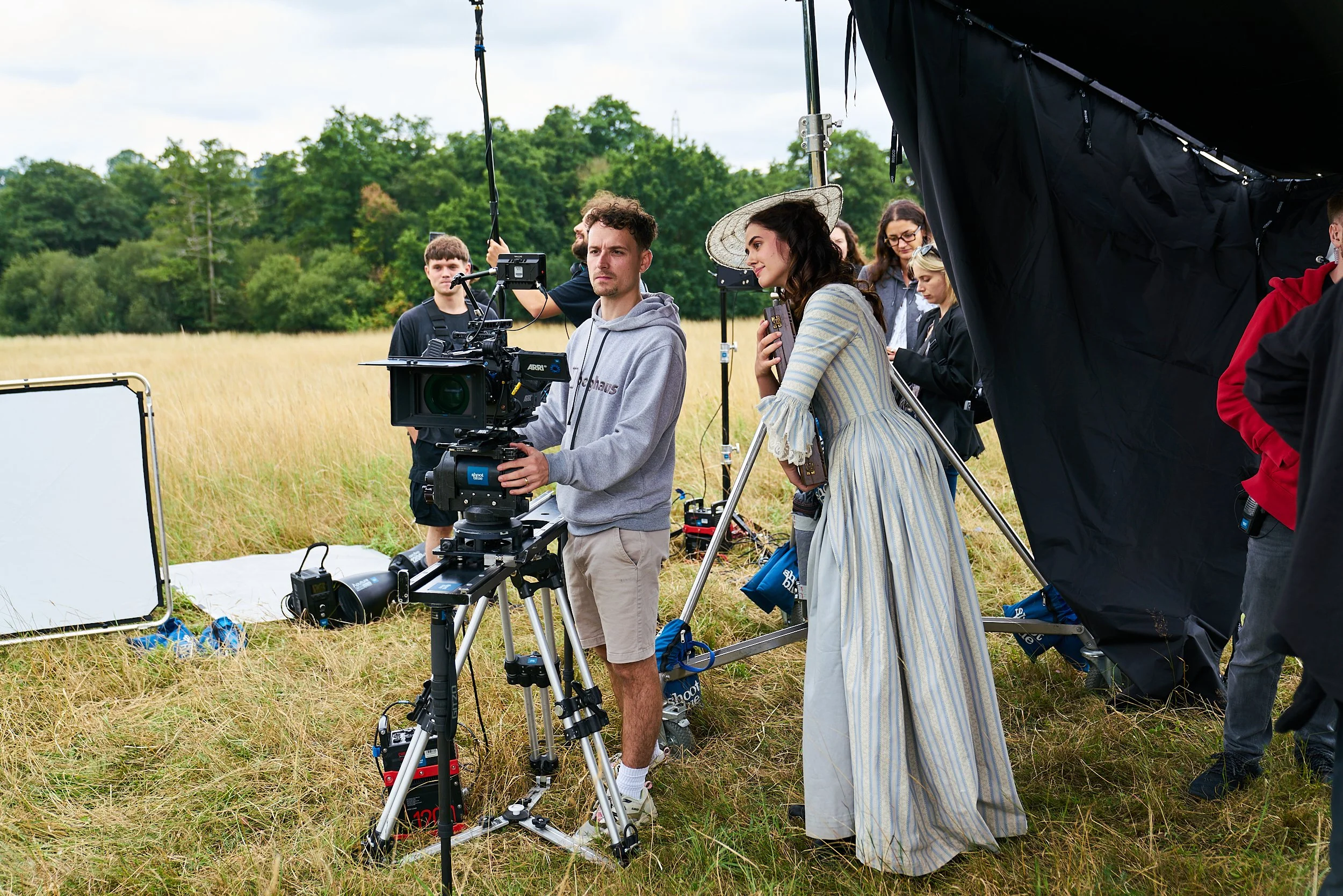
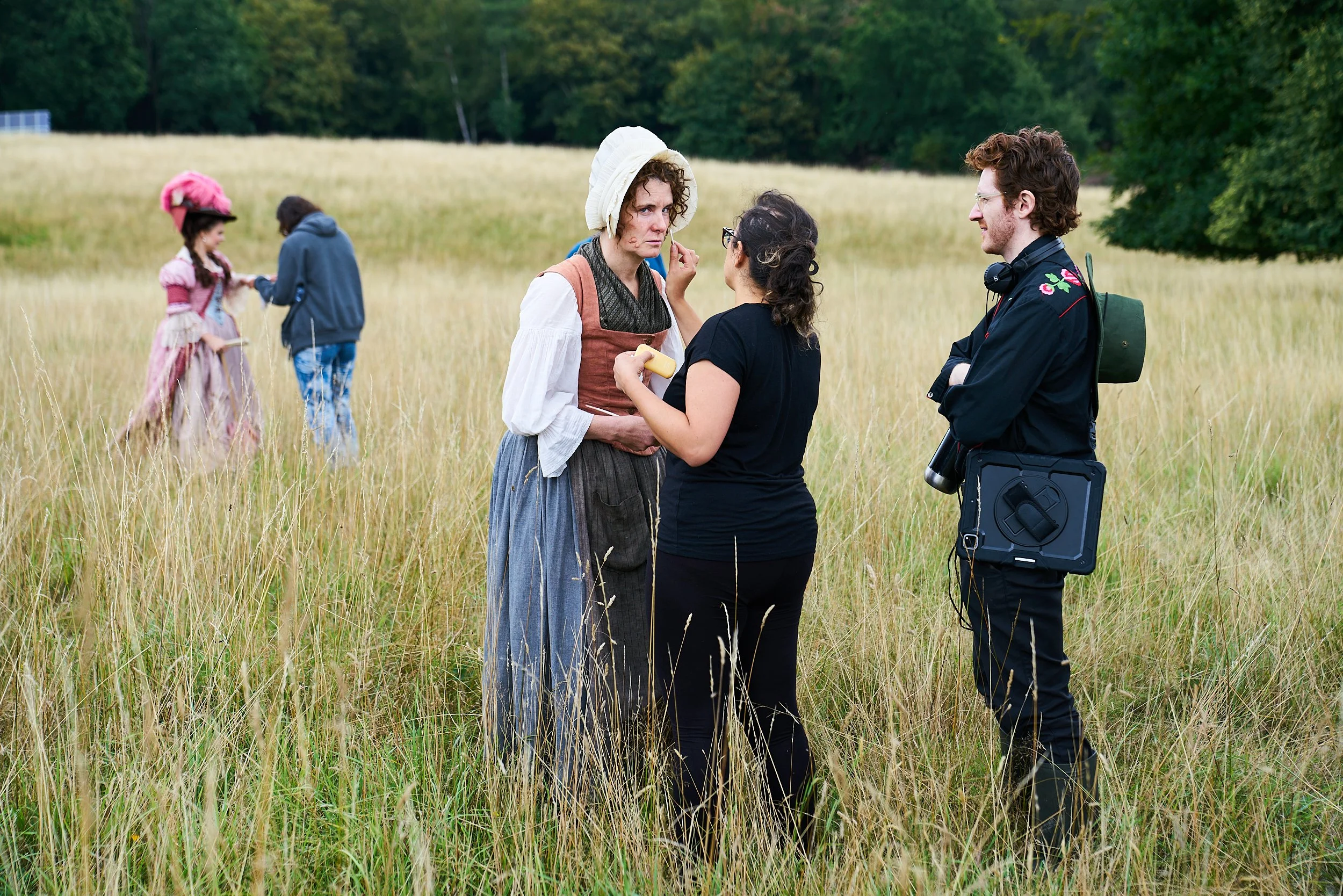
Fields. It's surprisingly hard to find a field / landscape that offered compositional possibilities, where you don't risk some member of the public slowly traipsing across the back of the frame. We realised the answer was to find a location that had private grounds, likely a stately home. However, these came with a hefty price tag, and often their lawns were too manicured. Finally, one of our producers Nathan Craig, found a stately home (that anecdotally, had briefly been owned by Led Zepplin) that wasn't on a location library, which was sympathetic to our project and had natural and photogenic grounds.
As we led up to the shoot day it was forecast to rain on our second day, but didn't feel we could move everything. So we crossed our fingers - and the gods laughed. It was torrential and our morning was mostly rained out. To cover ourselves, we had shot longer on our first day, then on the second we worked under cover for close-ups and grabbed the remaining necessary shots in a brief dry patch at day's end.

Photo Credit: DEVIN DE VIL @ licence to capture
Tell us about the journey of getting your film to audiences and some of the festival circuit highlights.
Post on a short can be slow but we managed to complete this within 5 month, with a deadline for a screening hosted by our funders Centerframe. Iron Box Films came on as a partner to fund the festival run. We quickly got it onto the festival circuit and focused on BIFA qualifying events. The film is short and fairly punchy so was often programmed towards the end of blocks as a big finish or pick-me-up before people left. It was nice to see the film, an intended audience pleaser, was landing with gasps, 'oo's and 'no's in the right place. Kino London gave us our first nomination for Andreas Aaser's score, which I believe was much deserved. Music is such an important part of my films and Andreas is very gifted and imaginative. Rhode Island gave us our US premiere and Bolton International film festival also stood out as a great experience.
What advice or hacks would you give to other short filmmakers?
Keep it short of focus the story and make it easy to programme. Keep it in one location so its easier to produce. iIf you're trying to make something that opens doors - keep the audience in mind.
Plan as much as you can, I storyboard everything myself, which is the final re-write before shooting (until we edit, of course!), which saves time.
Have an idea for every department, and brief them as clearly as you can.
Get the best cast you can! Our casting director, Chloe Blake was really helpful, she works with the National Theatre and has her ear to the ground about new talent.
Any film recommendations that we should add to our watchlist?
Once Upon a Time in the West, is a film I thought about a lot during the making of this film, as with the rest of the dollars trilogy, its inventive, plays with audience expectation and has such an operatic quality. It's climax's and pure cinema and I get the buzz I get when I watch a Hitchcock movie that you can see what the director is doing, which I always find thrilling.
Sweet Smell of Success, a noir-drama that I thought of because in his book 'On Filmmaking' the director Alexander Mackendrick (a Brit making his first US film) said he had been given a 'wordy' script but the writer Clifford Odett's (a famous playwright) told him - 'just do it fast'. I thought about that when dealing with the stylised language of Satisfaction. I also marvelled at the blocking of the film and stole moments from it. I'm a huge fan of the blocking of mid-centrury movies (40s-60s).
Days of Heaven - is always and inspiration for its editing, structure and elliptical storytelling, but this time I was thinking about the photography. Along with the paintings of Andrew Wyeth, this film helped me figure out the look and composition of the landscape. It was pivotal in me picking a location that have long grass that was somewhat yellowing, like corn, but not as difficult to work around.
All Watched Over by Machines of Loving Grace, Adam Curtis' documentary, draws incredible connections between obscure historical figures, science, philosophy, politics and society - I believe these alternative versions of history are a little subjective, but the ideas and stories had my jaw on the floor every ten minutes. Expanding Saisfactions' historical subject into a series we're constantly finding the roots of social concepts we now take for granted and Curtis will be in my mind when doing this.
What are you working on next?
We’re developing Satisfaction into a limited series about Ann and Belinda becoming hired guns fighting for women’s honour.
I’m also developing a few features, and packaging one caled Torn Velvet, about a fashion marketer who unravels when she discovers that the sight of safety pins triggers orgasmic, spiritually awakening seizues.
Interested in getting your work selected as Short of the Week?
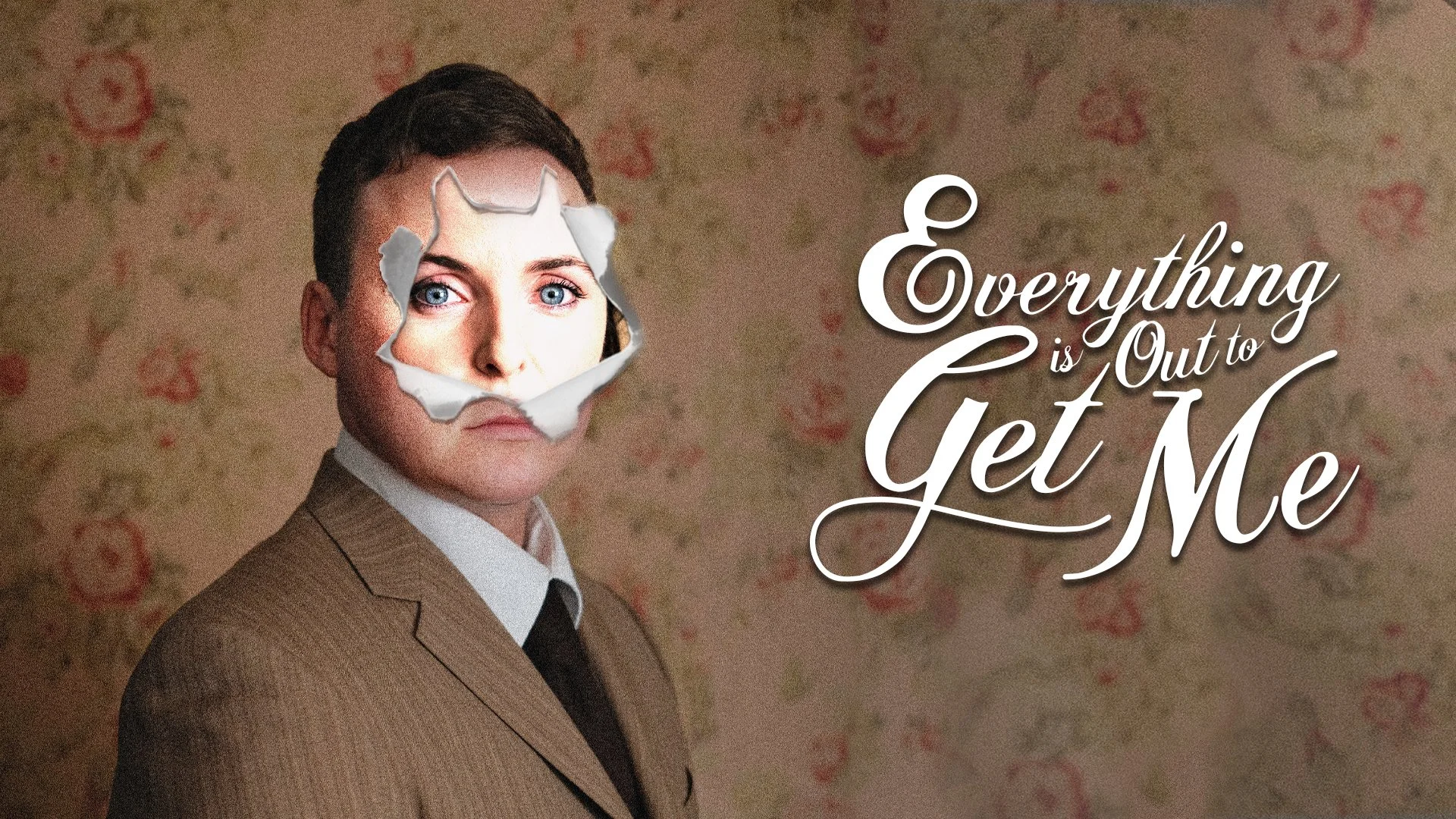
Everything Is Out To Get Me
A housewife finds out her ex-husband has happily re-married and has a newborn baby, but there’s more to his newfound happiness than meets the eye.

Written & Directed by Dustin Curtis Murphy
Produced by Dustin Curtis Murphy & Joshua Carrington Birch
Cinematography by Joshua Carrington Birch
An abused housewife finds out that her ex-husband has happily re-married and has a newborn baby, but there’s more to his newfound happiness than meets the eye.
ABOUT THE FILM
EVERYTHING IS OUT TO GET ME was shot on 16mm film and screened at 21 festivals internationally, including 9 BIFA Qualifiers. Highlights include the Unrestricted View Film Festival (Honourable Mention for Best Editing & Nominated for Best Score & Best Make Up), Dances With Films, Fastnet, Beeston Film Festival, Crystal Palace International Film Festival, North East International Film Festival, Spirit of Independence Film Festival, Sunderland Shorts Film Festival, Romford Film Festival (Nominated for Best Score and Best Screenplay) and TweetFest. The film was also nominated for Best Cinematography at the 2023 British Short Film Awards where it was also long-listed for Best Score and Best Costume Design. Upon wide release it’s been featured by Kodak’s Shoot Film channel, Minute Shorts, and Beyond the Short.
ABOUT THE FILMMAKER
Dustin Curtis Murphy is an award-winning writer, director, and producer creating work at the crossroads of social impact and commercial appeal. His films often focus on character-driven narratives with relevant social themes and tightly structured plots, frequently working in blended genre. His debut feature film "Coyote" won the Grand Prize for Best Sci-Fi Feature at VORTEX, the Audience Award for Best Feature at the Romford Film Festival, and Best Director at the Unrestricted View Film Festival. He is also the CEO of Kino Short Film and the festival director for the BIFA-qualifying Kino London Short Film Festival.
READ OUR INTERVIEW WITH DUSTIN

Tell us about the origin of EVERYTHING IS OUT TO GET ME and how this project came about.
It was summer 2022 and I was just about to wrap production on my debut feature film, COYOTE. I’d spent many years making short films, developing my voice as an artist, experimenting, failing, dusting myself off and getting up again… That process was always leading me towards the lifelong goal of feature filmmaking.
Having finally rolled the feature film boulder up the cinematic mountain, Sisyphean-style to appease the film gods, I certainly wasn’t feeling the need to start at the bottom of the mountain again with another short… but then frequent collaborator, DOP Joshua Carrington Birch, approached me with an offer I couldn’t refuse…
”Let’s do something we’ve never done before.”
He had my curiosity.
“Let’s shoot a project on 16mm film.”
...but now he had my attention.
Growing up in the 90’s, all of my early student projects were all shot on digital. That technology followed me into all of my subsequent work, but I was always trying to make my work look filmic and cinematic (with varying degrees of success). However, there really is no substitute for the real thing.
So how did the story develop from there?
Since 16mm film just oozes the textures of a bygone era, it felt natural to develop this project as a period piece. It was also important to me to create a mutually beneficial portfolio piece for all involved. Something that really showcased all of my friend’s immense talent vs just wrangling them to enable a singular vision.
I was also extremely interested in playing with structure, subverting the usual formulas rampant in modern filmmaking to deliver something fresh. With this film (spoiler alert) I wanted to the audience to feel completely different about these characters by the end of the film than they did at the beginning. The good guy becomes the bad guy and the bad guy becomes the victim of who we thought was the good guy… I wanted to use these narrative twists to challenge audiences biases.
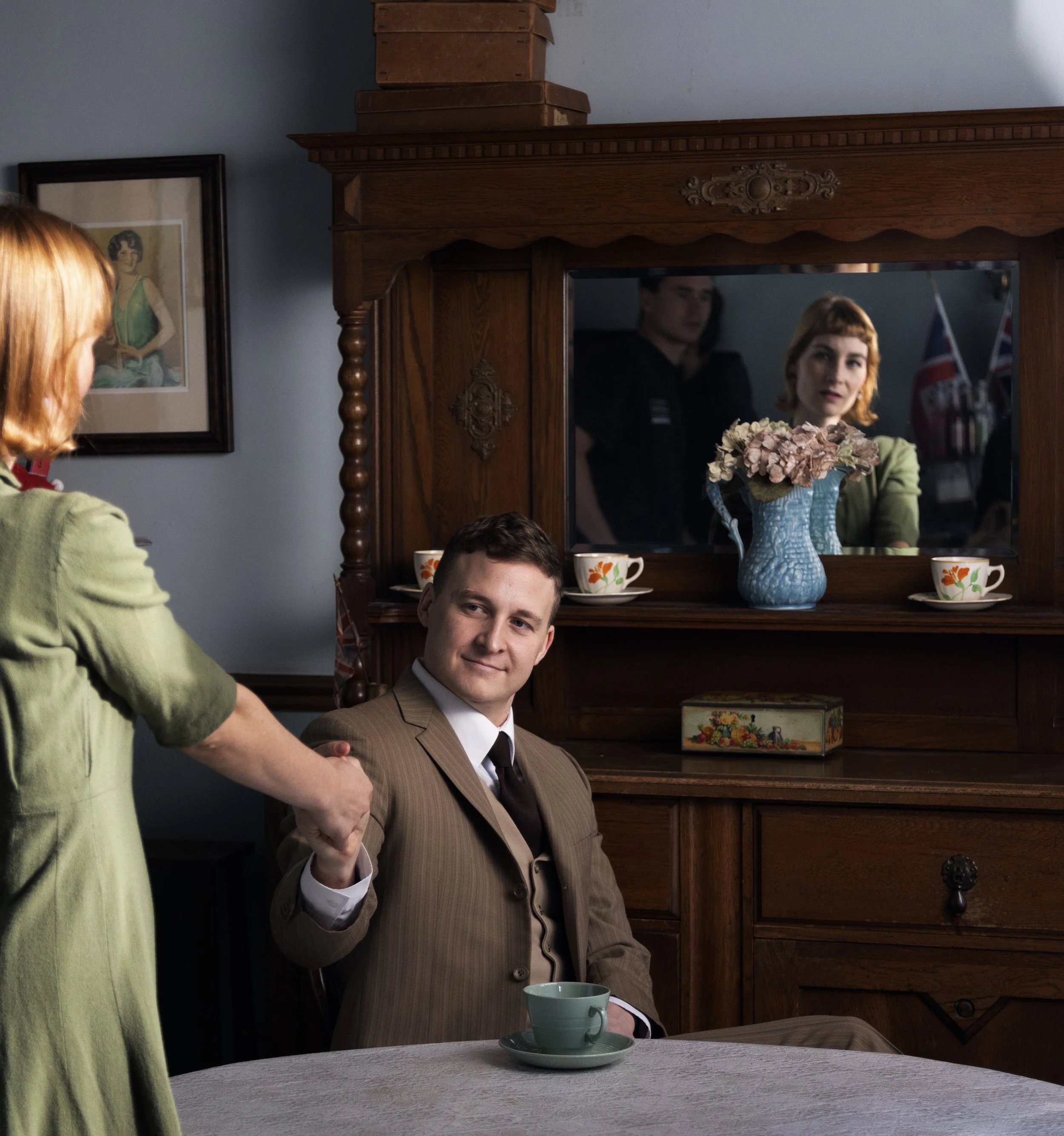
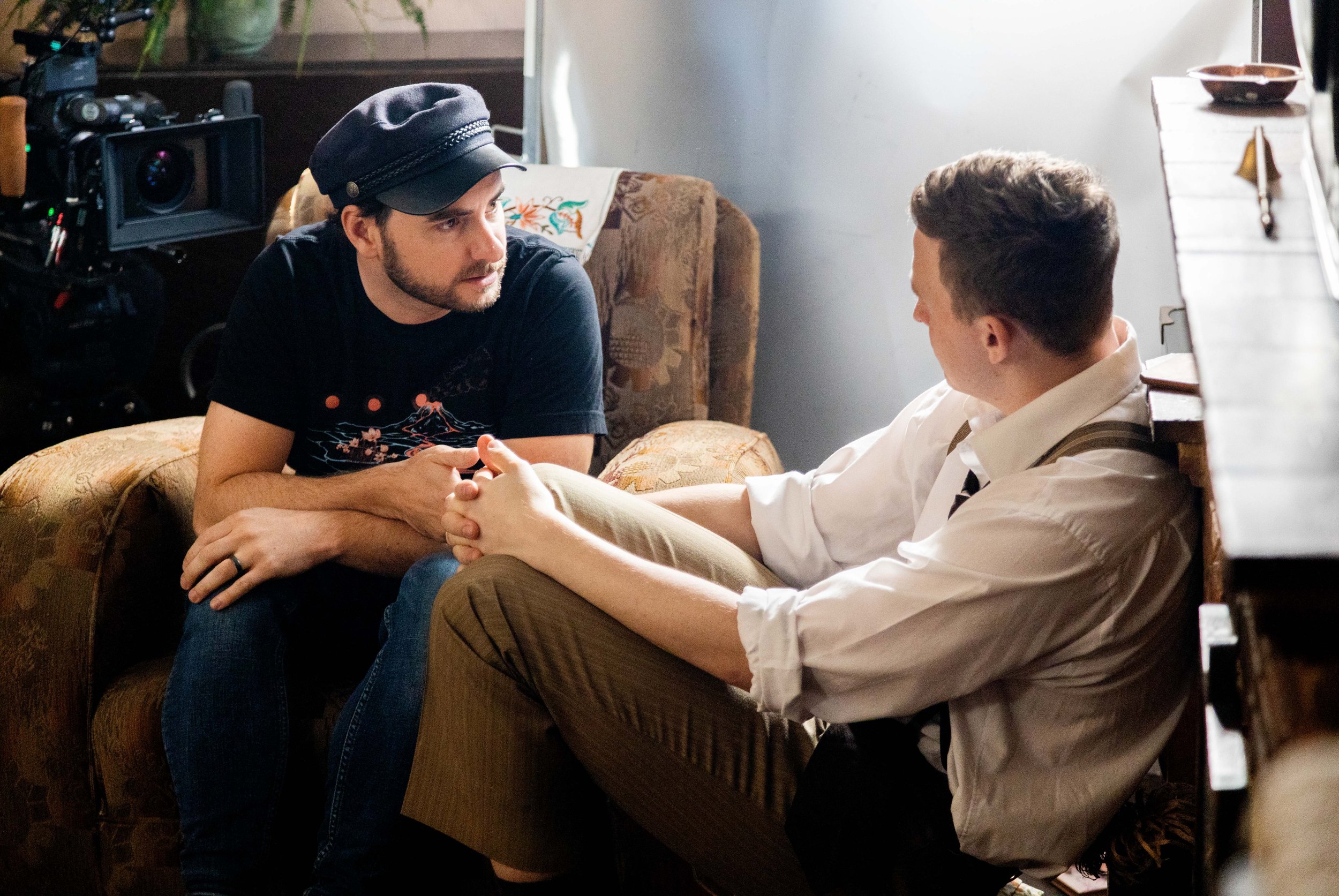
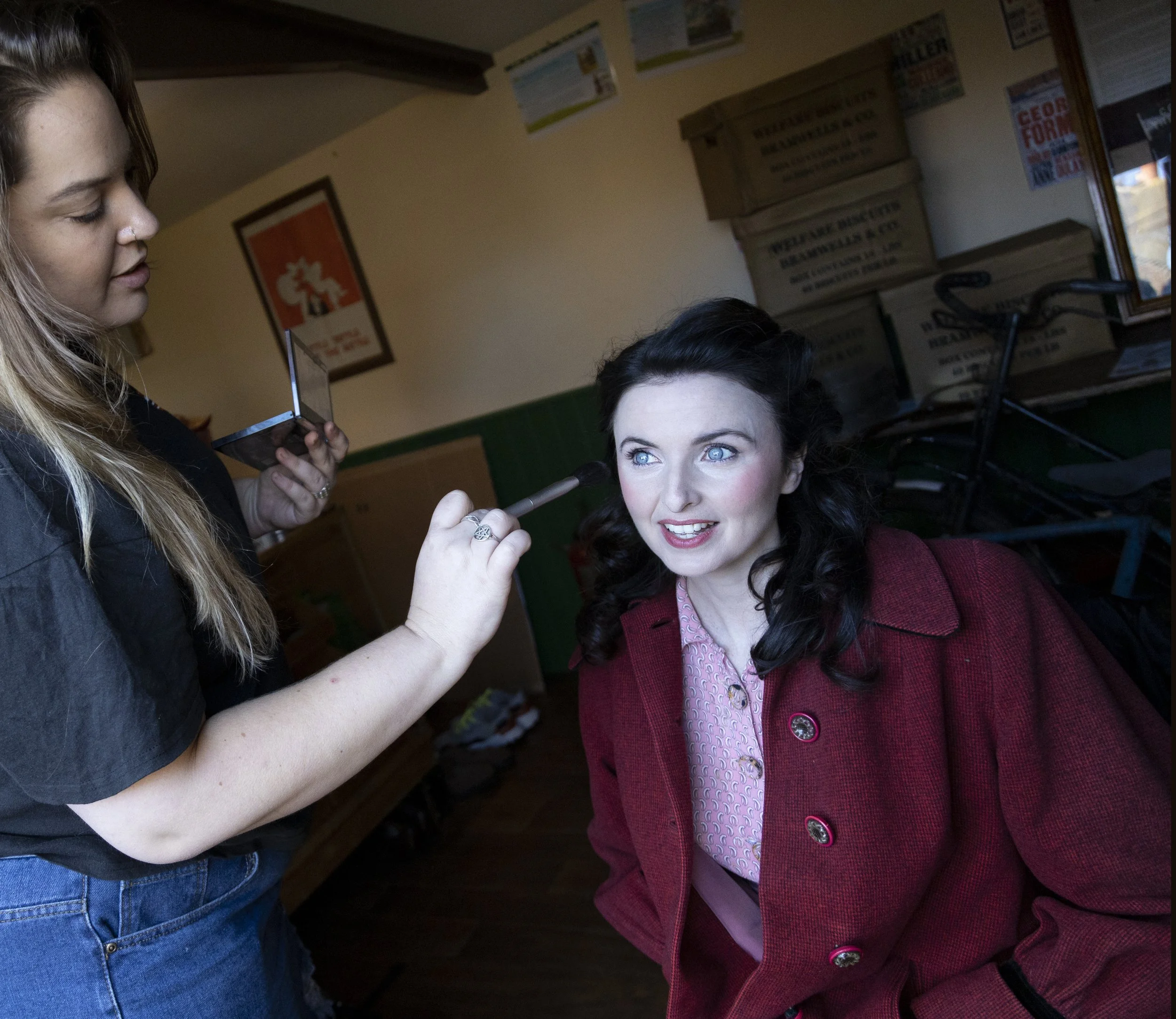
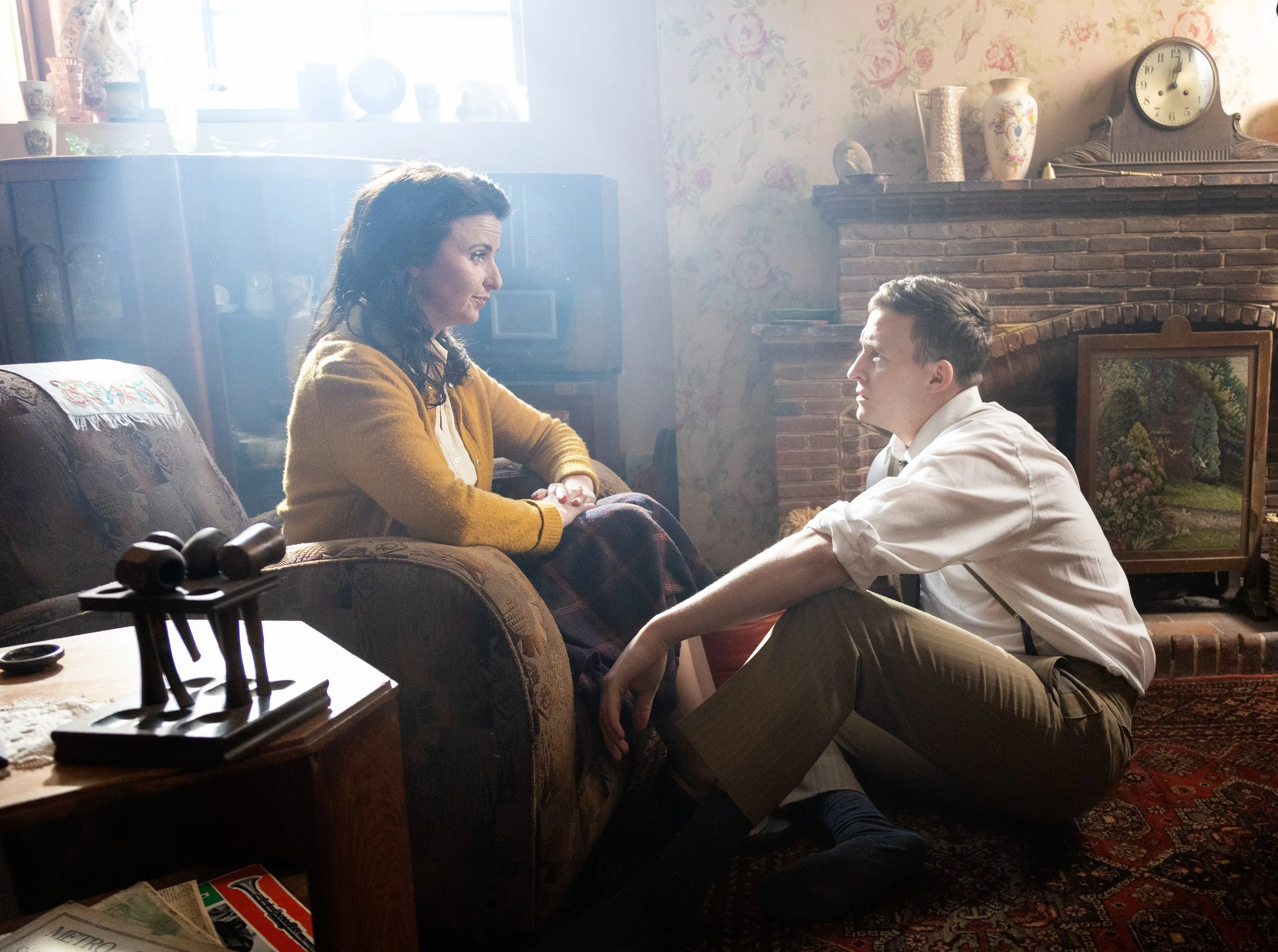
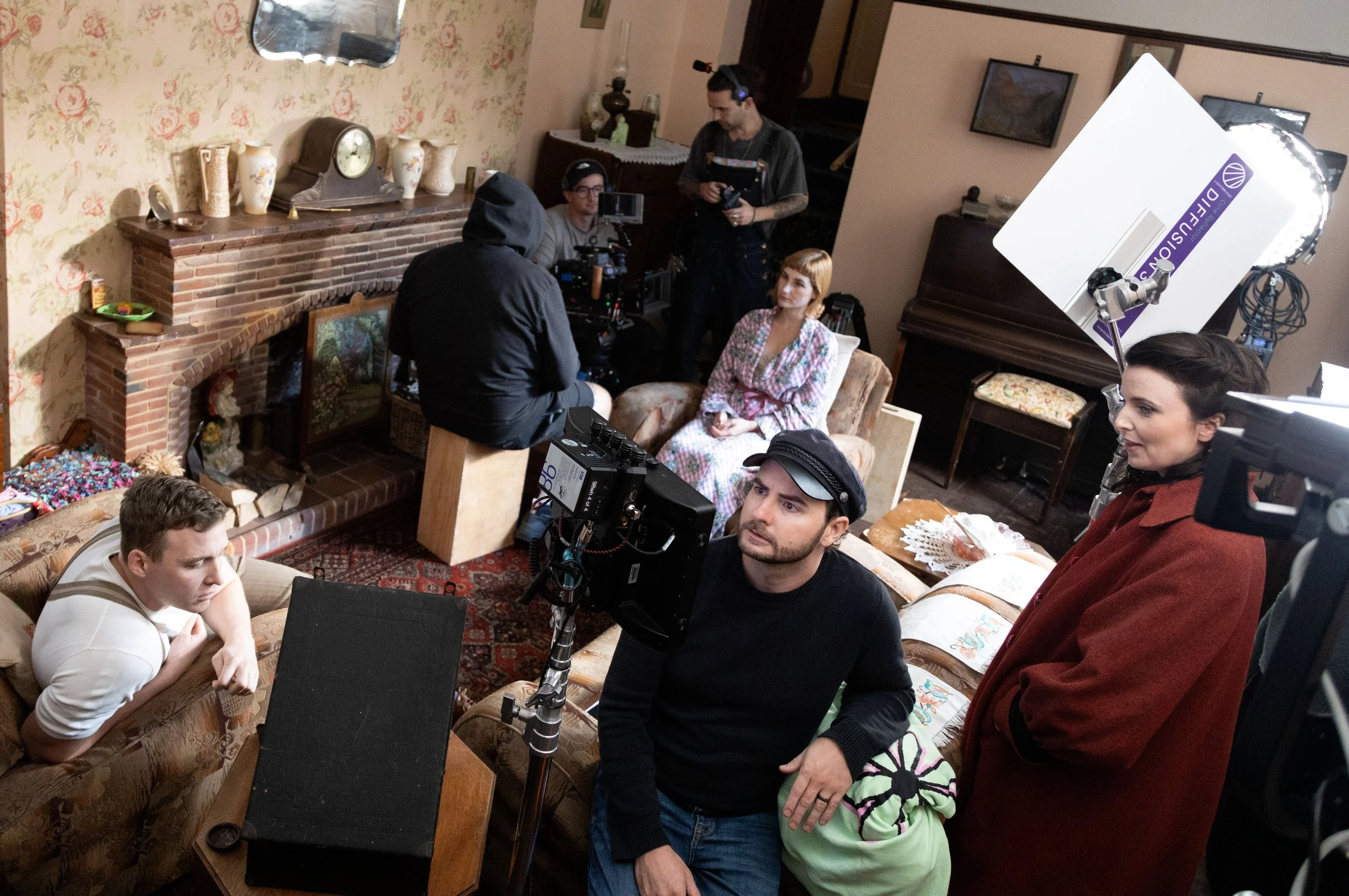
Let’s chat about your choice to tell this story through narration. Why did you make that choice?
It’s odd, but narration can be quite controversial in some pretentious screenwriting / industry circles. Some people consider the use of narration to be “bad writing” or “lazy writing”, but I wholeheartedly disagree. Narration done badly is indeed awful, but then again the same is true for dialog or plot.
Creating a blanket rule that narration should never be used because it’s an inferior art-form is hogwash malarkey. Imagine Fight Club without narration. Same with Forrest Gump, Stand By Me, Apocalypse Now, Adaptation, Casino… I could go on forever. If you look at IMDB’s list of Top 250 films of all time you will see so many examples of narration.
One key deciding factor in making this film a 100% narrated piece was the fact that our film camera was noisy which would’ve impacted our ability to record clean dialog. Additionally the narrative spans many years in the matter of a few minutes. Our film is about the entire scope of a relationship, not a single defining moment of a relationship, so narration was a great tool to link scenes together over the passage of time. The film is also heavily rooted in the misrepresentations of the leading character. Our narrator is the quintessential “unreliable narrator”. The audience starts off believing everything she’s telling us. We empathise with her tale of victimhood, but as the story unfolds we start to realise that the images we’re seeing don’t line up with her words and we’ve been lied to. I wanted the lead character to not only gaslight her partner in the film, but also to gaslight the audience - what a better tool to use for that than narration.
I don’t think the essential components that make this short film what it needed to be would’ve worked without the use of narration, and it certainly was a fun style to experiment with. However, I will say that in the final mix we noticed that the music and visuals were so strong that we didn’t need as much narration as was initially scripted.

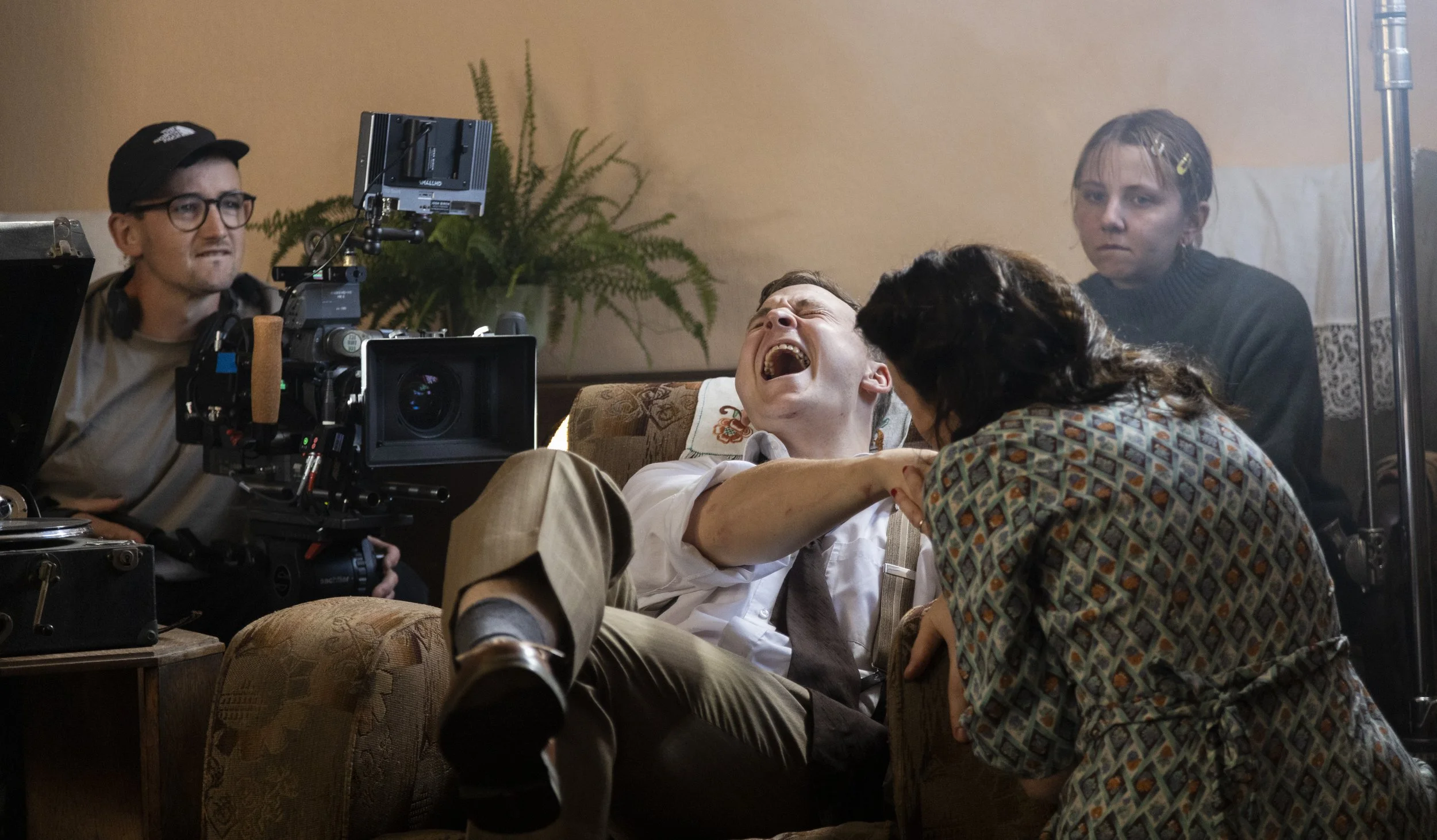
Tell us about the music of EVERYTHING IS OUT TO GET ME.
The score is truly one of my favorite things about this film, and in general working with composers is one of my favorite parts of the collaborative process of filmmaking. (I love many other collaborative relationships as well, so this is in no way meant to throw shade at those who aren’t composers…)
I’d met Thom Robson after he won the award for Best Score at the first year of Kino’s film festival for his work on From Fragments - a beautiful dance film about dementia. I often scout talent via my work with Kino, and I was always looking for an excuse to finally collaborate with Thom. We did work briefly together on my micro-short Filthy Animals, but Everything Is Out To Get Me was what I’d consider our first proper collab.
Thom and I both have a very sensitive ear for digitally created string instruments, so to make the score the portfolio piece it needed to be, we were fortunate enough to work with a 40 piece string orchestra out of Budapest who recorded remotely. It was the same orchestra who does many Hollywood projects including Tim Burton’s Wednesday, but they still set aside 50 minute sessions to help out smaller projects. It was amazing to hear them nail Thom’s composition in just a few takes.
The score is available on Spotify is anyone fancies adding it to their playlist.
Tell us about the journey of getting your film to audiences and some of the festival circuit highlights.
This short was blessed with a very healthy festival run, and while there are great several festival experiences throughout, it’s US premiere at Dances With Films remains my favorite festival experience to date, not just for this film, but for all that I’ve done.
Dances With Films takes place at the historic TGC Theaters on Hollywood Blvd. and it’s everything you think a big Hollywood film festival should be. It’s very well attending and they have special industry events for screening filmmakers where you can actually get in the room with key industry decisions makers. The staff is very friendly and they absolutely champion grass roots filmmakers vs succumbing to the rampant nepotism and privilege that many other big festivals do.
What are you working on next?
The feature length script for Everything Is Out To Get Me is deep into development at this point with several drafts completed. For the feature I’m leaning more heavily into the genre elements that are hinted at towards the end of the short, in particular the home invasion. However, after directing, producing, writing, and editing my debut feature film, it’s certainly not an experience I’m willing to subject myself to again. Making the feature certainly came with it’s highs (and lows) and I’ll always be thankful to some amazing collaborators and investors that believed in the project, but at the end of the day it was a micro-budget production which meant that the solution to most problems was for me to do the work myself. This of course lead me down a path of massive burnout, so for my own wellbeing I’ll not longer be looking to take on four full time production jobs at the same time.
To ease into doing another feature, I’d actually like to get my mojo back by doing a few shorts. I think a lot of people look at shorts as something you graduate from once you’re in the feature film world, but they’re such different mediums. I have a lot of stories I’d like to tell and not all of them should be features.
Hey, if David Lynch can make shorts throughout his career without being embarrassed then why should anyone else feel any different. Go scratch your creative itch any way that feels right to you.
Any film recommendations that we should add to our watchlist?
I’ve mostly spent the last year revisiting my old favorites. Previously, it became kind of a competition between me and friends to see who could boost their IMDB/Letterbox’d view count the highest, but I realized that after being exposed to SO many films over the years I’ve become harder and harder to impress. Pair that with the current state of the industry pushing out more data-driven content vs grand artistic achievements, and I became one bored viewer when it came to new releases…
In slightly similar vein to Everything Is Out To Get Me, I just revisited Marriage Story which is an absolute masterpiece.
For something newer… I super enjoyed Mickey 17 and don’t care what any of the haters had to say about it. Most entertained I’ve been in the cinema in awhile.
Apply to get your short selected as our Weekly Pick

Swimming
A film about a girl who wants to be a fish…

Written & Directed by Gregory Randolph Jr.
Produced by Stanley Mathews
Cinematography by Bethany Yang
A film about a girl who wants to be a fish…
ABOUT THE FILM
SWIMMING premiered at Animal Nature Future Film Festival. It appeared at 2 iterations of Day Dream Fantasy Youth Festival in Glasgow, Scotland and Milan, Italy, as well as being selected for the Earls Court International Film Festival (UK), Goa International Film Festival (India), Canal Dream ICI as part of the London Design Festival, and the Lift Off Global Network Sessions 2023 Jury Choice.
ABOUT THE FILMMAKER
Gregory Randolph Jr. (writer/director) was born in New York City and raised in Boston, Massachusetts. After graduating from Providence College in Rhode Island he moved back to New York to pursue a career in filmmaking. There he worked as a video editor for NBC Universal, ABC News, and HBO. He started his own production company Grandolp Media in 2016. Greg enrolled in the MA filmmaking program at London Film School in 2021. Greg is currently working on a feature film which he is developing now.
Stanley Mathews (producer) is an Indian-born, Qatar-raised filmmaker and producer known for his captivating storytelling. With a Bachelor of Arts in Filmmaking from Whistling Woods India and a Master of Arts in International Film Business from the University of Exeter and the London Film School, Stanley has worked on over 15 short films, some available on Disney+ Hotstar India. He has also directed brand videos with 400k social media views and co-produced the upcoming Indian Feature documentary "Rest in Manhole." Recent credits include the Doha Film Institute Granted short film "Project: Aisha ", Swimming & Different Faces (16mm, 35mm) supported by Kodak & shot on film.
Bethany Yang (cinematographer) is a cinematographer and gaffer from Harbin, China. She enrolled at the London Film School in 2021. Since then she has DoP'd over 15 grad films from London Film School and worked extensively in the camera and lighting department for film and television.
READ OUR INTERVIEW WITH Gregory
Welcome to our Short of the Week series. Tell us a bit about yourself and your filmmaking background.
Sure, I've been making films for quite a while. I was born in New York City and raised in Boston. I was always making short movies with my friends growing up. I did my undergrad at Providence College as an English major and film minor. I made a short documentary on a music venue and a short narrative. I also did a short experimental film called Purgatory Brook with a friend from BU who has an assignment to do somehting in the vein of David Lynch.
I worked as a video editor after college. I lived in New York and worked for the television show Open House NYC and National as a segment and show editor. I worked on all aspects of post-production from ingest of footage to delivery of the final show for broadcast internationally.
I joined the London Film School in 2021. There I made several shorts both narrative and documentary. Swimming is an independent film I made in between terms at LFS. We shot it on 16mm film and had a wonderful time making it. I am glad its received recognition and I have a brilliant cast and crew to thank for helping me make this film a reality.
Tell us about the genesis of Swimming and your motivation for making this film.
Swimming is about a girl who wants to be a fish. I got the idea one day after another shoot we had just wrapped. A friend of mine brought a book out of a bookshop we were having a coffee at. I thought it odd and asked if she had stolen the book. She didn't have a receipt or bag. For some reason, it got in my head - what if someone was stealing books from a bookshop because they didn't want to confront the cashier with what it was they were reading? As if they were embarrassed about the contents of the book. That was the genesis of Swimming. To me, Swimming is about achieving want you want in life and finding your "school" or community.
What were some of the main obstacles you experienced when making Swimming and how did you overcome them?
We wanted to shoot from film and challenge ourselves in that regard. Finding an affordable way to shoot the film and rent the camera equipment necessary was difficult. We have Kodak London to thank for offering an affordable rate to shoot film. We have the now inactive Pro Cam Take 2 for offering the camera equipment necessary to make the project. We also tapped Student Union Lighting at the London Film School for all the necessary lighting equipment and camera dolly.
The film was also about explaining the world of the film to the actors. A world in which it is possible to become a fish. The film is metaphorical but I wanted to find that line between metaphorical and real. That is what makes the movie special.
Tell us about the journey of getting your film to audiences and some of the festival circuit highlights.
It took some time to find an audience for Swimming as it usually does with a new film from an emerging filmmaker. There is often a lot of rejection and self-doubt when trying to find a home for a film you spent so much of your time and thought on. We were very happy when an LFS alumni-run film festival Animal Nature Future Film Festival saw merit in the project. We premiered the film and it has been received very well by audiences since then. I was able to speak in front of an audience at ANFFF. It was then accepted at the Day Dream Fantasy Youth Festival in Glasgow. I was able to go there to speak about the film. Since then it has had some other nice film festival placements in Milan, Goa, India, and at Earls Court International Film Festival. We are very excited to have Swimming be a part of Kino Short of the Week. Swimming was also recently accepted to the Ukrainian short film festival Max Sir International Film Festival. Swimming will be shown at Lviv Art Palace in Ukraine. It will also be screened at over 100 schools in small towns and villages where children have limited access to international films.
What advice or hacks would you give to other short filmmakers?
Just make it. Try and write something possible within your means, but dream big. Think about the simplicity of Swimming's log line. A girl who wants to be a fish. There is a lot possible there. I hope one can watch Swimming and be inspired to think conceptually about whatever it is you are looking to make. We made this film on a very small budget and it is now being shown all over the world. You can make a film with a limited budget and still receive praise for it if that is what you wish. For me, I am grateful to my co-collaborators for achieving the things we did within our means. I am happy others can watch the film and be inspired by it.
Any film recommendations that we should add to our watchlist?
I just watched Kneecap and enjoyed it. It's a nice mix of storytelling sensibilities, but also something fresh about it. And the rapping is absolutely terrific. I highly recommend it.
What are you working on next?
My grad film from London Film School, Different Faces is currently in the film festival selection process. We are excited to announce its premiere soon.
A short film script I wrote was recently accepted to the Linz International Short Film Festival Talent Academy. They offer a short film lab with residencies at both the Cannes Film Festival and the Linz International Short Film Festival. The lab also offers courses to improve the script and market the film. I will start the lab in January and am very much looking forward to making the next film. It's about a failing actress who is looking for the next step in her career.
Interested in getting your work selected as Short of the Week?

Slay
Living with flatmates can be tough. Living with an influencer can be even tougher. Phoebe, Jade and Heather have had enough and conspire to 'deal with' Danielle once and for all.
Written, Directed & Produced by FRAN ST. CLAIR
Living with flatmates can be tough. Living with an influencer can be even tougher. Phoebe, Jade and Heather have had enough and conspire to 'deal with' Danielle once and for all.
ABOUT THE FILM
SLAY screened at Sunday Shorts, Nightmares Film Festival, the Greenwich Film Festival (where Fran St Clair won for Emerging Actor) Boundless Film Festival (where it won a Special Mention), Rome Prisma, Poor Life Choices (winning Best Horror Comedy Short), Independent Shorts Awards (winning Best Dark Comedy Short) and Women’s Comedy Film Festival in Atlanta
ABOUT THE FILMMAKER
Fran St Clair is an award-winning actor, writer, and director based in London. What started as an actor's desire to create her own roles evolved into the founding of Myrtle Tree Studios. Her passion for comedic storytelling was sparked by SLAY, leading her to focus on writing comedy. Her latest surreal comedy, NICE PACKAGE, is currently in post-production, and she also stars in her co-created web series DO WE EAT HIM. The series has quickly gained attention worldwide, racking up 70,000 views in just over a week, with plans to bring it into the mainstream. Other notable projects include GREENSLEEVES INC., a co-written sustainability satire that won the 2024 VMI Sustainable Script competition. Fran will take on the lead role of eco-fashion influencer Fleur in the upcoming film, which is set to premiere at the BIFA-Qualifying Crystal Palace Film Festival in March 2025.
READ OUR INTERVIEW WITH fran
Welcome to our Short of the Week series. Tell us a bit about yourself and your filmmaking background.
Thank you so much for featuring SLAY as part of your Short Film of the Week series! My name is Fran St Clair and I’m the writer, directer, producer of the film. Oh, and I also play Jade! My journey into filmmaking has been a little different as my main passion is acting. I’ve always loved storytelling and I’ve acted for as long as I can remember, so naturally with the unpredictable nature of this industry I decided that if I wanted to keep working on creative projects I would have to start making my own. That’s how SLAY was born. Prior to this, I’d made another film called CAKE earlier in 2023 which was my first little experimental short with just me and my DoP and friend Jay Fisher. After that experience, I decided I wanted to make something bigger, better, less serious and much more ridiculous. So I gathered all of my amazingly talented filmmaker and actor friends and we got to work.
Tell us about the genesis of slay and your motivation for making this film.
The SLAY journey began in December 2022 with the intention of writing a flatmate horror story. There were few people in my life at the time that has shared their annoyances with flat sharing. People leaving their dirty dishes in the sink for weeks, using up and never replacing the toilet roll, helping themselves to snacks that aren’t theirs and so on. I also love stories about unlikeable characters and the complexities of female friendships and thought it would be a really fun premise for a short. So, I took all of these flatmate dramas, threw in some unlikeable characters and thought of what the worst case scenario could be when you’ve absolutely had enough. I knew from the very start that I wanted my friends Kelsey Cooke and Charlotte Pathe (who are amazing actors) to take on the roles of Heather and Phoebe. This made the writing process super easy as I pictured all of their voices so strongly and knew we would have so much fun together in these roles. I wanted the film to be fun, camp and feminine and even though it’s a comedy and the surface level themes are unserious, the characters are also complex and emotionally intelligent. Once we had the script, we found the talented India Plummer to take on the role of the terrible ‘Influencer' flatmate Danielle and we were all set. Some of my references included Mean Girls, Heathers and Bodies Bodies Bodies.
Tell us about the genesis of Slay and your motivation for making this film.
We had a fair few obstacles when making this film! It was made on a very low budget. Though we did raise some funds through crowdfunding, like most things it would have been much easier with some more money. We also booked a location that didn’t quite look like the photos, so we had to do some re-jigging when it came to our floor plans. The house next door was also having an entire renovation happening. So that was a nice surprise. During filming for the living room scene we had to stop and start quite a few times whenever they starting drilling and banging - which was the whole day. I was so lucky to have such an amazing and passionate team around me that really believed in the vision and worked so hard to make it happen. So obstacles aside this film was such a dream to make!
What were some of the main obstacles you experienced when making Slay and how did you overcome them?
We had a fair few obstacles when making this film! It was made on a very low budget. Though we did raise some funds through crowdfunding, like most things it would have been much easier with some more money. We also booked a location that didn’t quite look like the photos, so we had to do some re-jigging when it came to our floor plans. The house next door was also having an entire renovation happening. So that was a nice surprise. During filming for the living room scene we had to stop and start quite a few times whenever they starting drilling and banging - which was the whole day. I was so lucky to have such an amazing and passionate team around me that really believed in the vision and worked so hard to make it happen. So obstacles aside this film was such a dream to make!
Tell us about the journey of getting your film to audiences and some of the festival circuit highlights.
After a few selections, SLAY had its first in person screening at Big Fridge Film Festival which was really exciting. Some of the team were able to join and it was exciting seeing it up on the big screen. I have a few other shots in the works right now so the hope is to do a special screening event for all of them in the future.
What advice or hacks would you give to other short filmmakers?
Not sure I’m in the position yet to impart wisdom, but I do feel like I’m always learning. I think the most important thing is having a great team around you that share your vision. If you don’t have those people yet you’ll find them, that’s why networking events and festival screenings are so great because you can meet so may interesting and talented people. Another piece of advice to offer would just be if you have an idea - write it. It doesn’t matter if you don’t make it, getting something down on paper is the only way you’ll ever start.
Any film recommendations that we should add to our watchlist?
Sticking to comedy, Bottoms by Emma Seligman was an instant 5 star from me. Then leaning more towards drama, Scrapper by Charlotte Regan. Loved it.
What are you working on next?
I have a few things in the works right now that are keeping me nice and busy. I’m in pre-production for my next short film Nice Package which is filming at the end of January. Another comedy but this one is a more dreamy and surreal approach to the mundane life of a very bored young woman. I’m also working on another short film called Lava Cake with my friend and collaborator Govind Chandran, as well as a Zom-Com mini series.
Interested in getting your work selected as Short of the Week?
Kino Short of the Week - Best of 2024
That’s a wrap on our Short of the Week series for 2024. If you’re looking for indie alternatives to add to your holiday watchlist, why not dip into our archives?
In 2024 our Kino Short of the Week series featured shorts of all genres ranging from horror to drama, from animation to experimental, comedy and more.
As always, to help maximise viewership for filmmakers, we featured films on a non-exclusive basis helping to support releases from Omeleto, Alter, Directors Notes, and Vimeo Staff Pick as well as supporting those filmmakers who chose to self-distribute on their own channels.
We of course think every film we selected is worth a watch, but here’s 10 that stood out.
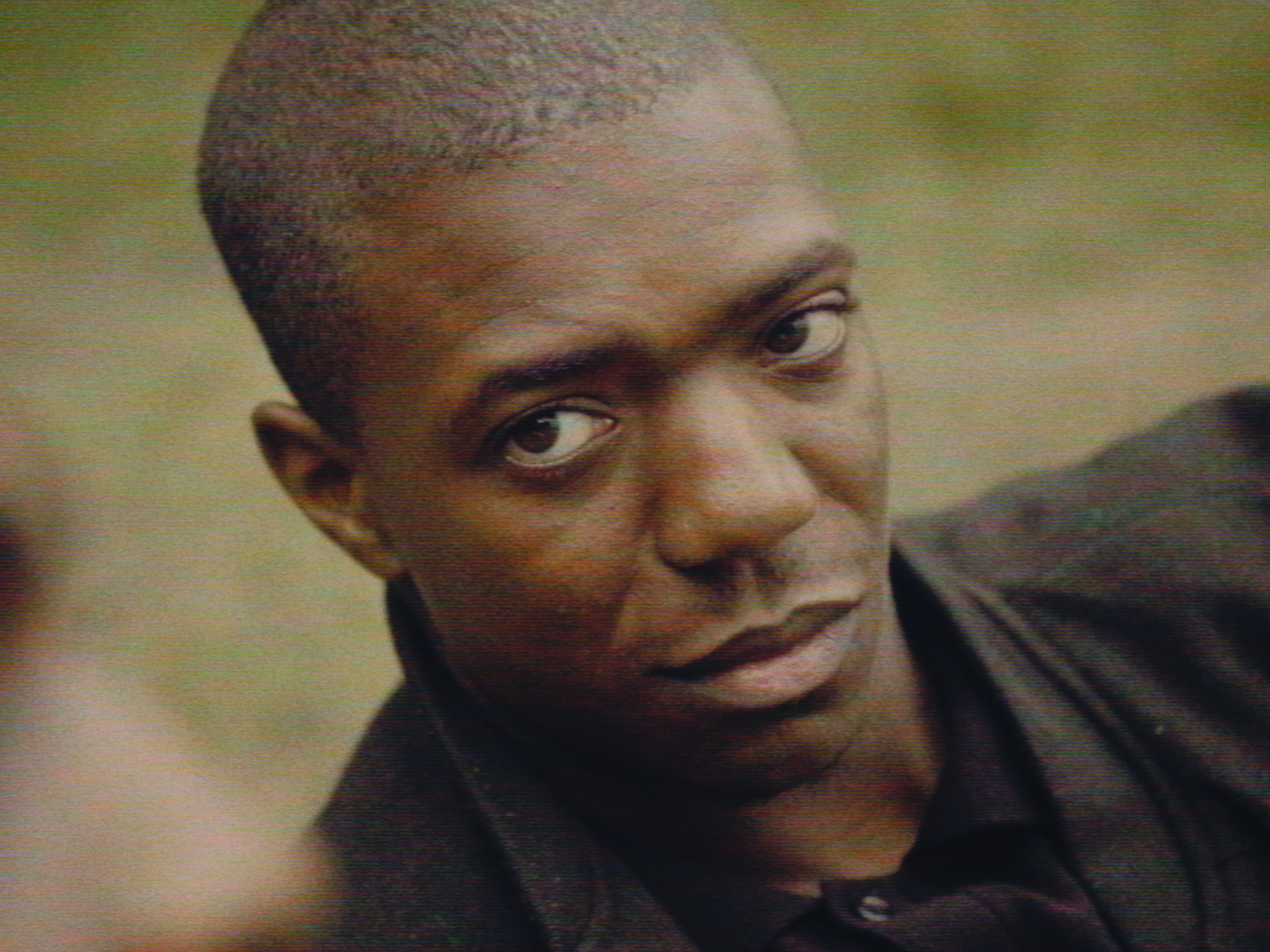
10. SCRUTINY
Written & Directed by James Quinn
Produced by Maria Ogunyale
On a bus journey across south London, a young man’s anxiety spirals into a vortex of self-doubt and torment - causing him to question: can he trust his memories?
An illustration of the process and impact of anxiety, and the demands of city life that intensify it.

9. LONDON’S FORGOTTEN
Written & Directed by Liam Pinheiro-Rogers
PRODUCED BY Cyrus Mirzashafa & Levon Gharibian
In the urban streets of London, the stories of would-be knife crime victims are connected by a wandering drifter who has loose ends to tie.

8. VOICES
Directed by Abbie Lucas
Written by Omar Khan | Produced by Håkan Carlsson
A couple overhears a violent fight next door and must decide whether or not to get involved.

7. DEAD WHISTLE STOP
Written & Directed by Sean Mckenna
Produced by Jamie Macdonald
Daniel’s not going to the office today. A dying man asked him to deliver a letter. Though he’s not sure who the dying man was or where the person he’s delivering it to is. Or what, if anything, it has to do with his new neighbours, The Illuminated Brotherhood of the All Seeing Eye.

6. SNAKE DICK
Written, directed & Produced by David Mahmoudieh
PRODUCED by George Lako & Annalea Fiachi
Jill's got the snake. Julia's got the flute. Alone, they have nothing. But together, they have a secret weapon to fight the darkness...

5. STONES
Written, produced, & Directed by Matthew Hopper
On a trip to his old family home in the Scottish Highlands, a troubled man argues on the phone with his stoic father, forcing him to confront a dark issue in their relationship.

4. CRY LIKE A GUY
Directed by Ant Rubinstein
Written by Catherine Willoughby
Why do we cry? What’s the deal with those little droplets of emotion? Kieran Bew (HBO's 'House of the Dragon', Netflix's 'Warrior') leads us on a gruff, goofy, educational and emotional adventure through the senses into the fascinating world of tears. A feast for the feels.

3. WAVING
Written, Produced & Directed by Rolfin Nyhus & Steven Brumwell
His worst fears seemingly realised; a distraught father takes one last walk through his ruined world. For most people, being at the centre of their own world and having a loving family is a wonderful thing. For Charlie, it's literally a nightmare. A short film about OCD.

2. EVERYBODY DIES SOMETIMES
Written & Directed by Charlotte Hamblin
Produced by Leonora Darby, Charlotte Hamblin, James Harris, & Mark Lane
A dark comedy about death anxiety that follows Mara as she grapples with the belief that she has killed everybody she's gotten close to.

1. BOY IN THE BACK SEAT
Written & Directed by Scott Pickup
Produced by Jonny Ross, James Owen & Simon Marriott
1986. A young boy is left unattended in the car while his volatile dad takes care of some ‘business’ in a dodgy local pub. What could possibly go wrong?
Honourable Mentions
Even though these films didn’t make our Top 10 we still think they’re pretty great and well worth a watch.
Hold my hand

gHanimah

Submit to our Short of the Week series to be considered for our 2025 season

Snapshot
An aspiring autistic photographer is plagued by a painful memory that exacerbates his persistent struggles with unemployment and negotiating the job interview process.

Written & Directed by JOHN CLARK
PRODUCED BY SAM BARNETT & JIM WRAITH
An aspiring autistic photographer is plagued by a painful memory that exacerbates his persistent struggles with unemployment and negotiating the job interview process.
ABOUT THE FILM
SNAPSHOT is the debut film from John Clark and was funded and supported by the BFI Network. Snapshot is based on John Clark's lived experience, of trying to gain employment as an autistic adult. The film includes a debut performance from Josh Ward, whose real-life experiences mirror the character and themes presented within the film.
The film won Best International Short Film a the Wigan & Leigh Film Festival, and also screened out of competition at the BAFTA Qualifying Bolton Film Festival as part of the Film Hub North Showcase. Other festival highlights include the BIFA qualifying North East International Film Festival, Catalyst International Film Festival, Romford Film Festival and Mansfield Film Festival where it received 4 nominations including Working Class Voice Category, Best Lead Performance, Best Editing, and the Heart Of Mansfield (Top Prize). It was release on Omeleto earlier this year.
ABOUT THE FILMmakers
John Clark is a Writer and Director who first garnered national attention with his candid, introspective short documentary; Asperger's: And What Of It? a paraphrased edition of his surrounding work of his lived experiences as an Autistic Adult. It was screened at The National Autistic Society's Autism Uncut Film Festival in 2017, and from there applied for funding through Film Hub North for what became the short Snapshot, his professionally credited Written and Directorial debut.
READ OUR INTERVIEW WITH JOHN
Welcome to our Short of the Week series. Tell us a bit about yourself and your filmmaking background.
Many thanks for having us! Snapshot is my professionally credited Writer and Directorial debut. Before this, I had made a series of self-produced short films, with one in particular that led on to the development of Snapshot. The short; Asperger's: And What Of It? is a paraphrased film of my similar work of the time which was entered into The National Autistic Society's Autism Uncut Film Festival in 2017. Gaining nationwide attention as a Finalist in the Aspiring Filmmakers category. It is a candid, introspective short documentary of my lived experiences as an Autistic adult.
Tell us about the genesis of Snapshot and your motivation for making this film.
Whilst residing in South Yorkshire, I'd meet Sam Barnett (after being introduced to him) at Sheffield Showrooms over a series of Coffee meetings about the (then) possibility of creating a short film together. I'd discussed my lived experiences of unemployment and regaled tales of various disastrous job interviews as an Autistic adult, and wanted to highlight the lack of support Autistic adults such as myself face, due to perpetuated stigmas and stereotypes about those with the condition. Only 22% of Autistic adults are in any form of employment due to these barriers, and not only did I wish to highlight this alarming statistic, but I also wished to create a visually immersive experience that put the audience directly into the subjective world of an Autistic person, and their direct experiences with sensory and communication difficulties, amongst the intrusive thoughts as a result of pervasive mockery, scrutiny and misunderstandings. From there, Sam introduced me to his small creative team, where we put together a funding application into Film Hub North which we were successfully awarded for. We're still working together on future projects!
Throughout, DOP Jim Wraith helped with in kind support from Sheffield Hallam University, with kit hire, crew and locations, all proving highly beneficial as a further utilising of our resources.
What were some of the main obstacles you experienced when making Snapshot and how did you overcome them?
We were greenlit for funding in January 2020. 3 months later...As a result of the occurring events, we then had to develop Snapshot over a series of Zoom meetings. It was a blessing in disguise, as it gave us a real opportunity to flesh out the story into what you see today. Film Hub North were incredibly supportive of me and us, especially through a rather difficult time in everyone's lives. Though the film went through constant development right up until the final cut! The real challenge came from utilising our limited resources. £10,000 leaves little margin for error! Auditions were Self-Tapes and Zoom calls, and further development was remote, until we were finally able to film over 5 days in April 2021, still under COVID guidelines of that given time, which meant we didn't really have enough time for on-set rehearsals, or blocking. COVID also meant we were running on a skeleton crew of about 8-10 people, who all appear in Snapshot at some point. I cameo twice! From script to screen, we all really had to think on our feet. The Bus sequence was originally set on a Train, but the Train company quoted a third of the budget! Such a sequence (which has been seen as something of a highlight) was also supposed to be a flash-in-the-pan moment when one Interviewer asks; "Getting here's not a problem for you, is it? No?" We also spent a year remotely editing Snapshot, where we evolved the idea of using the Bus sequence as a Turning Point for the film. Originally, it would cut straight from Ian's bedroom to the Interview, but it didn't feel right. You know in your mind when you're that involved with the creation of a deeply personal story to you what works, and what doesn't.
Tell us about the journey of getting your film to audiences and some of the festival circuit highlights.
Film Freeway can be costly! But we divided the remainder of the budget into attempting to hit the bigger festivals, before the local ones. Any selection was a win in our eyes, and for a low-budget debut, getting into 8 out of a possible 38 is quite the achievement! It is ridiculously competitive! All of the firsts were highlights for me. Snapshot premiered at Wigan & Leigh and won its award. We were unaware there was going to be any awards there, leaving me (ironically) speechless! Seeing Snapshot on the big screen for the first time sinking into my seat, was something of an experience too. My first panel interview at Romford Film Festival, where I was bricking it on the inside, but managed to explain how the film came to pass. The Omeleto selection also meant the world to me. The comments in particular. Reaching a further and wider audience, and having many Autistic people (and friends, family and Carers of Autistic people) deeply resonate with Snapshot was one of many other goals we set out when making it. The 5 star review on UK Film Review. Being selected here as well! Revisiting my old place of studies to screen the film and inspire Aspiring Filmmaking Students. Because of how this story is semi-autobiographical, there will always be that personal touch and deep gratitude for every success and accolade Snapshot has received. Especially with the rest of the cast and crew, who all have a personal connection with Autism too.
What advice or hacks would you give to other short filmmakers?
If writer's block rears its ugly head, write what you know. Yes, it's old hat, but it works. Even if you strip back the content, and amplify the context and underlying ring of truth with what your story's core message is, it should strike a chord with many. Kill your darlings. Also cliched, but true. You may very well have spent an incredibly long time setting up an exquisite shot, but if it's only served purpose is aesthetic, and doesn't help drive the story, cut it. It's a Short Film. You don't have long. When Snapshot's first pass was 22 minutes, it was far from engaging. Each scene needs to drive the next, progressing the story, and cementing its core arcs and messages until the very end.
Any film recommendations that we should add to our watchlist?
For similar short films, I highly recommend Pennywort, which tells a similar story from the perspective of a Young Autistic Woman. One scene in particular deeply resonated with me. Attempting to articulate Snapshot's vision was initially difficult. So, I was asked to cite past Films of inspiration or similar to what I had in mind. Films that we all have a mutual love for, such as; Pi, and Jacob's Ladder cropped up. Both have had a long lasting impact, because they tell compelling subjectively driven stories that help the audience get inside the mind of each character. I'd also recommend Tyrannosaur as that's also been a huge inspiration on the kinds of stories I wish to tell. Raw, subjective and unapologetic at times. A view of the world that sometimes needs a lens over.
What are you working on next?
With Hidden Pictures North, we are currently working on a Documentary Project that will emerge next year.
I also moved to Peterborough, where I shared Snapshot and am currently chasing funding for a Combined Arts Project with Metal Culture, examining how Deaf, Disabled and Neurodiverse communities within the city feel pigeonholed within a dichotomy of being branded as either Lazy Scroungers on the Benefits system, or put on pedestals as Paralympian Superheroes with unrealistic presumptions and expectations.
And finally, I currently tinker with my Feature Script which serves as an elongation of Snapshot that hopefully emerges some day! There's still a lot that needs to be said about Autism.


Tell us about the journey of getting your film to audiences and some of the festival circuit highlights.
We had our premiere in the Peckhamplex in October 2022 where we screened our film to not just the cast and crew but also those that are part of the community, charities and those who contributed to our crowdfund campaign. After that, we got good news after good news with various festivals. We managed to get into a decent amount at the end of the day. Highlights include meeting some great likeminded filmmakers at the Leeds International Film Festival and seeing some great horror shorts there. The South London Film Festival was another highlight as it unexpectedly snowed heavily that night! At the end of the day, every festival was great as I got to see some awesome films and meet some talented people.
What advice or hacks would you give to other short filmmakers?
I think that it is great to be ambitious and you should have a lot of ambition when it comes to making your short film but be realistic and know your limitations. I see too many short films that are very clunky and rushed because they tried to cram a lot of big budget aspects into it with a small budget. London's Forgotten was ambitious and had many locations but it's not something I'm expecting to get all the time, and we had a decent budget to go with that. Also, take time with the script. As stated above, it took a year until I truly understood what London's Forgotten was. Don't rush into things.
Any film recommendations that we should add to our watchlist?
Oh, well, I'll recommend some good ones that fit in with the style of London's Forgotten for sure. I would say David Lynch films, such as Eraserhead and Muholland Drive for the surrealism. The Exterminating Angel by Luis Buñuel is also a good shout equally for the surrealism as well as using it for social commentary. Bullet Boy if you're looking for a grounded urban London story.
What are you working on next?
A proof of concept social-horror short film called Scelus! (Scelus is Latin for "To commit a crime"). I'm currently looking to shoot Scelus sometime within the next six months after I secure funding, and I couldn't be more excited to share the story with the rest of the world! The short deals with Riley, a 24 year old ex-criminal on community service, who plans to use his gift of seeing the dead to confront an entity in a run-down council flat before his curfew begins. I'm hoping to develop this short film into a feature to expand the world further.
Interested in getting your work selected as Short of the Week?

Animal Behavior
A skilled wildlife foley artist has his methods challenged by a newcomer with an innate understanding of animal behavior.
Written & Directed BY Adrian Delcan
A skilled wildlife foley artist has his methods challenged by a newcomer with an innate understanding of animal behavior.
ABOUT THE FILM
ANIMAL BEHAVIOR won the Audience Award at the 2023 National Film Festival for Talented Youth and Best Actor at the New York City Independent Film Festival. Other festival highlights include the Crested Butte Film Festival, LA Shorts International Film Festival, Anchorage International Film Festival, Waco Independent Film Festival, and PÖFF Shorts (Black Nights Film Festival in Estonia).
ABOUT THE FILMMAKER
Adrian Delcan is a filmmaker originally from Southern California. His writing often features blood and broken families. He was a writer on Judas, the latest game by BioShock creator Ken Levine. His debut feature film, Old Man, is completed and will be released in January 2025.
READ OUR INTERVIEW WITH ADRIAN
Welcome to our Short of the Week series. Tell us a bit about yourself and your filmmaking background.
I was a suburb kid; I grew up an hour from Los Angeles in Orange County. Being this close to Hollywood gave my friends and me a lot of motivation. We felt like it was possible to make the kinds of movies we loved. We worked on tons of short films - most of which I would never want anyone to see, and others I still take lessons from. I found out early on that a great script made the process of filmmaking feel a lot freer, so I started focusing on writing. I went to college for film production and then after graduating I got a job as a writer on a Triple A video game. Now, I’ll be releasing my first feature in January 2025.
Making movies has always been my team sport. I love working with passionate and creative people in development, on set, or in the cutting room. It’s a joy I’ve experienced since I was a kid, and it hasn’t changed a bit all these years later.
Tell us about the genesis of Animal Behavior and your motivation for making this film.
I had only made short films until the feature, and coming off a 90-minute project, I was eager to work on something smaller again. I wanted to experiment with all the tools I had learned, and Animal Behavior became the result of those interests. My goal was to create a singular POV, use lots of camera movement and zooms, and to collaborate with the very funny Ben Fiorica (the lead). Ben had never acted before, but he was a good friend and I knew he had great command of his gestures, all of which are very idiosyncratic. I thought his qualities would contribute beautifully to the lonely, strange, and obsessive protagonist I was writing. I redrafted the script many times after conversations with Ben - we talked a great deal about how we could make this guy really pathetic and jealous, much of which we shot but ultimately had to leave out of the final export. The first cut of this was twice the length.


What were some of the main obstacles you experienced when making Animal Behavior and how did you overcome them?
Animal Behavior was my thesis project in college, and the school that I went to had a fantastic production system that all students were required to follow when making their films. It kept us accountable and taught us a lot about industry standard procedures, but it also came with some incredibly frustrating restrictions. To my crew’s surprise, our school didn’t allow us to film inside their foley studio, so we had to build a four-walled set of a foley studio in a stage about fifty-feet from the real one. Luckily, my production designer, Jen Ledbury, was incredible. With the encouragement of the college’s art department, she was able to raise a barn despite very limited resources. Ultimately, I was really happy we got to make our own; it gave us a lot more control over the way it looked on camera and allowed us to design a floorplan around blocking ideas. I admire Jen’s talent and determination, and I’m very proud of the set we created.


Tell us about the journey of getting your film to audiences and some of the festival circuit highlights.
We were fortunate to have several opportunities to screen Animal Behavior in theaters around the world, and it’s been very rewarding to hear the reactions from all these different audiences. It was particularly special to screen the movie downtown at LA Shorts and at NFFTY in Seattle. When I watch it on the big screen I still notice new things Ben and Winston were doing... I’m always grateful for the chance to show it in a theater, but I’m especially excited to finally release it online for a digital audience through Kino Short Film!
What advice or hacks would you give to other short filmmakers?
I think that a carefully designed schedule can be a very creative tool for directors working with limited resources. Further than just being conscious of your cast and crew’s stamina, it’s also a way of preparing your priorities for each sene before walking into the day.
Any film recommendations that we should add to our watchlist?
I’ll recommend some movies that inspired Animal Behavior. While writing, I was thinking a lot about the ending of Denis’s Beau Travail. It’s ridiculous, it’s like coming up for air after ninety minutes underwater.
I really wanted to do something as shocking and poignant, but the ending in Animal Behavior was much darker and I don’t think it could’ve be treated differently.
I’ve thought about how I would adapt this into a feature, and the movie I always come back to is Altman’s 3 Women. I think I would bring the character’s obsession into a realm of identity crisis, like we see in that story.
My DP, Raviteja, and I really wanted to make our movie look dark, with lots and lots of shadows. We studied some interior scenes, lit with one or two practicals, in Coppola’s The Conversation and Wender’s The American Friend. Beyond their beauty, they also feature brilliantly crafted sequences. They don’t feel like they needed to compromise anything for how gorgeous they look.
Apply to get your short selected as our Weekly Pick

10 Hot Steps To Be Adventurous In Bed
It's the end of Ava and George's third date... and they've gone home together. Sexual tension is high. Things are getting steamy. But they're a bit rusty, a bit out of sync. Will it be a night of magic or will it all prove too hot to handle?
Director/Cinematographer Maximilian Newcombe
Written by Kerry Bruce
ProduceD BY Dominic Varney & Mia Nuttgens
It's the end of Ava and George's third date... and they've gone home together. Sexual tension is high. Things are getting steamy. But they're a bit rusty, a bit out of sync. Will it be a night of magic or will it all prove too hot to handle?
ABOUT THE FILM
10 Hot Steps To Be Adventurous In Bed was an Official Selection at the London Lift- Off Film Festival and received an Honourable Mention at Margate Film Festival.
ABOUT THE FILMmaker
Maximilian Newcombe is an Essex-based filmmaker and camera operator who has worked on projects for a huge number of businesses big and small, and has shot a number of award-winning short films in a wide variety of different genres.
Kerry Bruce is a Scottish Traveller and writer with a passion for comedy and storytelling. She studied at the Royal Central School of Speech and Drama and was a member of the Royal Court Writers Group. Her stage work has been performed at venues such as the Southwark Playhouse and the Wee Red Bar. Kerry's screenwriting credits include the short film Money Dance by AnyThink Films, and she has also contribute to the Cake Theatre podcast.
Dominic Varney is a London-based songwriter and actor. He studied at The University of Manchester before graduating from The Royal Central School of Speech & Drama in 2019. This year Dominic graduated as a composer from the course, Book, Music & Lyrics, and recently showcased his 2nd year work on a musical adaptation of Miss Congeniality at Crazy Coqs in London. He has also starred in award winning short films, and won Best Acting Duo for his performance in Light Fantastic at the Independent Shorts Awards (2021). He also has extensive experience working in Theatre In Education.
Mia Nuttgens is an actor, voiceover artist and filmmaker from South London. She studied Drama & English Literature at the University of Manchester and the MA in Classical Acting from the Central School of Speech and Drama. After graduating she co-produced 3 seasons of the CAKE podcast, working with over 40 female creatives internationally, and has worked on numerous short films including ‘La Noche de Anoche’ which she filmed in Barcelona last year. She performed the lead of Mistress Ford at the Cambridge Shakespeare Festival this summer and is currently working on an international theatrical production of Tom Sawyer, touring France and the French Islands.
READ OUR INTERVIEW WITH PRODUCER/ACTORS MIA & DOMINIC
Welcome to our Short of the Week series. Tell us a bit about yourself and your filmmaking background.
We are Mia Nuttgens and Dominic Varney, the Producers and Actors in 10 Hot Steps To Be Adventurous In Bed. We met studying Drama at the University of Manchester and performed in numerous shows together, including An Evening With The Voices In Annie's Head at the Edinburgh Fringe Festival 2017. We then both separately studied on the MA Acting course at the Central School of Speech and Drama and have since been performing in theatre and film, training and creating our own work.
Dominic has co-written Chosen, a pop-rock comedy musical about Sue, an IT Support Technician in her 60s, who wakes from a coma to discover half the world has been zombified. He is currently touring Chosen as part of the Rewrites showcase in partnership with The Lowry, Birmingham Hippodrome, MAST Mayflower Studios and Norwich Theatre.
Mia has just finished work as the lead Layla in Barcelona-based short ‘La Noche De Anoche’ and is currently performing in an international production of Mark Twain’s Tom Sawyer, touring France and the French Islands.
10 Hot Steps To Be Adventurous In Bed is very special to us as it is the first short either of us have ever produced.
Tell us about the genesis of 10 Hot Steps To Be Adventurous In Bed and your motivation for making this film.
We originally performed 10 Hot Steps To Be Adventurous In Bed as part of a theatrical writing showcase at the Southwark Theatre in partnership with the Central School of Speech and Drama MA Writing course. We loved the script, created by our brilliant writer Kerry Bruce, and thought it would make a wonderful short film especially to showcase ourselves as actors. We then asked Kerry to adapt it for screen.
What were some of the main obstacles you experienced when making 10 Hot Steps To Be Adventurous In Bed and how did you overcome them?
The primary obstacle was sourcing the location. Originally the script was set at a bus stop so we producers, with our DoP/Director Maximillian Newcombe, took a lot of time scouting potential shoot locations in our local area. We reached out to Lambeth Council and TFL to secure permission to use the location and whilst Lambeth Council gave us permission to film, TFL refused to allow us to film anything with swearing or sexual content at a bus stop- unfortunately something we could not compromise for this film! Ultimately we decided to move the film to an indoors location which, whilst allowing for much more favourable shooting conditions, created a more intimate feel and also raised the stakes for the characters to already be back at George’s house.
Tell us about the journey of getting your film to audiences and some of the festival circuit highlights.
We had our screening in the heart of Lambeth at Dogstar in Brixton, which felt right as from our extensive location scouting we felt this film was very much rooted in Lambeth. We also took the opportunity to showcase other work from the creators involved in this project so hosting a mini film festival surrounded by our friends, family and collaborators was a really special moment.
What advice or hacks would you give to other short filmmakers?
Work with people and projects you trust and can have fun with! Our industry has so many talented people who are full of expertise, advice and enthusiasm, all of which we found invaluable in making our debut short.
Any film recommendations that we should add to our watchlist?
In terms of romantic comedies or dramas that inspired us…Harry Wootliff’s Only You is a gorgeous romance starring Josh O’Connor and Laia Costa. Before Sunrise and About Time are romantic staples!! And Ned Caderni’s short film Light Fantastic is amazing; ignore the fact that Dom is in it and that Ned edited 10 Hot Steps.
Interested in getting your work selected as Short of the Week?
Cry Like A Guy
Why do we cry? What’s the deal with those little droplets of emotion? Kieran Bew (HBO's 'House of the Dragon', Netflix's 'Warrior') leads us on a gruff, goofy, educational and emotional adventure through the senses into the fascinating world of tears. A feast for the feels.
Directed by Ant Rubinstein
Written by Catherine Willoughby
PRODUCED BY UNIT 9 FILMS
Why do we cry? What’s the deal with those little droplets of emotion? Kieran Bew (HBO's 'House of the Dragon', Netflix's 'Warrior') leads us on a gruff, goofy, educational and emotional adventure through the senses into the fascinating world of tears. A feast for the feels.
ABOUT THE FILM
CRY LIKE A GUY has been featured online with Film Shortage, Beyond the Short, Minute Shorts, and Curation Hour. I won awards at Sunday Shorts and Indie Short Fest in LA, received Honourable Mention at the Margate Film Festival, and was nominated for Best Micro Film, best editing, and best sound at Phoenix Rising. Additional festival highlights include Little Venice Film Festival and Boundless Film Festival.
ABOUT THE FILMmakers
Ant Rubinstein is a London based director / VFX artist / general creative nerd. Armed with an Engineering degree from the University of Cambridge and a couple of years working internally at Red Bull Media House - he’s recently moved into directing commercials for global brands (Google, Meta, Mastercard, Honda, Ford) and music videos for Chart topping artists (Sean Paul, Camilla Cabello). He picked up aa Young Director Award at Cannes for a zero-budget pandemic short film - which is now preserved in the BFI national archives. In his filmmaking he is all about innovating and pushing boundaries wherever possible, he loves that intersection where tech meets art, and especially loves getting his hands dirty building creative contraptions using the latests tools and technologies.
Catherine Willoughby is a planing director at Adam & Eve DDB by day, and a passionate poet / writer of spoken word by night.
READ OUR INTERVIEW WITH ANT & CATHERINE
Welcome to our Short of the Week series. Tell us a bit about yourself and your filmmaking background.
We’re a London based writer director duo - by day Catherine (writer) is a planning director at Adam & Eve DDB and by night an avid poet / writer of spoken word. Ant (director) is a freelance filmmaker working in commercials, with a keen interest in VFX and messing about with the latest tools and technology. Together we love collabing on projects like this, we like to make things that play to our creative strengths and that can also inspire, educate and entertain at the same time. Our last short ‘There’s Something Going Around’ was about how memes kept us sane during the pandemic, and it ended up preserved in the BFI national archives (as well as garnering a coveted Kino short of the week selection too) .


Tell us about the genesis of Cry Like A Guy and your motivation for making this film.
Believe it or not, the topic was inspired by a disagreement between Catherine and Ant. We realised we’d been socially conditioned to have opposing views about the value and usefulness of tears, and wanted to explore that in a piece of creative writing. Catherine wrote a longer spoken word poem originally, then we decided to make it into a film - and target it specifically at men as that had more of a cultural hook than crying in general.
We started by researching to answer the simple question “why do we cry?”, and the explanation fit into those three broad themes. So we wove them together in a story that builds continuously; starting with what’s happening in your body (biological), then looking outwards to your interaction with other people around you (sociological), and then zooming out even further to consider people across time (historical) - painting the full picture that today’s stigmatisation of male tears is not very productive or sensible. The whole process was a fascinating journey of research and discovery.
This is a huge topic, and such an important one too. We feel that the boundaries of traditional masculinity are very much in flux at the moment, and we hope this film can play a small part in reshaping the narrative. We’d love it to be seen by as many people as possible in an educational context and we’re working on charity partnerships / amplification to get it in front of the people who could benefit the most from the messaging.


What were some of the main obstacles you experienced when making Cry Like A Guy and how did you overcome them?
The hardest bit of any short film project has go to be getting it off the ground and building that initial momentum! We had such a great script and I knew we needed to find the right narrator who could do it justice, but at the start when it’s just an idea in your head how do you convince people to see the value in it? Because I do a lot of VFX, my approach was to create a really intricate 3D animatic of the whole thing, we plotted out exactly what was going to happen and when - particularly how it was going to flow together with these theatrical sliding scenery pieces. I worked on this for a good few months, knitting the story together and figuring out exactly what we needed. This was the only thing I could really do to drive the project forward by myself, but the pre-vis actually became invaluable in getting people excited and on board - It’s what enabled us to attract Kieran as our narrator. It also meant on the shoot we could be super efficient with coverage, as we had the film pretty much all laid out already in terms of what shots we needed where, to stretch our slender budget to the absolute maximum.
Tell us about the journey of getting your film to audiences and some of the festival circuit highlights.
My approach to getting this out there in the world has just been make as much noise as I possibly can about it online! Our premiere was just on my YouTube channel (after a screening for friends and crew) - and I’m constantly posting behind the scenes snippets and making-ofs on instagram to get people to go and watch the full thing. Side note: I’d definitely recommend behind the scenes content as a great way to promote a film on social media, little snackable snippets are much more engaging and shareable than a full film that requires attention and focus, plus there’s a multitude of pages that will repost good behind the scenes content if you make it for them! Because we both work in advertising we’re trying to get it in front of as many industry people, brands and agencies as we can - with the ambition being we can find a purpose for it with a charity or a cause to amplify the message.
What advice or hacks would you give to other short filmmakers?
This was my time doing a short with a really established actor, we were so lucky to get Kieran on board and I think my big learning / hack would be don’t be scared to go after a big star! If you can find a way to get through to them and you’ve got a good idea I don’t think anyone is off limits. That applies to crew, VFX artists and everyone involved in the process. Filmmaking is a team sport and you never know who you might be able to get on board and how much they might be able to elevate your work if you don’t try! For us, the narrator was always going to be what the success of the film hinged on and Kieran’s experience in House of the Dragon, Netflix’s Warrior and all manner of other ‘tough guy’ roles made him a perfect fit for the part.
Any film recommendations that we should add to our watchlist?
An inspiration for this film that I heartily recommend was Wes Anderson’s adaptation of Henry Sugar on Netflix, mainly for the theatrical transitions and sliding set pieces - they add a whimsical sprinkle of surprise and delight to every scene and elevate moments that could just be a mundane cut. I think in this world of oppressive CGI and Ai there’s something so special about clunky mechanical transitions that really feel handmade. Another big inspiration for us was ‘Quarter life poetry’ by Samantha Jane, we love the spoken word narrator lead narrative. It’s such a great way to tell a story with so much lyrical flair and creative flourish, a piece we defintely aspired to emulate!
Interested in getting your work selected as Short of the Week?

Simon
When Simon knocks on a couples door, he brings news that will turn their world upside down.

Written & directed by Ed Willey
ProduceD BY Rachel Foster
When Simon knocks on a couples door, he brings news that will turn their world upside down.
ABOUT THE FILM
SIMON was produced as part of the LAMDA 48hr Film Fest where it was shortlisted among Top 11. It also won the Audience Award at Super Shorts Hackney and played at other national and international film festivals.
ABOUT THE FILMmaker
ED WILLEY After a revelation that he wanted to get into filmmaking right when the pandemic hit, Ed has discovered a love of writing and directing. After studying at MetFilm Ed is now a regular competitor in the London 48-hour film competition where his films have won several awards and this year was invited to be part of the jury. Ed likes to embrace the sillier side of things but also enjoys creating a bit of tension. Ed is currently deep in pre-production on a sci-fi/dark comedy short and is writing his first feature.
READ OUR INTERVIEW WITH ed
Welcome back to our Short of the Week series. What have you been up to since we last featured your film A Real Pair?
Thanks, it's great to be back! Including Simon, we've done three 48-hour competitions (I do love a challenge!) and was just on the jury for this year's London 48-hour. I'm also now deep in pre-production for a (non-48hour) Sci-fi/Dark Comedy short which makes a nice change and I'm very excited about.
Tell us about the genesis of Simon and your motivation for making this film.
Simon was created for the inaugural LAMDA 48-hour competition, which we found out about literally as we landed back in the UK coming home from Filmapalooza in Lisbon, where we'd been attending the global 48hr festival (definitely not addicted to this form of filmmaking...). Being another 48-hour film, we knew we wanted to keep the story as simple as possible and hit upon the 'long lost child' idea almost straight away and ran with it.
What were some of the main obstacles you experienced when making Simon and how did you overcome them?
The first thing is just creating something on such a tight deadline with so few people, as this competition had a limit of eight people per team. Trying to get a complete narrative into so few pages in just a few hours is a tough task. The first draft ended up being too 'funny' all the way through, and we knew if we wanted the ending to land we had to play it straight for as long as possible.
Tell us about the journey of getting your film to audiences and some of the festival circuit highlights.
Once the competition ended, we really felt we had something that could play well at festivals so decided to give it a big push. Despite already being available online (due to the competition) we've had a great number of selections and picked up a good few nominations and most pleasing won a few audience awards, which are by far the most gratifying :) I like to try and travel to screenings whenever I can and getting to visit different places around the UK and experience other people seeing your work on the big screen is pretty special.
What do you think is the biggest challenge short filmmakers face trying to break into the industry?
It feels like it's becoming increasingly harder to stand out in what is a rapidly growing space. With filmmaking now so accessible (which of course is great!) some of the mid-large festivals are taking in 1000s of submissions, meaning loads of great films are missing out. Leveraging genres can definitely help you reach viewers hungry for stuff to watch, but it feels like we need something more than festivals to showcase work, which is why something like this that runs year-round is so great.
Any film recommendations that we should add to our watchlist?
I'm generally rubbish at keeping up with the latest releases so have only just watched Jordan Peele's NOPE which was incredible, great visuals, great performances and great storytelling. Also, thanks to one of the big summer blockbusters we recently revisited Blade which still has a banging opening scene which is up there as one of my favourite movie openings.
Interested in getting your work selected as Short of the Week?
Hold My Hand
In this recognisable advert, a gang of giddy sunseekers go on a trip they’ll never forget.

Written, directed by Lucy Hilton Jones & Elliot Taylor
PRODUCED by Greenfingers Film
In this recognisable advert, a gang of giddy sunseekers go on a trip they’ll never forget.
ABOUT THE FILM
HOLD MY HAND was a straight-to-online release, but has since been screened at Blade and Bow Showcase, Glasgow and Adult Film Club, Manchester.
ABOUT THE FILMmaker
Lucy Hilton Jones is an award-winning actor/writer/director and co-founder of Greenfingers Film. A two-time Funny Women Award finalist and BBC Comedy Collective semi-finalist, her short films have been screened nationally and internationally. She loves working on projects that mix realism and the absurd with levity and playfulness. Her first feature film is currently in development.
Elliot Taylor is a Manchester based Writer, Director and Editor. As a filmmaker, he is interested in using comedy and horror to poke fun at societal issues. His previous short film Bin Day (2023) was a silly exploration into AI and how it can be used for job automation. This film went on to be screened at the BAFTA qualifying Manchester Film Festival. It also won Best Ensemble Cast at the Comedy Short Awards, as well as winning Best Low Budget Short Film at Romford Film Festival.
Greenfingers Films is an internationally award-winning film collective based in Manchester. It consists of Writer/Directors Lucy Hilton-Jones and Elliot Taylor as well as Director of Photography Dann Cooper. All of our films have a focus on the silly, spooky and surreal.
READ OUR INTERVIEW WITH elliot and lucy
Welcome back to our Short of the Week series. What have you been up to since we last featured your work - Nanny Neigh Neigh?
Thanks so much for having us again! We've been up to all sorts. At the end of 2022 we, for some reason, decided it would be a good idea to shoot three films in a weekend. Luckily our delusions paid off! They're now all at the end of their festival runs having done very nicely, so we'll be releasing those soon. We also shot another short in the Hold My Hand location (can you tell we like to make our lives hard) and that's almost done in post so we'll be submitting that to festivals soon.
Tell us about the genesis of Hold My Hand.
We were asked to collaborate with Cozmos Films on a project shooting in a villa in Spain. Our only stipulation was that we could use the location for a Greenfingers project as well. Elliot worked on a certain set of travel adverts that you may recognise. HMH is a response to the horror of hearing such a chirpy pop song on repeat in the edit suite.
What were some of the main obstacles you experienced when making Hold My Hand and how did you overcome them?
This is the first time we've worked with VFX in one of our shorts. We're super happy with how it turned out (shout out to Natascha Farmer) but in retrospect, we should have consulted with someone before we filmed to make post-production even easier. Also, Lucy learned the hard way that there are both edible and toxic versions of fake blood.
Tell us about the journey of getting your film to audiences.
Like Nanny Neigh Neigh, we decided to put this film straight online. It's short and snappy and, in all honestly, we simply don't have a festival budget for all of our projects. We've had an amazing response on our Instagram and Youtube but we'd always like to reach more people so thanks for giving us a platform!
What advice or hacks would you give to other short filmmakers?
Keep momentum going if you can because the only way you'll learn is by doing. The simplest films can be the most effective so don't wait around for funding. Your taste will never match your art because your taste evolves with your development so don't be afraid to put things out if they aren't perfect in your eyes.
Any film recommendations that we should add to our watchlist:
Elliot: Paprika and Kneecap
Lucy: Sick of Myself and A Bunch of Amateurs (2022)
Interested in getting your work selected as Short of the Week?
London's Forgotten
In the urban streets of London, the stories of would-be knife crime victims are connected by a wandering drifter who has loose ends to tie.

Written & Directed by Liam Pinheiro-Rogers
PRODUCED BY Cyrus Mirzashafa AND Levon Gharibian
In the urban streets of London, the stories of would-be knife crime victims are connected by a wandering drifter who has loose ends to tie.
ABOUT THE FILM
LONDON’S FORGOTTEN screened at our BIFA Qualifying Kino Short Film Festival earlier this year. Other notable festival selections include Shorts On Tap, The British Urban Film Festival, Leeds International Film Festival, and Liverpool Film Festival. It won Best Experimental Short at The South London Film Festival and was nominated for Best Director at The British Short Film Awards. It recently premiered on Director’s Notes.
ABOUT THE FILMmakers
Liam Pinheiro-Rogers is the Writer/Director of London’s Forgotten. Since leaving film school in 2015, he has been making independent short films, with genres ranging from horrors to sci-fi to dramas. He built up a portfolio as a director of short films and music videos, while screenwriting short and feature films. One of his feature screenplays, “A Flood To Remember” won Second Rounder at the Austin Film Festival. Recently on the directors front, he has worked with clients such as musicians May Roze and Alex Ko, and the charity Missing People.
READ OUR INTERVIEW WITH LIAM
Welcome to our Short of the Week series. Tell us a bit about yourself and your filmmaking background.
So I was always very creative growing up, doing lots of drawings and coming up with all sorts of ideas for different concepts but never really knowing what exactly I wanted to do. Be a drawing artist? Novel writer? Comics? Videogames? I explored all of these different thoughts but nothing stuck. At 13 years old, I got to do a short (and terrible) film in my secondary school and it was there I realised I wanted to be a filmmaker. I wanted to write and direct specifically. From there, I went to film school to learn a bit more about the craft and after leaving, I started making a lot of self funded short films, producing most of them and building relationships, and really cutting my teeth making dramas, horrors, science fiction stories and so on until I found my voice. I always saw films as the best way for me to articulate different thoughts and ideas within my favourite genres and types of films.
Tell us about the genesis of London's Forgotten and your motivation for making this film.
London's Forgotten had a long journey from the concept to the finish line. I thought up the concept back in 2019, inspired by growing up in Tottenham and knowing people who were involved in gang activities. I lived in Tottenham for a good portion of my early life. It was when I went to secondary school where I realised what was going on in my area in terms of the gang lifestyle, and knife and gun crime. The catalyst for my parents deciding to get us out was our next door neighbour's son being shot in a neighbouring area to Tottenham. I wanted to use these facts, about the why and how questions about knife crime victims, to create a story about knife crime and my love of surrealism and horror played into that too. It was going to be a no budget thing shot on the weekend with a skeleton crew about a guy who finds his dead body in an alleyway. But the shoot was cancelled, which was a blessing in disguise. I went back to the drawing board and a montage kept popping in my head of knife crime victims, so I decided to combine that idea with my old idea to create something fresh and unique. Throughout the year, I met people who would eventually become members of the crew. We were going to shoot in April 2020 only for COVID to stop us. This gave me time to go over the script and make changes, which was a secondary blessing in disguise funnily enough! It was over a year later, in 2021, that we finally managed to successfully crowdfund London's Forgotten and shoot the film.
What were some of the main obstacles you experienced when making London's Forgotten and how did you overcome them?
We were battling up against a few issues doing the shoot for sure. One that really sticks to mind was having to recast an important character the night before the shoot. As we were shooting during COVID in 2021, one of our cast members unfortunately caught it a day before the shoot. Luckily, I kept my composure and the night before, I ran through different actors that could suit the role and managed to find the perfect fit for the character.
Tell us about the journey of getting your film to audiences and some of the festival circuit highlights.
We had our premiere in the Peckhamplex in October 2022 where we screened our film to not just the cast and crew but also those that are part of the community, charities and those who contributed to our crowdfund campaign. After that, we got good news after good news with various festivals. We managed to get into a decent amount at the end of the day. Highlights include meeting some great likeminded filmmakers at the Leeds International Film Festival and seeing some great horror shorts there. The South London Film Festival was another highlight as it unexpectedly snowed heavily that night! At the end of the day, every festival was great as I got to see some awesome films and meet some talented people.
What advice or hacks would you give to other short filmmakers?
I think that it is great to be ambitious and you should have a lot of ambition when it comes to making your short film but be realistic and know your limitations. I see too many short films that are very clunky and rushed because they tried to cram a lot of big budget aspects into it with a small budget. London's Forgotten was ambitious and had many locations but it's not something I'm expecting to get all the time, and we had a decent budget to go with that. Also, take time with the script. As stated above, it took a year until I truly understood what London's Forgotten was. Don't rush into things.
Any film recommendations that we should add to our watchlist?
Oh, well, I'll recommend some good ones that fit in with the style of London's Forgotten for sure. I would say David Lynch films, such as Eraserhead and Muholland Drive for the surrealism. The Exterminating Angel by Luis Buñuel is also a good shout equally for the surrealism as well as using it for social commentary. Bullet Boy if you're looking for a grounded urban London story.
What are you working on next?
A proof of concept social-horror short film called Scelus! (Scelus is Latin for "To commit a crime"). I'm currently looking to shoot Scelus sometime within the next six months after I secure funding, and I couldn't be more excited to share the story with the rest of the world! The short deals with Riley, a 24 year old ex-criminal on community service, who plans to use his gift of seeing the dead to confront an entity in a run-down council flat before his curfew begins. I'm hoping to develop this short film into a feature to expand the world further.
Interested in getting your work selected as Short of the Week?
Stones
On a trip to his old family home in the Scottish Highlands, a troubled man argues on the phone with his stoic father, forcing him to confront a dark issue in their relationship.
Written, produced, & Directed by Matthew Hopper
On a trip to his old family home in the Scottish Highlands, a troubled man argues on the phone with his stoic father, forcing him to confront a dark issue in their relationship.
ABOUT THE FILM
STONES won Best Low Budget Short Film at our BIFA qualifying short film festival earilier this year, where it was also nominated for Best Cinematography. Additional festival highlights include the BAFTA Qualifying Aesthetic Short Film Festival, and BIFA Qualifying Brighton Rocks International Film Festival, and Wimbledon Short Film Festival.
ABOUT THE FILMmakers
Matthew Hopper is a London based filmmaker. He has directed commercial/branded content for brands such as Qatar Tourism, The National Lottery and Booking.com.
In 2016 he wrote and directed “Rumble”, which screened internationally at festivals including Phoenix, Sao Paulo and Manchester. In 2018 he co-wrote and directed, “Between the Devil and the Deep Blue Sea”, which was part-funded by the BFI/Film London’s, London Calling Shorts Scheme.
In November 2018, his short western script, No Ordinary Stranger, was selected as one of the 3 winners of the Shore Scripts screenwriting competition.
His spec scripts have reached the semi-finals of several competitions such as Shore Scripts, The Golden Script Competition, and the Screencraft Fellowship.
His latest short, “Stones” won best low budget short film at Kino London festival and played at festivals such as Aesthetica, Brighton and Wimbledon. He has another short “Elephant” in the final stages of post-production.
Ludovic Hughes is a Scottish actor, producer and writer who began his career on the London stage. He has since starred in award winning short films Alegna, Miss Moneypenny and Man of the Hour. His film credits include Ride (2018) and Sacrifice (2020). His TV credits include Dune: Prophecy (2024), Belgravia: the Next Chapter (2023), Hotel Portofino (2023).
READ OUR INTERVIEW WITH MATTHEW
Tell us a bit about yourself and your filmmaking background.
Where to start? I'm a bit of a country bumpkin at heart, having grown up in Somerset in the West Country.
My passion for filmmaking sparked early on as a hobby. I used to watch old war films and westerns with my dad, and I'd make copy-cat TV shows and ridiculous little films with my sister and cousins on my grandfather's camcorder.
That said, growing up I never really considered filmmaking to be an option for me. I thought it was something that happened far away in Hollywood and it wasn’t until I went to uni and started making short films and music videos in my spare time and making contacts in the industry in London that I thought I could actually make a stab of it.
Since then, I have been stabbing away and over the past 10 years I’ve worked for various production companies as a runner, an editor, a self-shooter and in production before I made the decision to focus on writing and directing around 5 years ago. I now work full time as a director, making narrative films in my spare time because I love them and branded stuff/commercials because I need to eat!
Tell us about the genesis of Stones and your motivation for making this film.
The origin of how Stones came to be is actually a long (albeit incredibly poignant!) story. The abridged version is that Ludo Hughes (the film’s co-writer and lead) and I were good friends at primary school in Somerset but drifted apart when he moved away. We randomly reconnected in London five or so years ago when I saw him act in a friend’s short film.
Even though I hadn’t seen him for 17ish years we picked up right where we left off as 10 year olds and once again became good mates. As we were catching up, Ludo shared with me that his father, Mark, had sadly taken his own life about 8 years prior, which was a huge shock as both our families were close growing up.
We talked a lot about mental health, having both struggled with imposter syndrome and depression brought on by bereavement.
A couple of years later, after some serious deliberation we decided to make a film about our personal experiences as men, and also pay tribute to Ludo’s father, Mark. Ultimately we decided that a fictional story with characters inspired by real events and our experiences was the way to go.
What were some of the main obstacles you experienced when making Stones and how did you overcome them?
The main hurdle we faced was, unsurprisingly, funding. We were rejected by every funding scheme we applied to. But rather than letting that stop us, Ludo and I decided to scrape together what we could and make it happen on as little as possible. We saved up diligently and committed to bringing Stones to life no matter what.
Just as we were about to start shooting, that pesky old virus that begins with C came along and put everything on pause. Initially, it felt like the worst timing ever, but it actually turned out to be a blessing in disguise. We were originally set to shoot a different version of the script that involved brothers but were never fully happy with it. Being in lockdown gave us the time to really reflect and rewrite the story, honing in on what was truly important - the father-son relationship. This not only strengthened the narrative but also simplified the production, making it easier to shoot once restrictions lifted.
Shooting in a remote part of Scotland was another adventure altogether. It wasn't without its headaches, that's for sure. We filmed right up until the last light of day, then had to rush down the mountain in the dark to catch a local fishing boat I'd arranged to take us back to civilization. It was a bit of a race against time and quite the logistical challenge but it added a layer of excitement and camaraderie to the whole experience. In the end, overcoming these obstacles made the film all the more rewarding and fun. That along with AC Matt Farrant playing LOTR music on a speaker as we hiked for hours to get to shooting locations!


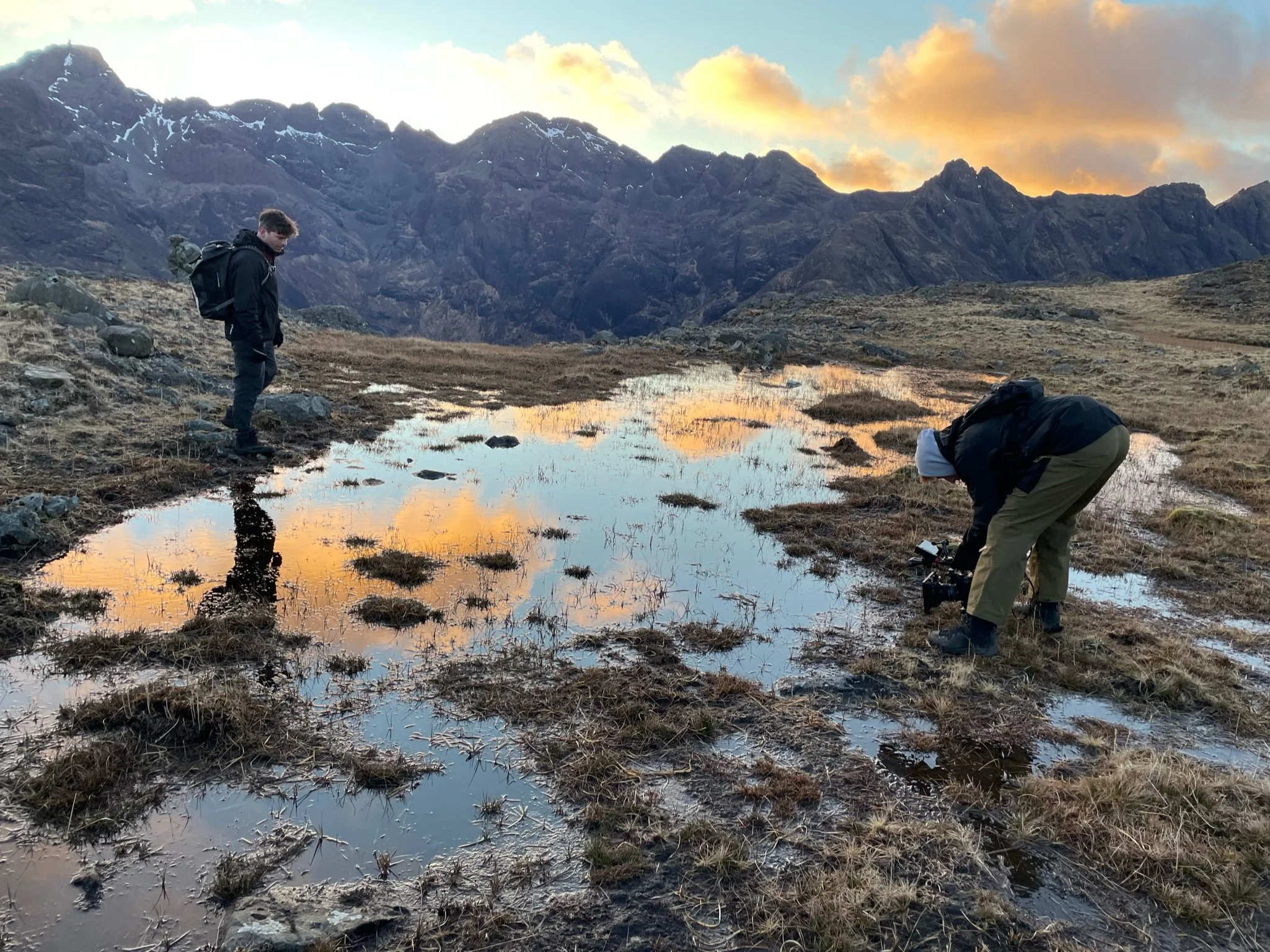
Tell us about the journey of getting your film to audiences and some of the festival circuit highlights.
Getting a film seen is actually one of the hardest challenges. There are so many good films out there and the bar is incredibly high, but there's also so much noise. Festival rejections are a major part of the process and I have developed a thick skin over time!
We decided to focus mainly on UK festivals, and were lucky enough to be selected at several BAFTA and BIFA qualifying festivals such as Aesthetica, Brighton, Kino, and Wimbledon. All of them were well attended, which was fantastic to see. I've been to festivals in the past where it's just one man and his dog, so it was really gratifying to watch our film with a real audience.
The highlight for us was undoubtedly the incredible messages we received from the audiences. We were blown away by the response; so many people reached out to say how much they enjoyed the film and how it resonated with them, having either struggled with mental health themselves or knowing someone who has. Plus, it was absolutely awesome to pick up the award for Best Low Budget Short at Kino!
Overall we’re really pleased with our journey so far and incredibly proud of the film we have made. Shout out to the awesome crew and actors who helped make it happen! You are all godsends and thanks for giving 110% to our film.

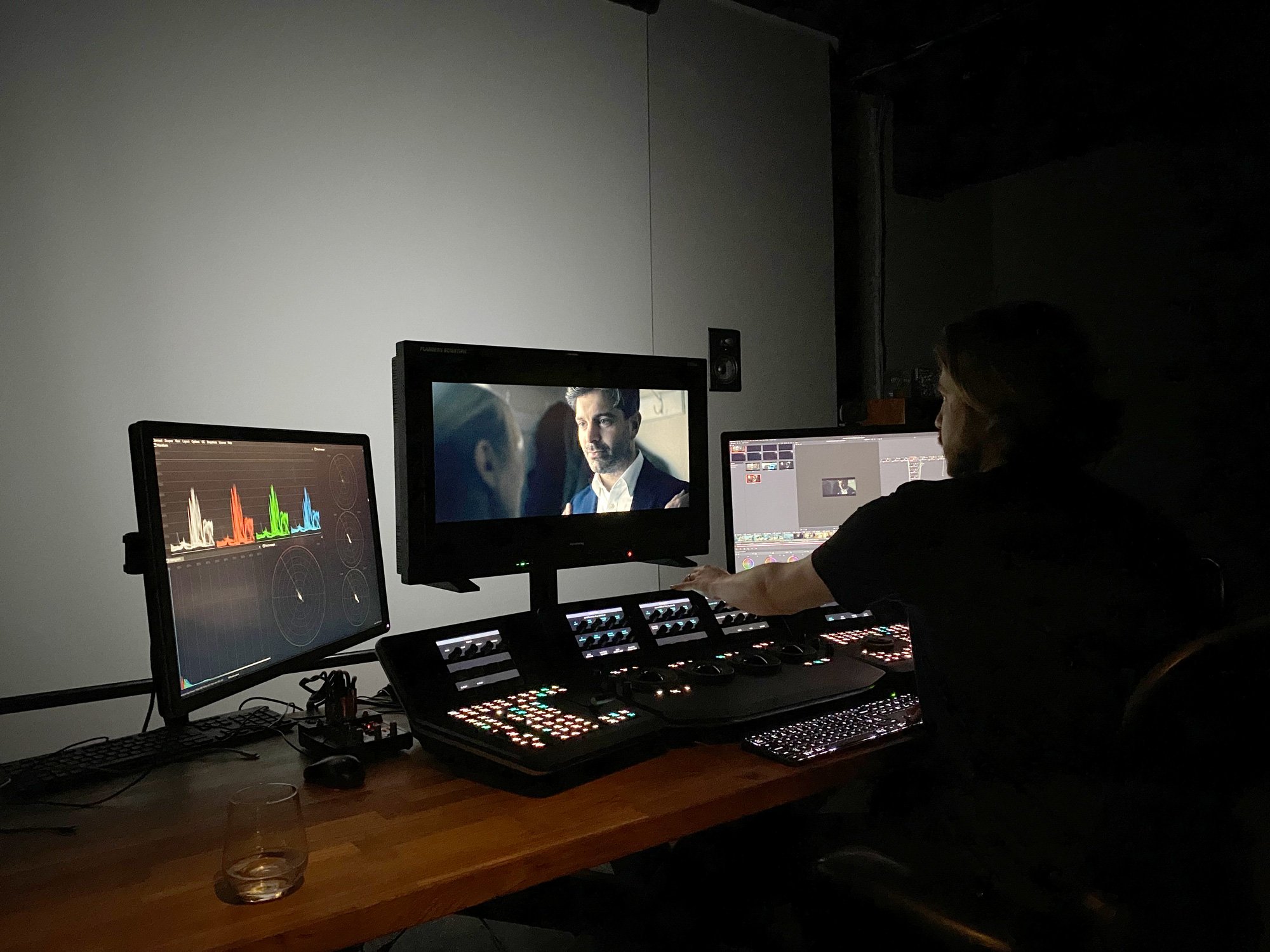

What advice or hacks would you give to other short filmmakers?
I have two, very cliched pieces of advice!
One is to make sure you have a good script. Take the time to iron out the kinks and make sure it says what you want to say. Get people to read it and feedback, as sometimes you get so close to a project that it is hard to see the wood from the trees.
The second is just make films with the resources you have available. Don’t wait for permission. Funding is a lottery. The odds are not in your favour. I have lost count of the number of times I have been rejected by funding schemes and festivals.
I now kinda live by Mark Duplass’ "The Calvary isn’t coming" philosophy. Save as much money as you can, persuade a bunch of filmmaker friends and get out and make stuff. You’d be surprised how many people are up for the ride.
Any film recommendations that we should add to our watchlist?
I was at Wimbledon Short Film Festival last week and saw a documentary short called ‘Blackstroke' and a comedy called 'Thanks for the Milk' that were fantastic!
Also, at Aesthetica and Kino, a short called ‘Terror’ which is such a cool idea and executed so well - again with not much money or means!
Interested in getting your work selected as Short of the Week?

Scrutiny
On a bus journey across south London, a young man’s anxiety spirals into a vortex of self-doubt and torment - causing him to question: can he trust his memories?
Written & Directed by James Quinn
Produced by Maria Ogunyale
On a bus journey across south London, a young man’s anxiety spirals into a vortex of self-doubt and torment - causing him to question: can he trust his memories?
An illustration of the process and impact of anxiety, and the demands of city life that intensify it.
ABOUT THE FILM
SCRUTINY was an Official Selection at the 2023 edition of our BIFA Qualifying Film Festival where is was nominated for Best Performance In A Drama (Isaiah Bobb-Semple) and Best Editing. I was also an Official Selection at the Manchester International Film Festival, S.O.U.L. Fest, EFN Short Film Festival, British Urban Film Festival, and South London Shorts.
ABOUT THE FILMmakers
James Quinn | Writer Director - James is a London based film writer and director whose work focuses on the internal battles we face. His latest short, Scrutiny, featured in the 1.4 Awards Shortlist, and screened at the BAFTA-qualifying British Urban Film Festival, Leeds International Film Festival, and S.O.U.L. Fest, as well as six BIFA-qualifying festivals.
Maria Ogunyale | Producer - Maria is an emerging producer known for her work on drama series for top broadcasters like Apple TV, Amazon Prime, BBC, Netflix, and Sky. With a strong background in production she focuses on creating high-end stories that are often untold, championing inclusivity and fresh perspectives. Maria's credits include "Trying," "This is Christmas," "I AM RUTH," "The Tower," "Mood," and "Top Boy." Her dedication to unique storytelling was highlighted in producing the short film "Scrutiny," showcased at the S.O.U.L Film Festival 2023. Maria is dedicated to exploring themes like social justice, mental health, and cultural representation, pushing the boundaries of traditional drama.
READ OUR INTERVIEW WITH JAMES
Welcome to our Short of the Week series. Tell us a bit about yourself and your filmmaking background.
Hi, thanks so much for having me! I’m James, a writer director based in London. I picked up a video camera as a kid and made films to make my friends and family laugh… and it stuck. At that age, I was at a major crossroad to decide whether to try to be either a filmmaker or a carpenter. I picked filmmaking. In hindsight, I don’t think they’re that different as professions. Filmmaking feels like carpentry to me.
Tell us about the genesis of Scrutiny. We understand that it stems from your personal experiences with anxiety. Can you tell us more about the inspiration behind the film?
I expect like most people, I’ve had various battles with anxiety and poor mental health. I was in a privileged enough position to be able to afford therapy. Shining a light on the mental process of my anxiety was transformative - seeing how it worked took its power away.
I felt like I’d peeked behind the curtain, but I’d never seen anxiety on screen how I experience it. So, I wanted to pay it forward. This film was an extension of that. It was like, ‘How does anxiety light, block, and edit my thoughts?’
Hopefully other people can take something helpful from this film too.
What were some of the main obstacles you experienced when making Scrutiny and how did you overcome them?
Shooting on a bus was loads of fun but really tricky. We wanted the genuine feeling of a moving bus, so our production team found us an amazing bus hire. We created a loop around south London and circled it for a whole day. We knew continuity and shot precision was out the window so we leant into that limitation and made it our style. The disorientating, staccato editing was a deliberate choice to reflect the internal anxiety and disguise that limitation.
Our brilliant DoP (Jasper Enujuba) was shooting on an easyrig. With the bus swinging up and down the roads, he needed some help to stay upright. I was the lucky crew member selected to steady him with a bear hug.
Tell us about the journey of getting your film to audiences and some of the festival circuit highlights.
In truth, I’m quite shy about my films. I find distribution and self-promotion hard, so we did a focused and limited festival run. With the type of festivals, we aimed high and I was absolutely delighted to get into the ones we did - all BIFA or BAFTA qualifying. We played alongside some amazing films. To share a screen with them was amazing.
But, I’m less interested in the number of viewers than catching those few people who feel a deep connection with the film. I’ve had quite a few people reach out with very personal messages about Scrutiny. Those are more meaningful to me than a 5 or 6 figure view count.
What advice or hacks would you give to other short filmmakers?
You’ll stop yourself long before anyone else does. That’s the case with me, at least. I get so focussed on the problem-solving aspect of filmmaking that I start finding more and more problems. And you can hide behind that and never make anything. A friend once told me ‘think less, do more.’ That’s advice I need to follow more.
Any film recommendations that we should add to our watchlist?
I was blown away by The Zone of Interest. My mind was in tatters for weeks after. And I recently watched the classic, Investigation of a Citizen Above Suspicion. What a distainful deconstruction of misogyny and patriarchy.
Interested in getting your work selected as Short of the Week?

My Alien Cowboy
Mary-Sue and her alien boyfriend have the most unusual, out of this world meet-cute story.
Written & directed by Kate Lloyd
A comedy short about Mary-Sue and her alien boyfriend, who have the most unusual, out of this world meet-cute story.
ABOUT THE FILM
MY ALIEN COWBOY screened at our Short Film Open Mic Night earlier this year and we’re exicted to spread this alien invasion to the web with it’s online premiere.
ABOUT THE FILMmaker
Kate Lloyd is a writer/director born and raised in London, UK. Her short films have screened at numerous film festivals around the world including London Short Film Festival, Lisbon and Hamburg. She previously worked in production/producing for companies including Manchester International Festival and the BBC. Kate has an unhealthy obsession with the weird, so she writes dark comedies inspired by a punk sensibility to disrupt the status quo. She likes to write about good people who do bad things, complicated characters who grab the audience by the heart and genitals.
READ OUR INTERVIEW WITH kate
Welcome to our Short of the Week series. Tell us a bit about yourself and your filmmaking background.
I started off in a fine art background, and studied Video Art at Brighton University, which is sort of like a fine art degree but in film. This provided me with a lot of education around theories, concepts and ideas, much more of an “intellectual” approach to art, which I later rejected in my work.
I am more interested in people - relationships and narrative, so I started making my own short films with more emphasis on these subjects..which was also much more fun than having to win intellectual points!
Tell us about the genesis of My Alien Cowboy. Can you tell us about the inspiration behind the film?
I absolutely love cheesy 70s B Movies, like early John Carpenter and David Cronenberg. So I knew I wanted to play around with this genre and make a film that was really sludgy, gnarly and off-beat film.
I also wanted to see what I could make with a limited budget of 300 pounds. There is a hotel in Brighton that has themed hotel rooms and one of them was an Americana themed room which looked absolutely fantastic, so I purposely wrote something I could set in that hotel.
And I wanted to explore in a comedic way the desperation people could go to in love, even losing your eye for a partner!
What were some of the main obstacles you experienced when making My Alien Cowboy and how did you overcome them?
Definitely the accent! I’m pretty new to on screen acting and I underestimated what a challenge an accent like that could be.
The shot where the eyeball falls on the floor also took a few practice shots to get right as you have to get the exact part of the eyeball to line up in focus.
Not sure if it’s was an “obstacle” exactly but I know the colour grader Alex Marshall and the DP Andrew Butler worked hard on making the flashback scene look like film, which I think it really does and adds a lot of texture and old school B Movie vibe to the short.
Tell us about the journey of getting your film to audiences and some of the festival circuit highlights.
We’re waiting to hear from a few genre festivals and local festivals in Brighton, due to financial limitations I am being cautious with over submitting and instead putting most of my finances into the budget for my next short.
It was a real pleasure to see it in front of an audience with Kino Short Film Open Mic, and I was super delighted to hear the laughs from the audience, it’s interesting that some parts I didn’t expect to get much laughs were the biggest.
Also excited to be part of Kino’s Short of the Week! Thanks for having us.
What advice or hacks would you give to other short filmmakers?
If you can find an interesting location and write your film around that, it will instantly stand out.
Any film recommendations that we should add to our watchlist?
Love Lies Bleeding by Rose Glass, I’m obsessed.
Interested in getting your work selected as Short of the Week?

Dating Violet
In a small-coastal town, where everyone knows everyone, Violet’s life crashes down when she is dumped by her boyfriend and her parents contemplate divorce.

Written & Directed by HOLLY TRENAMAN
Produced by MADELEINE JURD
In a small-coastal town, where everyone knows everyone, Violet’s life crashes down when she is dumped by her boyfriend and her parents contemplate divorce. Violet realises she has never known love at all and it affects her personal relationships. Violet is imprinted with scars of domestic violence, her parents failed marriage, and the pain of heartbreak, but through her friendship with Hunter Thorn, who is dealing with similar issues, she begins her road to recovery. Together, they depict different perspectives of broken families and exhibit the healing power of love, as they learn to accept the love they deserve.
ABOUT THE FILM
DATING VIOLET is the short film directorial debut of writer/director Holly Trenaman. Earlier this year we had the pleasure of screening it at our Kino Short Film Open Mic, however, the film enjoyed it’s World Premiere at Flickerfest International Film Festival. Additionally it won Best Director at Far South Film Festival and the Young Australian Filmmaker of the Year Nominee at Byron Bay International Film Festival.
ABOUT THE FILMmaker
Holly Trenaman is a writer and filmmaker from a small town south of Sydney. She has a Bachelor of Screen Production from the Australian Film, Television and Radio School, and a Masters of Creative Writing from The University of Technology, Sydney. She’s the writer and director of 6-part 'SISTAS' web series on YouTube, the award-winning short film 'Dating Violet', and she's in post-production on her first documentary short film. She works freelance in the TV industry - across reality and scripted - working her way up to screenwriting, while also writing fiction on the side. She hopes to address mental health topics, sex positivity, and darker issues through comedy, as well as alleviate standards of perfection in society by creating work that showcases imperfect characters.
READ OUR INTERVIEW WITH HOLLY
Welcome to our Short of the Week series. Tell us a bit about yourself and your filmmaking background.
I consider myself a writer first, and I actually decided to explore the film industry as a writer/director after stumbling upon the BFI London Film Festival in Leicester Square in 2017. I was on my gap year, and looking for 'purpose' as you do, and I ended up going to two weeks worth of premieres and screenings, and networking with other filmmakers, and knowing I needed to be part of this world. Being from a small town south of Sydney, I'd never seen anything like it, so I'm always very grateful that I decided to take that walk that night.
Tell us about the genesis of Dating Violet. Can you tell us about the inspiration behind the film?
Dating Violet is an allegory for domestic violence, which explores mental health issues and the different forms of violence in relationships through the perspectives of Violet and Hunter, who have both grown up in abusive homes. It details how this can affect children who have witnessed violence second-hand, since they are equally afraid that they will grow to perpetuate these violent behaviours in their romantic relationships - and I hope to expand on this if I can develop it into a longer form piece. Again, I thought of the title while standing in the crowd of a film premiere at the BFI LFF in 2017. I knew I wanted to explore these themes, but when the character of Violet came to me, it gave the whole idea clarity, and I went back to Sydney to study Film Production to understand how to execute ideas. I made this film in 2020 as my graduation film.
What were some of the main obstacles you experienced when making Dating Violet and how did you overcome them?
Filming the ocean scenes were the most challenging. They were so key to my vision for the film, since I wanted to capture visceral highs and lows, the turbulence of the ocean, and see Violet 'beneath the surface'. Violet and Hunter surf for the escapism, and I wanted to give the audience this feeling of freedom to contrast with their darker lives on shore. We filmed this at my local beach with a small but dedicated team, with volunteer lifeguards, and many friends and family members on set offering their help too. That is the only way we overcame and got these incredible shots on no budget!


Tell us about the journey of getting your film to audiences and some of the festival circuit highlights.
Our world premiere at Flickerfest in 2022 was special because that was a goal of mine, in a dream location, with Flickerfest being held on Bondi Beach. Byron Bay International Film Festival was also a highlight, since the night was hosted by Jack Thompson, an Australian veteran actor. But also I won prize money in other film festivals, so they are close contenders as well! I've also since done local screenings for people in my hometown who hadn't seen it, and it's been well received. The film is dedicated to my ex boyfriend Kane Richardson, and to my late cousin Zane Cahill, and I really felt their love during our screening at the KINO Open Mic night in London 2024 too.
What advice or hacks would you give to other short filmmakers?
Just do it! But also, I had written and directed a no-budget web series consisting of six 6-minute episodes before making Dating Violet and this was a masterclass in filmmaking do's and don'ts. I don't think I would've been able to pull off the quality of this short film without having the experience of the web series, as I was able to delineate certain production standards and up my game a little bit professionally too.
Any film recommendations that we should add to our watchlist?
My favourite movie is 17 Again and nobody can tell me otherwise.
Interested in getting your work selected as Short of the Week?

The Jokes
After accidentally burning his breakfast, a man goes to a nearby cafe and struggles to read a graphic novel.
DIRECTED BY Eli Speigel
Written BY Eli Speigel & Stephen Thomas | PRODUCED BY Joshua Rosen & Daniel Feldman Green
After accidentally burning his breakfast, a man goes to a nearby cafe and struggles to read a graphic novel.
ABOUT THE FILM
THE JOKES premiered at Toronto Based Shorts and was an Official Selection at Naked Mountain IIFF, Tiny Film Festival, and Picture's Up Film Festival. It’s also been featured
with Beyond the Short and Film Shortage's Daily Short Pick.
ABOUT THE FILMmaker
Eli Speigel is a freelance director and editor born and still stuck in Toronto. He is typically seen puttering around the Christie Pits neighbourhood, and surfaces on social media when he has short films, videos, or music to release.
READ OUR INTERVIEW WITH ELI
Welcome back to our Short of the Week series. What have you been up to since we featured you last short Mayonnaise?
Thanks for having me back. That feels like kind of a while ago and yet I've still been doing the same old. I currently have another short film called Gone Fishin' in the can... and I have no idea what to do with it. Next week I will find out if I get a grant to do another short film about a guy who watches people through their phones in order to generate suggested content for them in real time.
Tell us about the genesis of The Jokes. What was the inspiration behind the film?
The inspiration for The Jokes came from a collection of short stories of the same name by Stephen Thomas. It's technically an adaptation of a handful of those stories... some I combined, others I warped. Thomas' stories don’t have beginnings, middles, or ends; they are moments more than anything else. I singled out the ones that felt like the characters were disassociating, experiencing the intense mental process of disconnecting from oneself, and doing so in mundane locations and trivial environments. Having an intense emotion while in a disconnected public place brings out a certain comedy due to its juxtaposition. Having an existential crisis in a cafe while the stranger beside you is filming a TikTok on their phone could cause you to question the significance of the crisis itself. I wanted to explore this scenario visually and sonically and meld several of Thomas’ micro moments into a series of connected vignettes; slivers of life rather than slices of life. I think suffering from mental illness can be funny. Or maybe the world around me is just a funny place to be suffering from mental illness. I'm not sure which.
What were some of the main obstacles you experienced when making The Jokes and how did you overcome them?
The main obstacle wasn't really an obstacle, it was more of a test. I decided to shoot this by myself with my Sony A7s iii. I wanted to see how good I could make something look without having to ball out on a camera that I would need at least two other people to build and operate. I had friends come on different days as an extra pair of hands and a sound recordist, but that was the extent of the crew! And then I had the amazing Erik Bayley and Deanna Marano colour grade and sound mix respectively. The ACTUAL obstacle for me is typically location. How can I find well lit, visually interesting places that suit my story and characters... and then get proper access to them? In this case I was able to shoot at my friends Shelby and Stephen's house, as well as the main actor Conrad's apartment. Luckily I also have an in with the picturesque First and Last Coffee Shop. The tough one was the scene in the alleyway. It was so bright that day, I could only kind-of see my camera monitor and we were shooting guerilla style near the back of a restaurant called Banjara in the early afternoon before they opened. The market scene was also tough because the Nut House (as far as I could tell) was the only market/grocery store that closed with enough time before sundown. I sent them an email, and they were into hosting a little film shoot, but said we could only come in after they close. That gave us about 2 hours to get the scene done... and we did it!
Tell us about the journey of getting your film to audiences and some of the festival circuit highlights.
I simplified that journey and I'm more interested in local screenings and making the films as accessible and easy to find as possible, rather than playing the lottery that is submitting to big festivals. I'm 32, and I think I'm a few emails with the word "unfortunately" away from snapping. Although a few film festivals still pique my interest. The Jokes premiered at a locals only festival in Toronto in December called Toronto Based Shorts. It's only 2 years old but it's one of the best nights for local film here. This week The Jokes is playing at a fun festival in West Hollywood called Picture's Up.
What advice or hacks would you give to other short filmmakers?
Save up to buy your own camera and make friends with people that are interested in running around with that camera. Start a favour network with other filmmakers and actors around you.
Any film recommendations that we should add to our watchlist?
I just watched ...and Every Cavity was a God-Shaped Hole by Zachary George and it rocked. I also saw A Year of Staring at Noses by Karen Knox and Matt Eastman, Northened by Una Di Gallo, Goblin High by Isaac Roberts, and The Sweater by Maziyar Khatam recently and loved them!