Written & Directed by Ian Curtis
Produced by Sarah Van Parys & Carley Armstrong
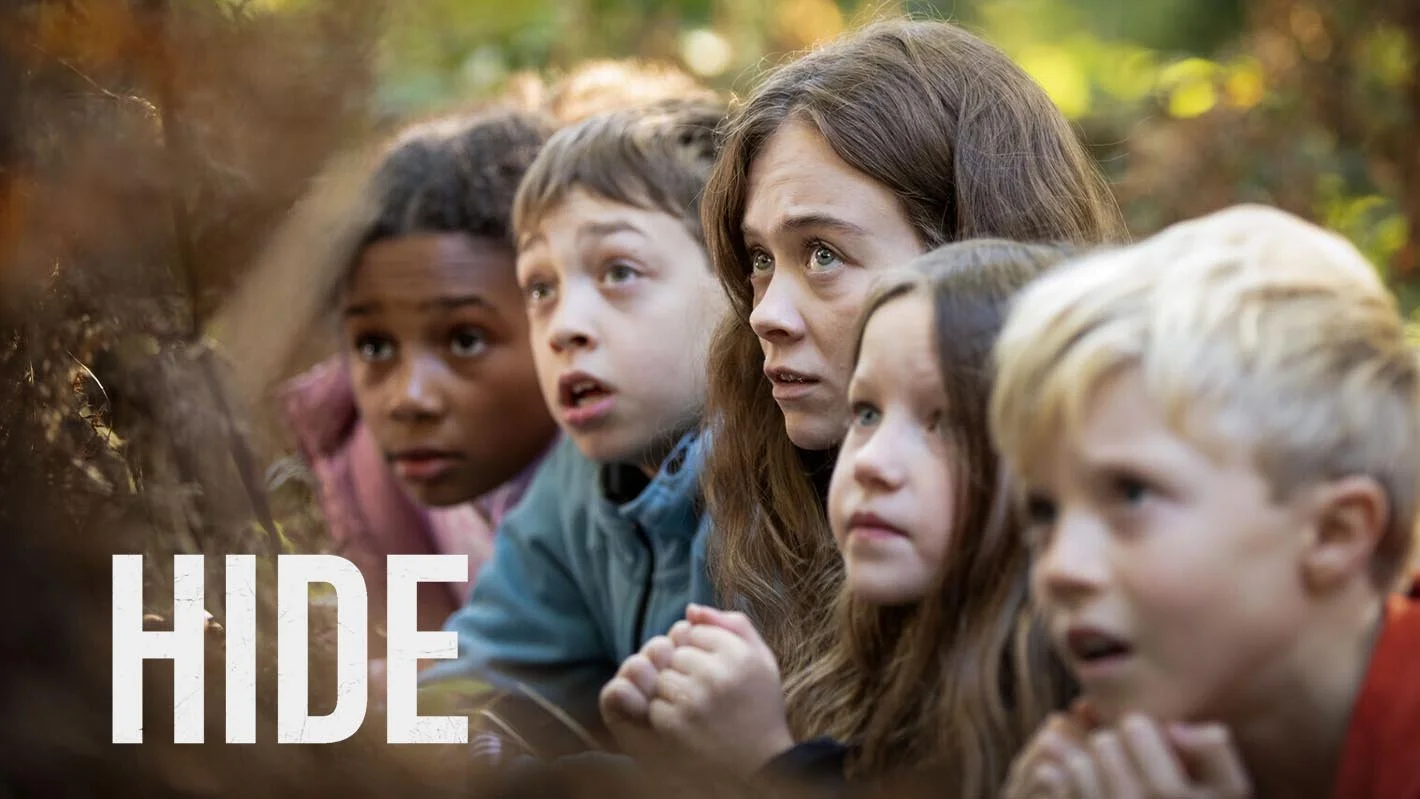
17 year old Abi holds her family together in a home shaped by poverty. But when their world comes crashing down, Abi faces a life changing decision to keep her and her young siblings safe.
Where she’s from, there’s one rule: trust no one.
And when trouble comes… Hide.
ABOUT THE FILMMAKER
Born and raised in Stockport, Ian Curtis trained at The Drama Centre London and worked as an actor in TV and Theatre for ten years before becoming a director.
He credits his performance background as heavily influencing the way he directs actors to create award-winning performances, which have earnt him an International Emmy, a Scottish Bafta and a Children’s Bafta. Ian co-created the multi-award nominated series ‘FM’ staring Daniel Kaaluya and Chris O’Dowd for ITV2.
His previous short films, which also deal with class struggles, have played at festivals internationally.
READ OUR INTERVIEW WITH IAN
Welcome to our Weekly Pick!
Many filmmakers are making short films as their calling card portfolio pieces, hoping they'll help them get career advancement into TV and features. You however have quite a prolific CV directing dozens of TV shows for the past 20+ years. Hide is your first short film in 11 years.
Can you chat about your motivation to return to the short form with this project?
Quite simply, to return to telling stories rooted in themes and conversations that matter most to me. Hide always felt like a short. We talked about expanding it into a feature, but its power lies in the short, sharp hit of a story about childhood poverty, mental health and social services. It delivers everything it needs to in those 21 pages.
Your background is also in acting. Would you go so far as to call yourself an actor’s director? What is your approach to working with actors?
If it’s truthful, it’s believable. I trained at drama school (The Drama Centre London) and acted on stage and screen for twelve years before I started directing. Being an actor makes me deeply appreciate the craft of acting. It is a skill, and without these skilled technicians, great stories would not be great films.
I suppose my background gives me an instinct for how much I need to convey to an actor when rehearsing, or when going for a second or third take. Some actors don’t need notes because they get it. Others are doing a great job, but are sending the character’s story in a direction that doesn’t help the character’s trajectory beyond that scene. So my approach is always to discuss the character’s motivation and objective when required, and if our answers are aligned, you usually arrive at the same conclusion about how best to play the scene.
One of my acting teachers (Reuven Adiv) taught me that we shouldn’t always know the answers before we rehearse. That’s not to say don’t be prepared — I’m always prepared — but the joy of this job is collaboration. You’re all there to tell the story. A story has many beating parts, and discovering those parts together is the fun bit. Lastly, no role, no matter how small, is insignificant. I’ve seen good actors come in, deliver one line, and steal the scene with their performance.
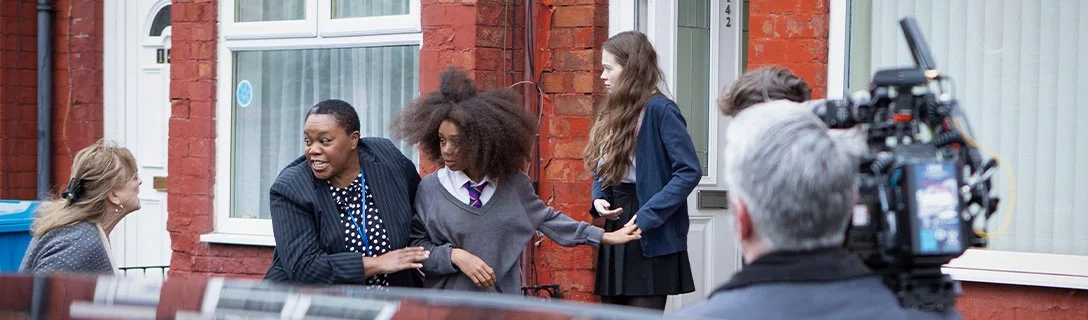
The performances in Hide were very strong, however Niamh Bradshaw in the leading role of Abi was a particular standout. She shows great depth for a young performer. I assume your paths crossed first collaborating on Hollyoaks, a series you’ve directed 63 episodes of. Was the role specifically written for Niamh or how did you go about casting?
It was written with Niamh in mind. I’d had the pleasure of working closely with her for a few years on Hollyoaks, and I knew how honest, instinctive and questioning an actor she was. She is adept at being strong while also exploring vulnerability, and when I was still figuring out the story for Hide, I just knew Niamh would be the right person to lead it.
In your director’s statement, you mention a lot of statistics that paint a dire portrait of how UK social security systems are failing families and children.
For example, how 3.6 million children live in absolute poverty compared to 3.3 last year. You’ve called these stats “an urgent wake up call to all of us, especially the UK Government.”
In what ways have you seen audiences wake up to these harsh realities during screenings of Hide? Has Hide gotten an audience with any UK leadership with power to affect change, and if so what has been their reaction to the film?
The stats were taken from sources including the Department for Work and Pensions, The Trussell Trust and The Guardian. At the time of writing this, a quarter of the children in a classroom of thirty are living in poverty. How are we supposed to solve wider problems in society if 25% of the next generation of teenagers and young adults have endured this start in life? Poor health, hunger, lack of concentration in school leading to under‑performance, low self‑esteem, anger at the life you’ve been dropped into, and bigoted, ill‑informed ideological views about the UK. And remember, children living in poverty are living with poverty‑stricken parents. If 25% of the population is sick, we are all sick, psychologically and somatically. It is a cycle that needs to be addressed by radically minded politicians (fingers crossed for Andy Burnham).
When Hide was in its first year on the festival circuit, we screened it for Labour councillors in the North East and Liverpool, who said they wanted to share the film within the wider Labour Party to support their plans to drive down child poverty. We also gave Hide to a Trussell Trust food bank in Blackburn to use in a collective introspection on poverty in the UK, and told the Trust they were free to use the film in any way that might help lobby for more support and investment.
We’ve been approached by a film distribution company who feel Hide will find receptive audiences both theatrically and educationally. If Hide can encourage more people to see that fixing child poverty is a huge benefit to our wider society, then it will have done its job.
To date, Hide has won eighteen awards on the international festival circuit, which only goes to show how universal these issues are. Q&As at festivals often centre on people’s own personal experiences that relate to the film’s themes, and they’re grateful that Hide is out there, giving these stories a voice. Many want to know what happens next to the children. The story is open‑ended for a reason.
You’ve quoted Meghan Meek-O'Connor (senior child poverty policy adviser at Save the Children UK), “Today 4.3 million children are being failed.” However, Lisa Davina Phillip’s character of the social worker depicts someone whose heart is in the right place, but with limited power to help. Her final message to Abi is essentially to allow the system to separate her from her siblings in the hope that they’ll be reunited eventually.
Keeping in mind the harrowing data, do you think the current UK social security system should be trusted, or are sweeping reforms needed?
Obviously you’re an artist, not a policy maker, but in your research have you come across potential solutions to fix this broken system that’s failing children?
During my research for the film, I met with four Children’s Social Workers from different areas of the North West. Their views on the job varied based on their own experiences. Some said it was an incredibly tough job, working with clients who presented chaos on a daily basis, and they had to reconcile themselves to the reality that they couldn’t prevent some from ending up in prison. Others said it was the most rewarding job you could imagine, and that being a social worker was a calling. What got them up each morning was the knowledge that they were making a positive difference to people’s lives.
But what united them all was a desire to make people’s lives better. To make children’s lives better and safer. You don’t become a social worker for the salary, the same way you don’t become a teacher for it. You do it because you want to contribute, connect, and give of yourself. Something we all should do as decent human beings. My vision for Hide is not dissimilar to the work of a social worker: it’s to see the best in people, the potential.
Hide was shortlisted for BFI Shorts funding. One of the requests from the BFI was to shorten the script to make it shootable within budget. One of the scenes we removed was set in a school where Abi is bullied for being poor, a metaphor for how a section of society views those living in poverty. So I don’t think the system is broken. I think austerity, Brexit, high taxes, low wages, university fees, a lack of opportunity, a lack of jobs, and £500 Oasis tickets are the issue. I could go on. But what social workers can’t be is a sticking plaster, and many believe that is what they believe they are.
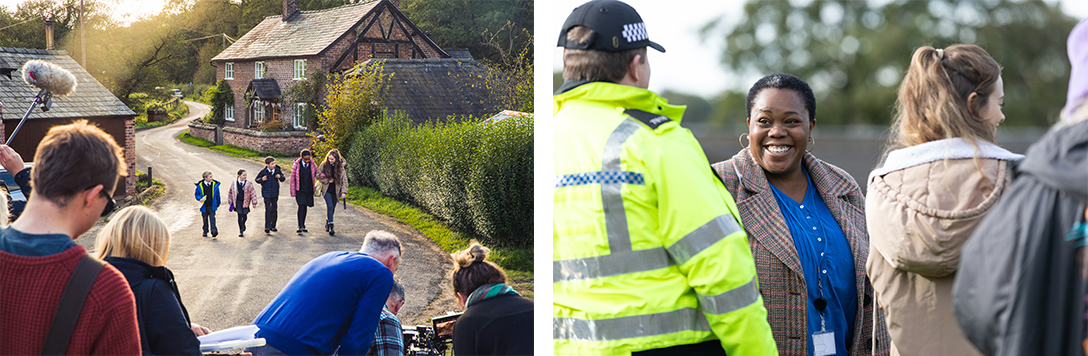
What's next for you?
I write TV pilots and feature film scripts when I’m not directing television, straddling the seesaw of creative optimism. First on the list is a film based around some of the same themes as Hide.
And last, but not least? Any film recommendations for our audience?
Funnily enough I watched Ken Loach’s Kes last night. I realised I hadn’t seen it in around fifteen years and wanted to remind myself why is still an utterly brilliant film. I don’t need to say why I feel it is. If you haven’t seen it watch it. If you have, watch it again. It’s currently available on Amazon Prime.
It sits alongside Lynne Ramsay’s Rat Catcher and Morvern Callar and Spielberg’s Empire of the Sun as films that inspired me to become a director. I recently watched The Invite directed by Olivia Wilde which I really enjoyed. Steve McQueen’s Hunger is outstanding as is the anthology Small Axe.
Ok, I’m just doing a film dump here. How long do we have?